AQA · A-Level · English Language
Course version: 7702 · Version from Sept 2017
Discourse: extended stretches of communication occurring in different…
Full specification wording
Language, the individual and society - Methods of language analysis: discourse: extended stretches of communication occurring in different genres, modes and contexts.
Discourse is language above the sentence: extended stretches of communication that cohere as a whole.
Checked against the AQA 7702 specification (opens in a new tab) on .
- Point 6 of 6
- 4 key terms
Study notes
From the checked teaching notes for this specification point.
The idea
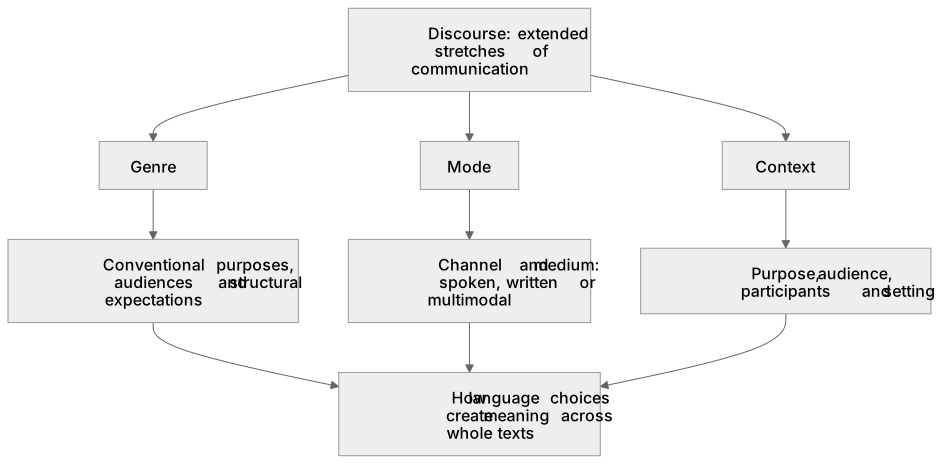
Discourse is language above the sentence: extended stretches of communication that cohere as a whole. Analysing it means asking how a text holds together, who it addresses and what it does. Genre shapes expectations: a recipe, a political speech and a group chat follow different conventions. Mode concerns channel and medium: spoken, written or multimodal, with different degrees of planning, permanence and interactivity. Context covers purpose, audience, participants and setting. A student might annotate a charity appeal, noting direct address, rhetorical questions, repeated lexical fields and a problem–solution structure, then explain how these features construct a persuasive relationship with readers. Assessment rewards precise, contextualised analysis of how language choices create meaning across whole texts, not feature-spotting.
What earns the marks
- Define discourse as language beyond the single sentence, focusing on how stretches of communication are organised and made coherent.
- Distinguish genre as a socially recognised text type with conventional purposes, audiences and structural expectations, such as a news report, a speech or an advice column.
- Explain mode as the channel of communication, comparing spoken, written and multimodal texts in terms of planning, permanence, spontaneity and interactivity.
- Analyse how context, including purpose, audience, participants and setting, shapes language choices and interpretation.
- Use discourse-level frameworks such as cohesion, discourse markers, adjacency pairs, turn-taking, narrative structure and rhetorical organisation.
- Support claims with short, accurately transcribed quotations and explain the effect of each feature rather than merely labelling it.
Common mistakes and how to put them right
Treating discourse as a synonym for a single sentence or paragraph.
Put it right: Analyse how whole texts or extended exchanges are structured and made coherent.
Listing genre conventions without linking them to purpose and audience.
Put it right: Explain how each convention positions or influences the reader or listener.
Assuming written texts are always planned and spoken texts always spontaneous.
Put it right: Judge planning and spontaneity from evidence such as editing, false starts, hedges and repair.
Exam tips
- Read the whole text or transcript once for gist before annotating discourse features, so your analysis reflects the complete stretch of communication.
- Integrate context into every analytical point: connect a feature to purpose, audience, mode or genre rather than describing it in isolation.
- Use precise discourse terminology, such as cohesion, discourse marker or adjacency pair, and always explain the effect of the feature you name.
Try the lesson
The start of the Language, the individual and society - Methods of language analysis: discourse: extended stretches of communication occurring in different genres, modes and contexts. lesson, made from checked teaching notes for this specification point.
Have a go first
Which term refers to extended stretches of communication occurring in different genres, modes and contexts?
Listen
Discourse is language above the sentence: extended stretches of communication that cohere as a whole. Analysing it means asking how a text holds together, who it addresses and what it does. Genre shapes expectations: a recipe, a political speech and a group chat follow different conventions. Mode concerns channel and medium: spoken, written or multimodal, with different degrees of planning, permanence and interactivity. Context covers purpose, audience, participants and setting. A student might annotate a charity appeal, noting direct address, rhetorical questions, repeated lexical fields and a problem–solution structure, then explain how these features construct a persuasive relationship with readers. Assessment rewards precise, contextualised analysis of how language choices create meaning across whole texts, not feature-spotting. A strong answer earns marks for these points. Define discourse as language beyond the single sentence, focusing on how stretches of communication are organised and made coherent. Distinguish genre as a socially recognised text type with conventional purposes, audiences and structural expectations, such as a news report, a speech or an advice column. Explain mode as the channel of communication, comparing spoken, written and multimodal texts in terms of planning, permanence, spontaneity and interactivity. Analyse how context, including purpose, audience, participants and setting, shapes language choices and interpretation. A common slip: Treating discourse as a synonym for a single sentence or paragraph. Instead, analyse how whole texts or extended exchanges are structured and made coherent. Exam tip: Read the whole text or transcript once for gist before annotating discourse features, so your analysis reflects the complete stretch of communication.
See it
Key words
Say what each word means before you turn the card.
Discourse
Try answering aloud or in your head before turning the card.
Genre
Try answering aloud or in your head before turning the card.
Mode
Try answering aloud or in your head before turning the card.
Context
Try answering aloud or in your head before turning the card.
See every definition
- Discourse
- Extended stretches of communication occurring in different genres, modes and contexts, analysed as language beyond the single sentence.
- Genre
- A socially recognised text type with conventional purposes, audiences and structural expectations, such as a news report, a speech or an advice column.
- Mode
- The channel of communication, comparing spoken, written and multimodal texts in terms of planning, permanence, spontaneity and interactivity.
- Context
- The purpose, audience, participants and setting that shape language choices and interpretation.
Label the diagram
Some boxes have lost their names. Pick the right name for each number.
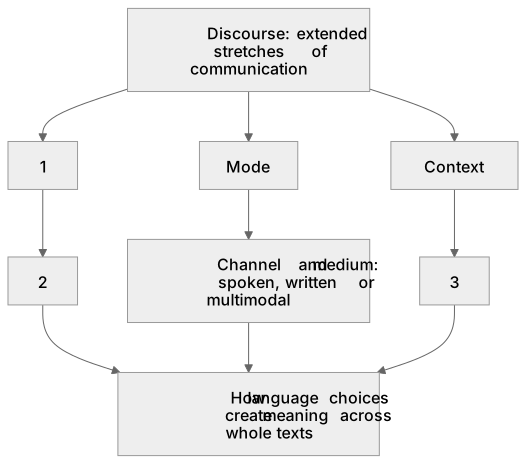
1Box 1
2Box 2
3Box 3
There is more to this lesson
The full lesson goes on to check your understanding and help you earn the marks. Create a free account to carry on, with your progress saved.
A week of Premium from your first lesson · Then the free plan continues · No card, no charge
Test your understanding of Language, the individual and society - Methods of language analysis: discourse: extended stretches of communication occurring in different genres, modes and contexts.
Active recall beats re-reading. Take an instant quiz now to test what you’ve learned and lock it into long-term memory.
A week of Premium from your first lesson · Then the free plan continues · No card, no charge