AQA · A-Level · English Language
Course version: 7702 · Version from Sept 2017
Pragmatics: the contextual aspects of language use
Full specification wording
Language, the individual and society - Methods of language analysis: pragmatics: the contextual aspects of language use
Pragmatics studies how context shapes meaning beyond literal words.
Checked against the AQA 7702 specification (opens in a new tab) on .
- Point 5 of 6
- 4 key terms
Study notes
From the checked teaching notes for this specification point.
The idea
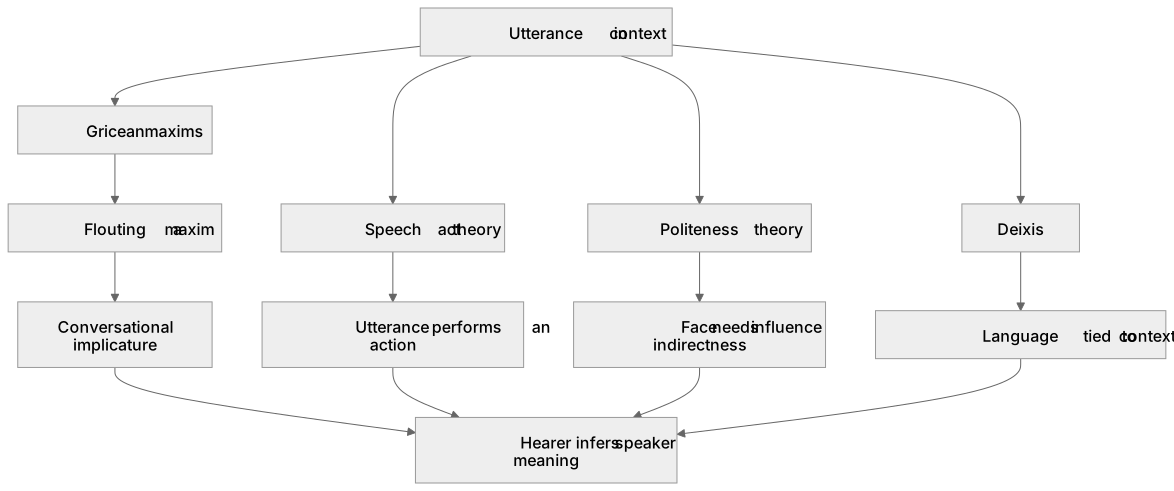
Pragmatics studies how context shapes meaning beyond literal words. It examines what speakers imply rather than state, how shared knowledge and setting guide interpretation, and how participants manage conversation. Key ideas include Grice's cooperative principle and its maxims of quantity, quality, relation and manner, flouting which generates conversational implicature. Politeness theory explains how face needs influence indirectness, while speech act theory shows that utterances perform actions such as promising, requesting or apologising. Deixis ties language to context through words like 'here', 'now' and 'you'. Analysing pragmatics means identifying these features in transcripts and explaining how participants infer meaning and manage relationships.
What earns the marks
- Identifies implied meanings and explains the contextual knowledge a listener needs to infer them.
- Applies Gricean maxims and explains how flouting them creates implicature.
- Recognises speech acts such as requests, apologies and promises and explains their force.
- Analyses politeness strategies and how they protect or threaten face.
- Explains how deixis and discourse context anchor meaning to a particular situation.
Common mistakes and how to put them right
Confusing semantics with pragmatics.
Put it right: Semantics concerns literal meaning, while pragmatics concerns speaker meaning in context.
Assuming a flouted maxim is broken accidentally.
Put it right: Flouting is deliberate and invites the hearer to infer an implicature.
Ignoring context when interpreting an utterance.
Put it right: State the setting, relationship and shared knowledge before drawing conclusions.
Exam tips
- Anchor every pragmatic claim in a quoted utterance from the data.
- Name the concept precisely, for example 'flouting the maxim of quantity', rather than describing it loosely.
- Explain the inference a real participant would make, not just the label of the feature.
Try the lesson
The start of the Language, the individual and society - Methods of language analysis: pragmatics: the contextual aspects of language use lesson, made from checked teaching notes for this specification point.
Have a go first
Which term refers to the implied meaning a speaker intends beyond the literal words used?
Listen
Pragmatics studies how context shapes meaning beyond literal words. It examines what speakers imply rather than state, how shared knowledge and setting guide interpretation, and how participants manage conversation. Key ideas include Grice's cooperative principle and its maxims of quantity, quality, relation and manner, flouting which generates conversational implicature. Politeness theory explains how face needs influence indirectness, while speech act theory shows that utterances perform actions such as promising, requesting or apologising. Deixis ties language to context through words like 'here', 'now' and 'you'. Analysing pragmatics means identifying these features in transcripts and explaining how participants infer meaning and manage relationships. A strong answer earns marks for these points. Identifies implied meanings and explains the contextual knowledge a listener needs to infer them. Applies Gricean maxims and explains how flouting them creates implicature. Recognises speech acts such as requests, apologies and promises and explains their force. Analyses politeness strategies and how they protect or threaten face. A common slip: Confusing semantics with pragmatics. Instead, semantics concerns literal meaning, while pragmatics concerns speaker meaning in context. Exam tip: Anchor every pragmatic claim in a quoted utterance from the data.
See it
Key words
Say what each word means before you turn the card.
Context and inferred meaning
Try answering aloud or in your head before turning the card.
Cooperative principle and implicature
Try answering aloud or in your head before turning the card.
Politeness and face
Try answering aloud or in your head before turning the card.
Speech acts and deixis
Try answering aloud or in your head before turning the card.
See every definition
- Context and inferred meaning
- The contextual aspects of language use, where shared knowledge and setting guide interpretation of what speakers imply rather than state.
- Cooperative principle and implicature
- Grice's principle with its maxims of quantity, quality, relation and manner, flouting which generates conversational implicature.
- Politeness and face
- Politeness theory explains how face needs influence indirectness, protecting or threatening face.
- Speech acts and deixis
- Utterances perform actions such as promising, requesting or apologising, while deixis ties language to context through words like 'here', 'now' and 'you'.
Label the diagram
Some boxes have lost their names. Pick the right name for each number.
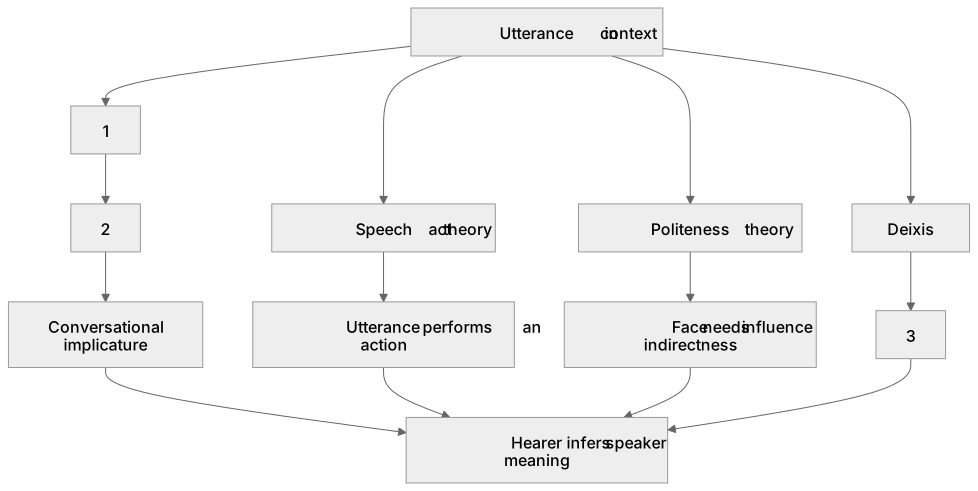
1Box 1
2Box 2
3Box 3
There is more to this lesson
The full lesson goes on to check your understanding and help you earn the marks. Create a free account to carry on, with your progress saved.
A week of Premium from your first lesson · Then the free plan continues · No card, no charge
Test your understanding of Language, the individual and society - Methods of language analysis: pragmatics: the contextual aspects of language use
Active recall beats re-reading. Take an instant quiz now to test what you’ve learned and lock it into long-term memory.
A week of Premium from your first lesson · Then the free plan continues · No card, no charge