AQA · A-Level · English Language
Course version: 7702 · Version from Sept 2017
Lexis and semantics: the vocabulary of English, including social and…
Full specification wording
Language, the individual and society - Methods of language analysis: lexis and semantics: the vocabulary of English, including social and historical variation
Lexis refers to the vocabulary of English, while semantics concerns meaning, including denotation, connotation, sense relations and semantic change.
Checked against the AQA 7702 specification (opens in a new tab) on .
- Point 3 of 6
- 4 key terms
Study notes
From the checked teaching notes for this specification point.
The idea
Lexis refers to the vocabulary of English, while semantics concerns meaning, including denotation, connotation, sense relations and semantic change. When analysing lexis and semantics, you examine word choices and their meanings, and you consider how vocabulary varies socially and historically. For example, occupational jargon such as 'plaintiff' and 'defendant' marks legal register, while older words such as 'thou' or 'thee' signal historical distance. Social variation includes dialect words, slang, sociolect and occupational lexis; historical variation includes archaic terms, semantic broadening, narrowing, amelioration and pejoration. You link these choices to context, identity, power and change, and you support every claim with precise textual evidence.
What earns the marks
- Identifies lexical choices accurately, including dialect words, slang, sociolect, occupational jargon, archaic terms and neologisms.
- Explains semantic meaning, distinguishing denotation from connotation and using sense relations such as synonymy, antonymy, hyponymy and polysemy.
- Analyses social variation in vocabulary, for example how occupational jargon such as 'plaintiff' and 'defendant' marks legal register and constructs professional identity.
- Analyses historical variation in vocabulary, for example how older words such as 'thou' or 'thee' signal historical distance and how processes such as broadening, narrowing, amelioration and pejoration change meaning.
- Links lexical and semantic choices to context, audience, purpose, identity and power, showing how vocabulary positions readers and reflects social groups.
- Supports analysis with precise textual evidence and appropriate terminology rather than vague comments about 'interesting words'.
Common mistakes and how to put them right
Confusing lexis with semantics.
Put it right: Treat lexis as vocabulary choices and semantics as meaning, and to show how the two interact.
Describing a word as 'old-fashioned' without naming the process.
Put it right: Use precise terms such as archaic, broadening, narrowing, amelioration or pejoration.
Ignoring social or historical context when discussing word choice.
Put it right: Explain how the vocabulary reflects a particular community, period, identity or power relationship.
Exam tips
- Choose a small number of lexical items that are genuinely significant and analyse them in depth rather than listing many words superficially.
- Use semantic terminology such as denotation, connotation, synonymy, antonymy, hyponymy and polysemy accurately and only where it fits the data.
- Anchor every claim about social or historical variation in a specific example from the text, such as a dialect form or an archaic pronoun.
- Connect lexical and semantic analysis to the wider context of the text, including its producer, audience, purpose and the social or historical setting.
Try the lesson
The start of the Language, the individual and society - Methods of language analysis: lexis and semantics: the vocabulary of English, including social and historical variation lesson, made from checked teaching notes for this specification point.
Have a go first
Which term refers to the vocabulary of English, including social and historical variation?
Listen
Lexis refers to the vocabulary of English, while semantics concerns meaning, including denotation, connotation, sense relations and semantic change. When analysing lexis and semantics, you examine word choices and their meanings, and you consider how vocabulary varies socially and historically. For example, occupational jargon such as 'plaintiff' and 'defendant' marks legal register, while older words such as 'thou' or 'thee' signal historical distance. Social variation includes dialect words, slang, sociolect and occupational lexis; historical variation includes archaic terms, semantic broadening, narrowing, amelioration and pejoration. You link these choices to context, identity, power and change, and you support every claim with precise textual evidence. A strong answer earns marks for these points. Identifies lexical choices accurately, including dialect words, slang, sociolect, occupational jargon, archaic terms and neologisms. Explains semantic meaning, distinguishing denotation from connotation and using sense relations such as synonymy, antonymy, hyponymy and polysemy. Analyses social variation in vocabulary, for example how occupational jargon such as 'plaintiff' and 'defendant' marks legal register and constructs professional identity. Analyses historical variation in vocabulary, for example how older words such as 'thou' or 'thee' signal historical distance and how processes such as broadening, narrowing, amelioration and pejoration change meaning. A common slip: Confusing lexis with semantics. Instead, treat lexis as vocabulary choices and semantics as meaning, and to show how the two interact. Exam tip: Choose a small number of lexical items that are genuinely significant and analyse them in depth rather than listing many words superficially.
See it
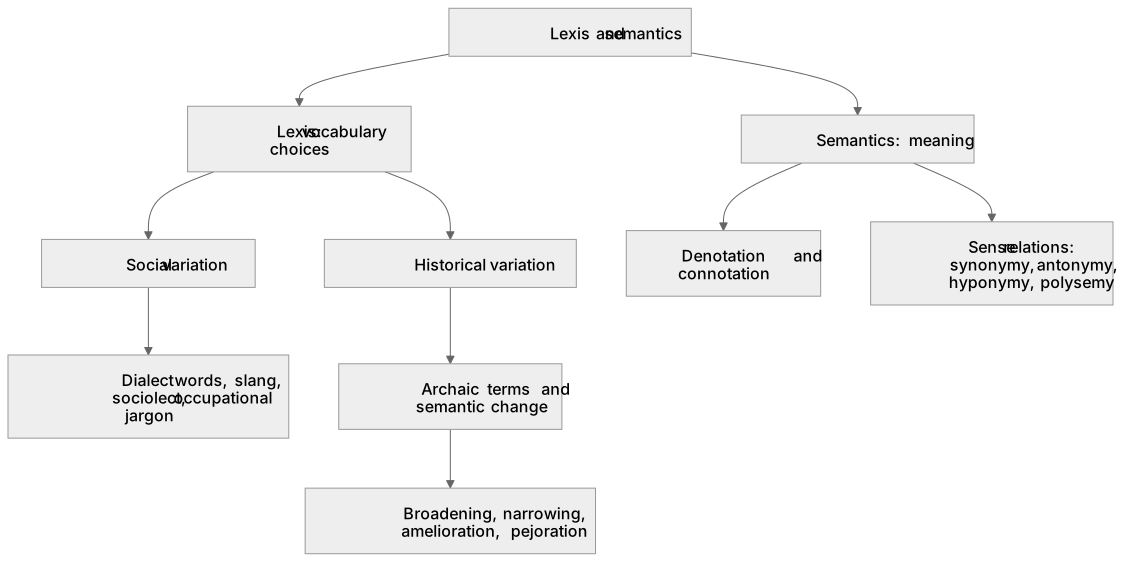
Key words
Say what each word means before you turn the card.
Lexis
Try answering aloud or in your head before turning the card.
Semantics
Try answering aloud or in your head before turning the card.
Social variation
Try answering aloud or in your head before turning the card.
Historical variation
Try answering aloud or in your head before turning the card.
See every definition
- Lexis
- The vocabulary of English, including social and historical variation.
- Semantics
- Concerns meaning, including denotation, connotation, sense relations and semantic change.
- Social variation
- Includes dialect words, slang, sociolect and occupational lexis.
- Historical variation
- Includes archaic terms, semantic broadening, narrowing, amelioration and pejoration.
Label the diagram
Some boxes have lost their names. Pick the right name for each number.
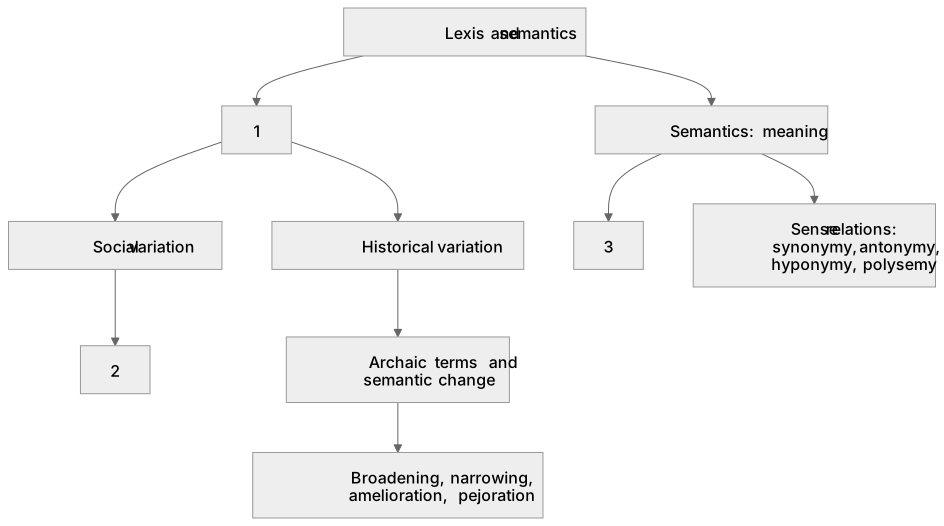
1Box 1
2Box 2
3Box 3
There is more to this lesson
The full lesson goes on to check your understanding and help you earn the marks. Create a free account to carry on, with your progress saved.
A week of Premium from your first lesson · Then the free plan continues · No card, no charge
Test your understanding of Language, the individual and society - Methods of language analysis: lexis and semantics: the vocabulary of English, including social and historical variation
Active recall beats re-reading. Take an instant quiz now to test what you’ve learned and lock it into long-term memory.
A week of Premium from your first lesson · Then the free plan continues · No card, no charge