AQA · A-Level · English Language
Course version: 7702 · Version from Sept 2017
Grammar, including morphology: the structural patterns and shapes of…
Full specification wording
Language, the individual and society - Methods of language analysis: grammar, including morphology: the structural patterns and shapes of English at sentence, clause, phrase and word level
Grammar is the system of structural patterns that organises English, and morphology is its word-level part.
Checked against the AQA 7702 specification (opens in a new tab) on .
- Point 4 of 6
- 4 key terms
Study notes
From the checked teaching notes for this specification point.
The idea
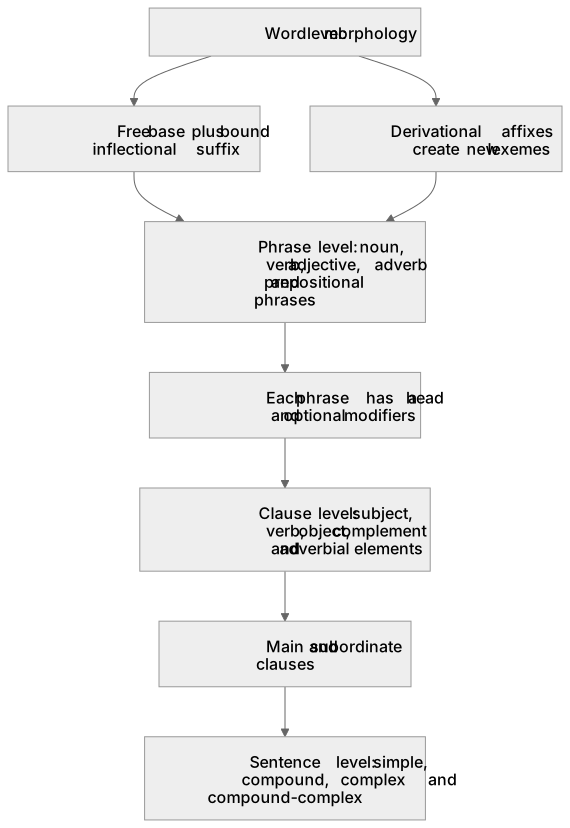
Grammar is the system of structural patterns that organises English, and morphology is its word-level part. At word level, morphology studies how morphemes build words: the free base 'help' plus the bound inflectional suffix '-ed' gives 'helped', while derivational affixes like 'un-' and '-ness' create new lexemes such as 'unhelpfulness'. At phrase level, words group into noun, verb, adjective, adverb and prepositional phrases, each with a head and optional modifiers. At clause level, phrases combine into subject, verb, object, complement and adverbial elements, producing main and subordinate clauses. At sentence level, clauses combine into simple, compound, complex and compound-complex structures. Analysing a text means labelling these shapes accurately and explaining the effects they create for a reader or listener.
What earns the marks
- Accurately identifies word classes and distinguishes lexical words from function words in a short extract.
- Segments words into morphemes and distinguishes inflectional from derivational morphology with correct terminology.
- Labels phrase types by their heads, for example noun phrase, verb phrase and prepositional phrase.
- Identifies clause elements such as subject, verb, object, complement and adverbial, and distinguishes main from subordinate clauses.
- Classifies sentence structures as simple, compound, complex or compound-complex and links choices to meaning or effect.
Common mistakes and how to put them right
Calling any word before a noun an adjective.
Put it right: Test whether it can be graded or compared, and check whether it modifies the noun or determines it.
Treating '-ing' as always a verb.
Put it right: Decide from function whether the word is a verb, a gerund or a participial adjective.
Confusing a phrase with a clause.
Put it right: A clause contains a subject and a verb, whereas a phrase does not.
Exam tips
- Quote the exact words you label so your grammatical analysis is verifiable.
- Use a consistent framework such as word, phrase, clause, sentence when structuring an answer.
- Link every grammatical feature you identify to a specific effect on meaning, audience or context.
Try the lesson
The start of the Language, the individual and society - Methods of language analysis: grammar, including morphology: the structural patterns and shapes of English at sentence, clause, phrase and word level lesson, made from checked teaching notes for this specification point.
Have a go first
Which term describes the smallest meaningful unit of grammar, such as the plural ending -s in cats?
Listen
Grammar is the system of structural patterns that organises English, and morphology is its word-level part. At word level, morphology studies how morphemes build words: the free base 'help' plus the bound inflectional suffix '-ed' gives 'helped', while derivational affixes like 'un-' and '-ness' create new lexemes such as 'unhelpfulness'. At phrase level, words group into noun, verb, adjective, adverb and prepositional phrases, each with a head and optional modifiers. At clause level, phrases combine into subject, verb, object, complement and adverbial elements, producing main and subordinate clauses. At sentence level, clauses combine into simple, compound, complex and compound-complex structures. Analysing a text means labelling these shapes accurately and explaining the effects they create for a reader or listener. A strong answer earns marks for these points. Accurately identifies word classes and distinguishes lexical words from function words in a short extract. Segments words into morphemes and distinguishes inflectional from derivational morphology with correct terminology. Labels phrase types by their heads, for example noun phrase, verb phrase and prepositional phrase. Identifies clause elements such as subject, verb, object, complement and adverbial, and distinguishes main from subordinate clauses. A common slip: Calling any word before a noun an adjective. Instead, test whether it can be graded or compared, and check whether it modifies the noun or determines it. Exam tip: Quote the exact words you label so your grammatical analysis is verifiable.
See it
Key words
Say what each word means before you turn the card.
Morphological structure of words
Try answering aloud or in your head before turning the card.
Phrase and clause architecture
Try answering aloud or in your head before turning the card.
Sentence types and complexity
Try answering aloud or in your head before turning the card.
Grammar as a meaning-making resource
Try answering aloud or in your head before turning the card.
See every definition
- Morphological structure of words
- The word-level part of grammar, studying how morphemes build words, such as a free base with a bound inflectional suffix or derivational affixes creating new lexemes.
- Phrase and clause architecture
- Words group into noun, verb, adjective, adverb and prepositional phrases, each with a head and optional modifiers, and phrases combine into clause elements producing main and subordinate clauses.
- Sentence types and complexity
- Clauses combine into simple, compound, complex and compound-complex structures.
- Grammar as a meaning-making resource
- Analysing a text means labelling these shapes accurately and explaining the effects they create for a reader or listener.
Label the diagram
Some boxes have lost their names. Pick the right name for each number.
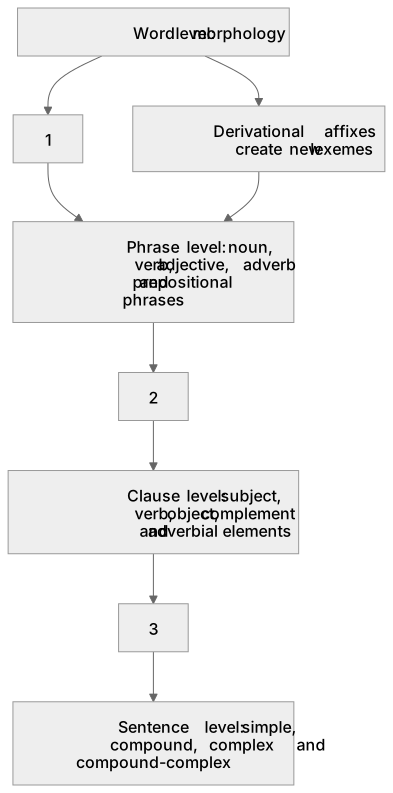
1Box 1
2Box 2
3Box 3
There is more to this lesson
The full lesson goes on to check your understanding and help you earn the marks. Create a free account to carry on, with your progress saved.
A week of Premium from your first lesson · Then the free plan continues · No card, no charge
Test your understanding of Language, the individual and society - Methods of language analysis: grammar, including morphology: the structural patterns and shapes of English at sentence, clause, phrase and word level
Active recall beats re-reading. Take an instant quiz now to test what you’ve learned and lock it into long-term memory.
A week of Premium from your first lesson · Then the free plan continues · No card, no charge