AQA · A-Level · English Language
Course version: 7702 · Version from Sept 2017
Exploration will include methods of language analysis, how identity is…
Full specification wording
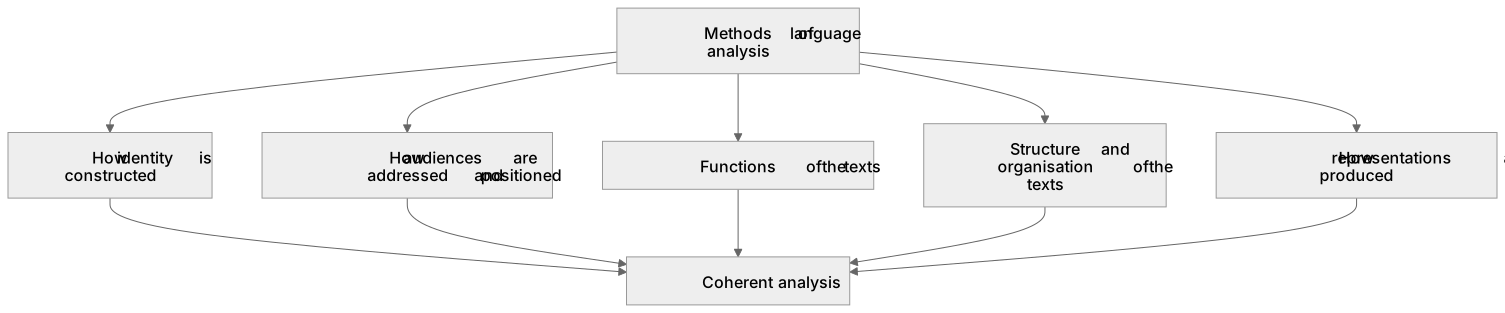
Textual variations and representations: Exploration will include methods of language analysis, how identity is constructed, how audiences are addressed and positioned, the functions of the texts, the structure and organisation of the texts, and how representations are produced.
This statement sets out the analytical scope for studying textual variations and representations.
Checked against the AQA 7702 specification (opens in a new tab) on .
- Point 3 of 3
- 4 key terms
Study notes
From the checked teaching notes for this specification point.
The idea
This statement sets out the analytical scope for studying textual variations and representations. You learn to apply methods of language analysis to texts, examining how identity is constructed through linguistic choices, how audiences are addressed and positioned by those choices, what functions texts perform, how they are structured and organised, and how representations are produced. For example, analysing a charity advertisement, you might note the use of second-person address to position the reader, a problem-solution structure, and lexical choices that construct the charity's identity as compassionate while representing recipients in a particular way. The skill is performed by selecting relevant linguistic evidence and explaining its effect, and it is assessed through your ability to integrate these dimensions into a coherent analysis rather than listing features.
What earns the marks
- Apply methods of language analysis (e.g. lexis, grammar, discourse structure) to identify and interpret linguistic features in texts.
- Explain how identity is constructed for participants, producers or groups through language choices and patterns.
- Analyse how audiences are addressed and positioned, for example through direct address, modality, or assumed knowledge.
- Identify and discuss the functions of texts, such as to persuade, inform, entertain or instruct, and how these functions shape language.
- Examine the structure and organisation of texts, including openings, closings, sequencing and layout, and their effects.
- Explain how representations are produced, considering the selection and combination of linguistic features that create particular versions of people, events or ideas.
Common mistakes and how to put them right
Listing linguistic features without explaining their effects or linking them to identity, audience, function, structure or representation.
Put it right: Pair a feature with an analytical point about its function or effect.
Treating representation as simply what a text is about rather than how language constructs a particular version of events or groups.
Put it right: Focus on the linguistic choices that produce the representation.
Ignoring the structure and organisation of texts and analysing only word-level features.
Put it right: Comment on how texts are sequenced, organised and shaped at discourse level.
Exam tips
- Use the statement's dimensions as a checklist when planning: methods, identity, audience, function, structure, representation.
- Select a small number of well-chosen examples and analyse them in depth rather than covering many features superficially.
- Use precise linguistic terminology accurately and always connect it to meaning and effect.
Try the lesson
The start of the Textual variations and representations: Exploration will include methods of language analysis, how identity is constructed, how audiences are addressed and positioned, the functions of the texts, the structure and organisation of the texts, and how representations are produced. lesson, made from checked teaching notes for this specification point.
Have a go first
A charity appeal uses the second-person pronoun 'you' repeatedly in the phrase "You can make a difference today." Which analytical point best explains how this addresses and positions the audience?
Listen
This statement sets out the analytical scope for studying textual variations and representations. You learn to apply methods of language analysis to texts, examining how identity is constructed through linguistic choices, how audiences are addressed and positioned by those choices, what functions texts perform, how they are structured and organised, and how representations are produced. For example, analysing a charity advertisement, you might note the use of second-person address to position the reader, a problem-solution structure, and lexical choices that construct the charity's identity as compassionate while representing recipients in a particular way. The skill is performed by selecting relevant linguistic evidence and explaining its effect, and it is assessed through your ability to integrate these dimensions into a coherent analysis rather than listing features. A strong answer earns marks for these points. Apply methods of language analysis (e.g. lexis, grammar, discourse structure) to identify and interpret linguistic features in texts. Explain how identity is constructed for participants, producers or groups through language choices and patterns. Analyse how audiences are addressed and positioned, for example through direct address, modality, or assumed knowledge. Identify and discuss the functions of texts, such as to persuade, inform, entertain or instruct, and how these functions shape language. A common slip: Listing linguistic features without explaining their effects or linking them to identity, audience, function, structure or representation. Instead, pair a feature with an analytical point about its function or effect. Exam tip: Use the statement's dimensions as a checklist when planning: methods, identity, audience, function, structure, representation.
See it
Key words
Say what each word means before you turn the card.
Methods of language analysis
Try answering aloud or in your head before turning the card.
Construction of identity
Try answering aloud or in your head before turning the card.
Audience address and positioning
Try answering aloud or in your head before turning the card.
Production of representations
Try answering aloud or in your head before turning the card.
See every definition
- Methods of language analysis
- The approaches used to identify and interpret linguistic features in texts, such as lexis, grammar and discourse structure.
- Construction of identity
- How identity is constructed for participants, producers or groups through language choices and patterns.
- Audience address and positioning
- How audiences are addressed and positioned, for example through direct address, modality or assumed knowledge.
- Production of representations
- How representations are produced through the selection and combination of linguistic features that create particular versions of people, events or ideas.
Label the diagram
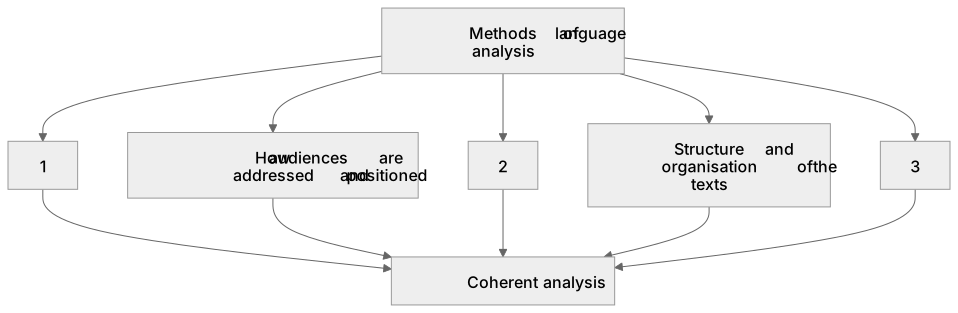
Some boxes have lost their names. Pick the right name for each number.
1Box 1
2Box 2
3Box 3
There is more to this lesson
The full lesson goes on to check your understanding and help you earn the marks. Create a free account to carry on, with your progress saved.
A week of Premium from your first lesson · Then the free plan continues · No card, no charge
Test your understanding of Textual variations and representations: Exploration will include methods of language analysis, how identity is constructed, how audiences are addressed and positioned, the functions of the texts, the structure and organisation of the texts, and how representations are produced.
Active recall beats re-reading. Take an instant quiz now to test what you’ve learned and lock it into long-term memory.
A week of Premium from your first lesson · Then the free plan continues · No card, no charge