AQA · A-Level · English Language
Course version: 7702 · Version from Sept 2017
When analysing texts, students should explore how language is shaped…
Full specification wording
Textual variations and representations: When analysing texts, students should explore how language is shaped according to audience, purpose, genre and mode, shaped according to context, used to construct meanings and representations, and used to enact relationships between writers, speakers and audiences or between participants within a text.
This statement defines the analytical core of textual study.
Checked against the AQA 7702 specification (opens in a new tab) on .
- Point 2 of 3
- 4 key terms
Study notes
From the checked teaching notes for this specification point.
The idea
This statement defines the analytical core of textual study. You must show how language choices are constrained and enabled by audience, purpose, genre and mode, and by wider context. You then examine how those choices construct meanings and representations, and how they enact relationships: between producer and receiver, or between participants inside a text. A workable method is to quote a short feature, name it precisely, explain its function for the audience or purpose, and link it to representation or relationship. For example, direct address in a charity appeal constructs the reader as a potential donor and enacts a relationship of moral obligation. Analysis should move beyond feature-spotting to interpretation, using contextual knowledge to justify claims without asserting fixed effects.
What earns the marks
- Explaining how audience, purpose, genre and mode shape specific language choices such as register, lexis, syntax or discourse structure.
- Linking contextual factors, including historical, social, regional or institutional influences, to textual features.
- Analysing how language constructs meanings and representations of people, groups, events or ideas.
- Examining how language enacts relationships, including power, solidarity, distance or intimacy between producer and receiver or among participants.
- Using precise linguistic terminology and short quotations to support interpretive claims about function and effect.
Common mistakes and how to put them right
Listing language features without explaining how they are shaped by audience, purpose, genre or mode.
Put it right: Attach each feature to a shaping factor and an interpretive point.
Treating representation as mere description.
Put it right: Analyse the linguistic choices that construct a particular view of the subject.
Assuming a single fixed effect on all readers.
Put it right: Discuss likely or possible effects, hedged and supported by contextual evidence.
Exam tips
- Use a four-move analytical sentence: feature, shaping factor, representation or relationship, contextual link.
- Anchor relationship claims in address forms, modality, pronouns or turn-taking rather than general assertions about tone.
- Keep quotations short and integrate them into your sentence so analysis, not retelling, dominates.
Try the lesson
The start of the Textual variations and representations: When analysing texts, students should explore how language is shaped according to audience, purpose, genre and mode, shaped according to context, used to construct meanings and representations, and used to enact relationships between writers, speakers and audiences or between participants within a text. lesson, made from checked teaching notes for this specification point.
Have a go first
A charity leaflet uses direct address and emotive nouns to persuade readers to donate. Which aspect of language use does this mainly illustrate?
Listen
This statement defines the analytical core of textual study. You must show how language choices are constrained and enabled by audience, purpose, genre and mode, and by wider context. You then examine how those choices construct meanings and representations, and how they enact relationships: between producer and receiver, or between participants inside a text. A workable method is to quote a short feature, name it precisely, explain its function for the audience or purpose, and link it to representation or relationship. For example, direct address in a charity appeal constructs the reader as a potential donor and enacts a relationship of moral obligation. Analysis should move beyond feature-spotting to interpretation, using contextual knowledge to justify claims without asserting fixed effects. A strong answer earns marks for these points. Explaining how audience, purpose, genre and mode shape specific language choices such as register, lexis, syntax or discourse structure. Linking contextual factors, including historical, social, regional or institutional influences, to textual features. Analysing how language constructs meanings and representations of people, groups, events or ideas. Examining how language enacts relationships, including power, solidarity, distance or intimacy between producer and receiver or among participants. A common slip: Listing language features without explaining how they are shaped by audience, purpose, genre or mode. Instead, attach each feature to a shaping factor and an interpretive point. Exam tip: Use a four-move analytical sentence: feature, shaping factor, representation or relationship, contextual link.
See it
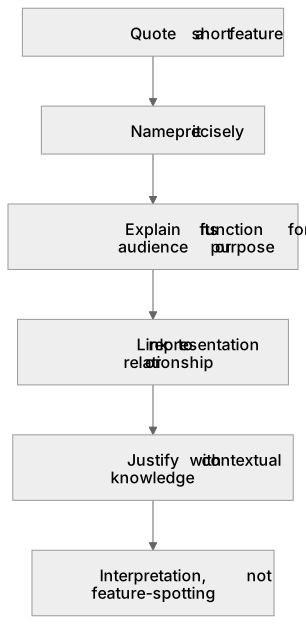
Put it in order
Put these steps in the order they happen.
- 1. Explain its function for audience or purpose
- 2. Name it precisely
- 3. Quote a short feature
- 4. Interpretation, not feature-spotting
- 5. Justify with contextual knowledge
- 6. Link to representation or relationship
Key words
Say what each word means before you turn the card.
Language shaped by audience, purpose, genre and mode
Try answering aloud or in your head before turning the card.
Context as a constraint and resource
Try answering aloud or in your head before turning the card.
Construction of meanings and representations
Try answering aloud or in your head before turning the card.
Enactment of relationships and positioning
Try answering aloud or in your head before turning the card.
See every definition
- Language shaped by audience, purpose, genre and mode
- Language choices are constrained and enabled by audience, purpose, genre and mode, such as register, lexis, syntax or discourse structure.
- Context as a constraint and resource
- Wider context constrains and enables language choices, and contextual knowledge is used to justify claims without asserting fixed effects.
- Construction of meanings and representations
- Language is used to construct meanings and representations of people, groups, events or ideas, rather than merely to describe.
- Enactment of relationships and positioning
- Language enacts relationships between writers, speakers and audiences, or between participants within a text, including power, solidarity, distance or intimacy.
Label the diagram
Some boxes have lost their names. Pick the right name for each number.
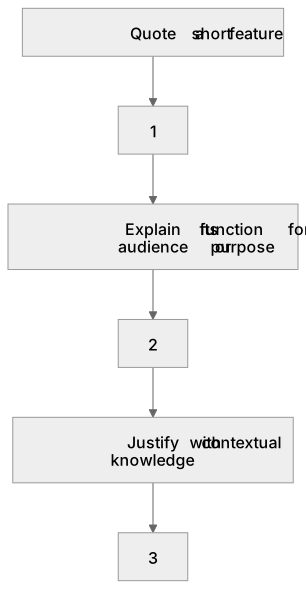
1Box 1
2Box 2
3Box 3
There is more to this lesson
The full lesson goes on to check your understanding and help you earn the marks. Create a free account to carry on, with your progress saved.
A week of Premium from your first lesson · Then the free plan continues · No card, no charge
Test your understanding of Textual variations and representations: When analysing texts, students should explore how language is shaped according to audience, purpose, genre and mode, shaped according to context, used to construct meanings and representations, and used to enact relationships between writers, speakers and audiences or between participants within a text.
Active recall beats re-reading. Take an instant quiz now to test what you’ve learned and lock it into long-term memory.
A week of Premium from your first lesson · Then the free plan continues · No card, no charge