Eduqas · GCSE · English Language
Course version: C700QS · Version from Mar 2026
AO3: Compare writers' ideas and perspectives, as well as how these are…
Full specification wording
Assessment - Assessment Objectives and Weightings: AO3: Compare writers' ideas and perspectives, as well as how these are conveyed, across two or more texts
AO3 asks you to compare what writers think and feel about a shared topic and the methods they use to communicate those ideas.
Checked against the Eduqas C700QS specification (opens in a new tab) on .
- Point 4 of 11
- 4 key terms
Study notes
From the checked teaching notes for this specification point.
The idea
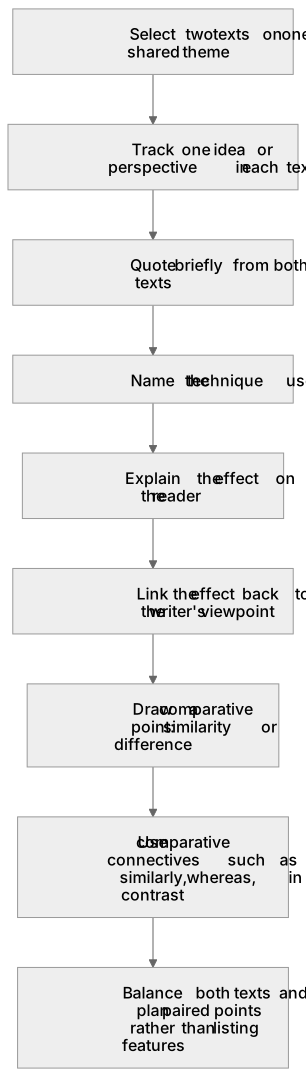
AO3 asks you to compare what writers think and feel about a shared topic and the methods they use to communicate those ideas. Ideas are the viewpoints, attitudes and messages a writer presents; perspectives are the stance shaped by their role, time or purpose. Conveying covers language, structure, form and tone. A strong method is to select two texts on one theme, such as attitudes to city life, then track one idea in each, quote briefly, name the technique, and explain the effect before drawing a comparative point. Comparison means identifying similarities and differences, not describing texts separately. You should balance both texts and use connectives such as similarly, whereas and in contrast. Assessment rewards sustained comparison of ideas and methods, supported by apt references, so plan paired points rather than listing features.
What earns the marks
- Identifies a clear idea or perspective in each text and states whether they are similar or different.
- Selects short, relevant quotations or references from both texts to support the comparison.
- Names and explains how a method such as word choice, imagery, sentence form or tone conveys the idea.
- Explains the effect of methods on the reader and links this back to the writer's viewpoint.
- Maintains balance between texts and uses comparative connectives to structure the response.
- Shows awareness that perspective may be shaped by context such as purpose, audience or time.
Common mistakes and how to put them right
Describing each text in turn without making direct comparisons.
Put it right by pairing points and using connectives such as similarly or whereas.
Retelling the content instead of analysing ideas and methods.
Put it right by focusing on what the writer thinks and how language or structure creates that impression.
Offering quotations without comment.
Put it right by explaining the effect of each reference and linking it to the writer's perspective.
Exam tips
- Plan two or three paired points, each covering an idea and a method from both texts.
- Use short embedded quotations so analysis stays focused and time-efficient.
- Signal comparison explicitly with connectives and comment on both similarities and differences.
Try the lesson
The start of the Assessment - Assessment Objectives and Weightings: AO3: Compare writers' ideas and perspectives, as well as how these are conveyed, across two or more texts lesson, made from checked teaching notes for this specification point.
Have a go first
In an AO3 comparison task, which of the following best describes what you must compare?
Listen
AO3 asks you to compare what writers think and feel about a shared topic and the methods they use to communicate those ideas. Ideas are the viewpoints, attitudes and messages a writer presents; perspectives are the stance shaped by their role, time or purpose. Conveying covers language, structure, form and tone. A strong method is to select two texts on one theme, such as attitudes to city life, then track one idea in each, quote briefly, name the technique, and explain the effect before drawing a comparative point. Comparison means identifying similarities and differences, not describing texts separately. You should balance both texts and use connectives such as similarly, whereas and in contrast. Assessment rewards sustained comparison of ideas and methods, supported by apt references, so plan paired points rather than listing features. A strong answer earns marks for these points. Identifies a clear idea or perspective in each text and states whether they are similar or different. Selects short, relevant quotations or references from both texts to support the comparison. Names and explains how a method such as word choice, imagery, sentence form or tone conveys the idea. Explains the effect of methods on the reader and links this back to the writer's viewpoint. A common slip: Describing each text in turn without making direct comparisons. Instead, pairing points and using connectives such as similarly or whereas. Exam tip: Plan two or three paired points, each covering an idea and a method from both texts.
See it
Key words
Say what each word means before you turn the card.
Writers' ideas and attitudes
Try answering aloud or in your head before turning the card.
Perspectives shaped by purpose and context
Try answering aloud or in your head before turning the card.
Language and structural methods
Try answering aloud or in your head before turning the card.
Comparative analysis and synthesis
Try answering aloud or in your head before turning the card.
See every definition
- Writers' ideas and attitudes
- The viewpoints, attitudes and messages a writer presents in a text.
- Perspectives shaped by purpose and context
- The stance shaped by a writer's role, time or purpose.
- Language and structural methods
- The language, structure, form and tone used to convey ideas.
- Comparative analysis and synthesis
- Identifying similarities and differences rather than describing texts separately, using connectives such as similarly, whereas and in contrast.
Label the diagram
Some boxes have lost their names. Pick the right name for each number.
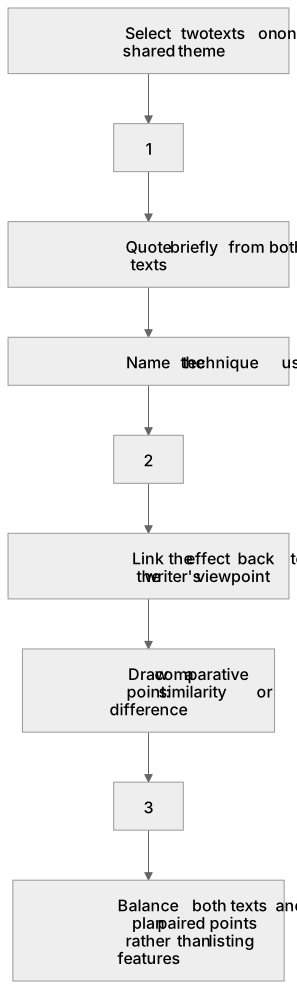
1Box 1
2Box 2
3Box 3
There is more to this lesson
The full lesson goes on to check your understanding and help you earn the marks. Create a free account to carry on, with your progress saved.
A week of Premium from your first lesson · Then the free plan continues · No card, no charge
Test your understanding of Assessment - Assessment Objectives and Weightings: AO3: Compare writers' ideas and perspectives, as well as how these are conveyed, across two or more texts
Active recall beats re-reading. Take an instant quiz now to test what you’ve learned and lock it into long-term memory.
A week of Premium from your first lesson · Then the free plan continues · No card, no charge