Eduqas · GCSE · English Language
Course version: C700QS · Version from Mar 2026
AO2: Explain, comment on analyse how writers use language and structure to…
Full specification wording
Assessment - Assessment Objectives and Weightings: AO2: Explain, comment on analyse how writers use language and structure to achieve effects and influence readers, using relevant subject terminology to support their views
AO2 asks you to explain, comment on and analyse how writers use language and structure to achieve effects and influence readers, supporting your views with relevant subject terminology.
Checked against the Eduqas C700QS specification (opens in a new tab) on .
- Point 3 of 11
- 4 key terms
Study notes
From the checked teaching notes for this specification point.
The idea
AO2 asks you to explain, comment on and analyse how writers use language and structure to achieve effects and influence readers, supporting your views with relevant subject terminology. The three verbs build in demand: explaining says what a choice does; commenting adds your response and judgement; analysing explores how and why the choice shapes meaning and the reader's reaction. Cover both language (word choice, imagery, figurative devices) and structure (how a text is organised, sequenced, paced, or how sentences and paragraphs are shaped). Always connect a technique to its effect on the reader rather than naming it in isolation. Use subject terminology precisely and only where it earns its place, for example identifying a simile and then analysing what the comparison makes the reader picture or feel.
What earns the marks
- Explains how a writer's language choice creates a particular effect, moving beyond simply naming the device.
- Comments on how a structural choice (such as sequencing, pacing or paragraphing) shapes meaning or the reader's response.
- Analyses how language and structure together influence the reader, linking technique to effect.
- Uses relevant subject terminology accurately and appropriately to support the points made.
- Supports views with precise textual evidence and explains the effect of that evidence.
Common mistakes and how to put them right
Naming a technique without explaining its effect (feature-spotting).
Put it right: State what the technique makes the reader think, feel or picture.
Covering only language and ignoring structure.
Put it right: Address how the text is organised, sequenced or paced as well as word-level choices.
Using subject terminology loosely or incorrectly.
Put it right: Use terms precisely and only where they clarify your analysis.
Describing what happens in the text instead of analysing how the writer shapes it.
Put it right: Focus on the writer's choices and their effects on the reader.
Exam tips
- Build each paragraph around a technique, its effect and the reader's response, using short embedded quotations.
- Deliberately include at least one structural point (organisation, sequence, pacing) alongside language analysis.
- Use subject terminology as a tool for analysis, not as a label to drop in and leave unexplained.
Try the lesson
The start of the Assessment - Assessment Objectives and Weightings: AO2: Explain, comment on analyse how writers use language and structure to achieve effects and influence readers, using relevant subject terminology to support their views lesson, made from checked teaching notes for this specification point.
Have a go first
A writer describes a storm by stating, 'the wind screamed through the trees'. What is the primary effect of using personification in this description?
Listen
AO2 asks you to explain, comment on and analyse how writers use language and structure to achieve effects and influence readers, supporting your views with relevant subject terminology. The three verbs build in demand: explaining says what a choice does; commenting adds your response and judgement; analysing explores how and why the choice shapes meaning and the reader's reaction. Cover both language (word choice, imagery, figurative devices) and structure (how a text is organised, sequenced, paced, or how sentences and paragraphs are shaped). Always connect a technique to its effect on the reader rather than naming it in isolation. Use subject terminology precisely and only where it earns its place, for example identifying a simile and then analysing what the comparison makes the reader picture or feel. A strong answer earns marks for these points. Explains how a writer's language choice creates a particular effect, moving beyond simply naming the device. Comments on how a structural choice (such as sequencing, pacing or paragraphing) shapes meaning or the reader's response. Analyses how language and structure together influence the reader, linking technique to effect. Uses relevant subject terminology accurately and appropriately to support the points made. A common slip: Naming a technique without explaining its effect (feature-spotting). Instead, state what the technique makes the reader think, feel or picture. Exam tip: Build each paragraph around a technique, its effect and the reader's response, using short embedded quotations.
See it
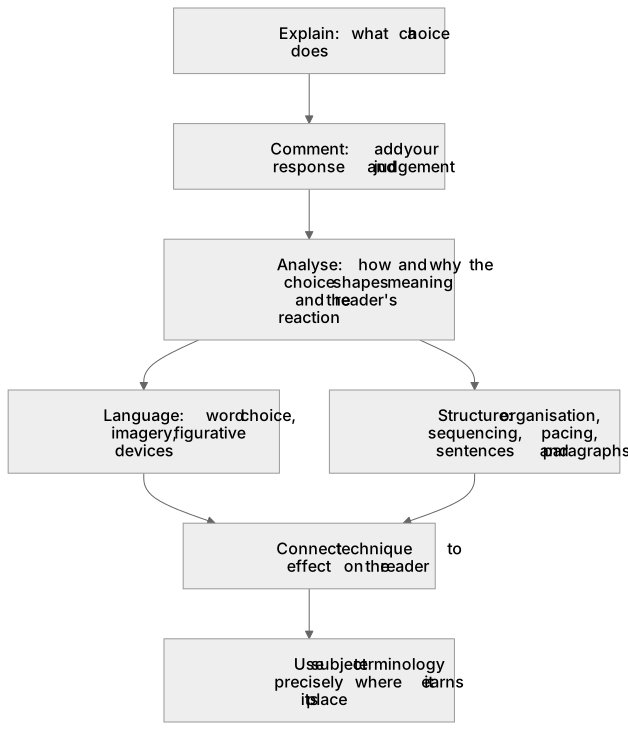
Key words
Say what each word means before you turn the card.
Language analysis
Try answering aloud or in your head before turning the card.
Structural analysis
Try answering aloud or in your head before turning the card.
Effect on the reader
Try answering aloud or in your head before turning the card.
Subject terminology
Try answering aloud or in your head before turning the card.
See every definition
- Language analysis
- Explaining, commenting on and analysing how writers use word choice, imagery and figurative devices to achieve effects and influence readers.
- Structural analysis
- Examining how a text is organised, sequenced, paced, or how sentences and paragraphs are shaped, and how this shapes meaning or the reader's response.
- Effect on the reader
- What a technique makes the reader think, feel or picture, which a technique must always be connected to rather than named in isolation.
- Subject terminology
- Relevant terms used precisely and only where they earn their place, to support the points made rather than as a label dropped in and left unexplained.
Label the diagram
Some boxes have lost their names. Pick the right name for each number.
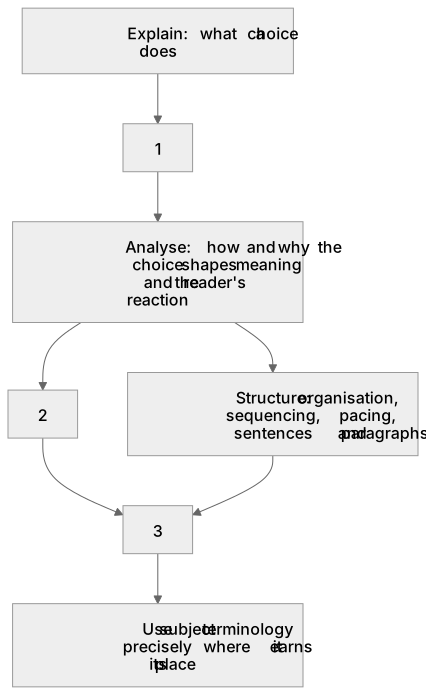
1Box 1
2Box 2
3Box 3
There is more to this lesson
The full lesson goes on to check your understanding and help you earn the marks. Create a free account to carry on, with your progress saved.
A week of Premium from your first lesson · Then the free plan continues · No card, no charge
Test your understanding of Assessment - Assessment Objectives and Weightings: AO2: Explain, comment on analyse how writers use language and structure to achieve effects and influence readers, using relevant subject terminology to support their views
Active recall beats re-reading. Take an instant quiz now to test what you’ve learned and lock it into long-term memory.
A week of Premium from your first lesson · Then the free plan continues · No card, no charge