Eduqas · GCSE · English Language
Course version: C700QS · Version from Mar 2026
AO7: Demonstrate presentation skills in a formal setting
Full specification wording
Assessment - Assessment Objectives and Weightings: AO7: Demonstrate presentation skills in a formal setting
AO7 assesses a spoken presentation delivered to an audience in a formal setting, not a casual chat.
Checked against the Eduqas C700QS specification (opens in a new tab) on .
- Point 9 of 11
- 4 key terms
Study notes
From the checked teaching notes for this specification point.
The idea
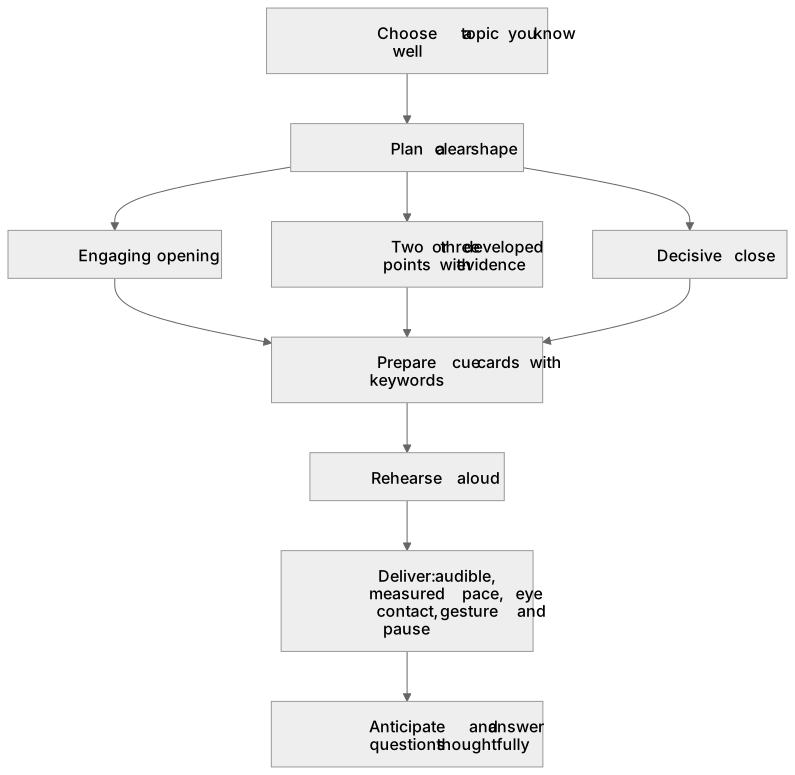
AO7 assesses a spoken presentation delivered to an audience in a formal setting, not a casual chat. Choose a topic you know well, such as whether school uniform should be abolished, and plan a clear shape: an engaging opening, two or three developed points with evidence, and a decisive close. Speak audibly at a measured pace, make deliberate eye contact around the room, and use gesture or pause to emphasise key ideas. Standard English and a formal register suit the occasion. Prepare cue cards with keywords rather than a full script, rehearse aloud, and anticipate questions so you can respond thoughtfully.
What earns the marks
- Content is well organised and developed, with a clear introduction, sequenced points and a conclusion that answers the central question.
- Register and vocabulary are formal and appropriate to the audience and occasion, avoiding slang and filler.
- Delivery is audible and fluent: controlled pace, varied intonation, purposeful pauses and minimal reliance on notes.
- Non-verbal communication supports meaning: eye contact is distributed across the audience and gesture reinforces key points.
- The presentation is sustained and meets the required duration without drifting or stopping abruptly.
- Responses to questions show understanding, listen carefully and answer relevantly rather than deflecting.
Common mistakes and how to put them right
Reading a full script word for word.
Put it right: Reduce the script to cue cards holding keywords and short prompts, then rehearse aloud.
Speaking too quietly or too quickly through nerves.
Put it right: Practise projecting to the back of the room and insert planned pauses after key points.
Choosing an overfamiliar topic with nothing to say.
Put it right: Select a subject you can support with specific examples, statistics or personal experience.
Exam tips
- Rehearse aloud at least twice with a timer so you know your pace and can trim or extend material.
- Prepare for two likely questions by noting a fact or example you could use in each answer.
- Open with a hook such as a striking question or statistic, and signal your close clearly so the audience knows you have finished.
Try the lesson
The start of the Assessment - Assessment Objectives and Weightings: AO7: Demonstrate presentation skills in a formal setting lesson, made from checked teaching notes for this specification point.
Have a go first
When demonstrating presentation skills in a formal setting, which approach is most appropriate for a candidate to use?
Listen
AO7 assesses a spoken presentation delivered to an audience in a formal setting, not a casual chat. Choose a topic you know well, such as whether school uniform should be abolished, and plan a clear shape: an engaging opening, two or three developed points with evidence, and a decisive close. Speak audibly at a measured pace, make deliberate eye contact around the room, and use gesture or pause to emphasise key ideas. Standard English and a formal register suit the occasion. Prepare cue cards with keywords rather than a full script, rehearse aloud, and anticipate questions so you can respond thoughtfully. A strong answer earns marks for these points. Content is well organised and developed, with a clear introduction, sequenced points and a conclusion that answers the central question. Register and vocabulary are formal and appropriate to the audience and occasion, avoiding slang and filler. Delivery is audible and fluent: controlled pace, varied intonation, purposeful pauses and minimal reliance on notes. Non-verbal communication supports meaning: eye contact is distributed across the audience and gesture reinforces key points. A common slip: Reading a full script word for word: delivery becomes flat and eye contact disappears. Instead, reduce the script to cue cards holding keywords and short prompts, then rehearse aloud. Exam tip: Rehearse aloud at least twice with a timer so you know your pace and can trim or extend material.
See it
Key words
Say what each word means before you turn the card.
Formal spoken register
Try answering aloud or in your head before turning the card.
Structured and developed content
Try answering aloud or in your head before turning the card.
Confident delivery and audience awareness
Try answering aloud or in your head before turning the card.
Responsive listening and questioning
Try answering aloud or in your head before turning the card.
See every definition
- Formal spoken register
- Standard English and vocabulary that are formal and appropriate to the audience and occasion, avoiding slang and filler.
- Structured and developed content
- Content that is well organised and developed, with a clear introduction, sequenced points and a conclusion that answers the central question.
- Confident delivery and audience awareness
- Delivery that is audible and fluent, with controlled pace, varied intonation, purposeful pauses and minimal reliance on notes, supported by eye contact and gesture.
- Responsive listening and questioning
- Responses to questions that show understanding, listen carefully and answer relevantly rather than deflecting.
Label the diagram
Some boxes have lost their names. Pick the right name for each number.
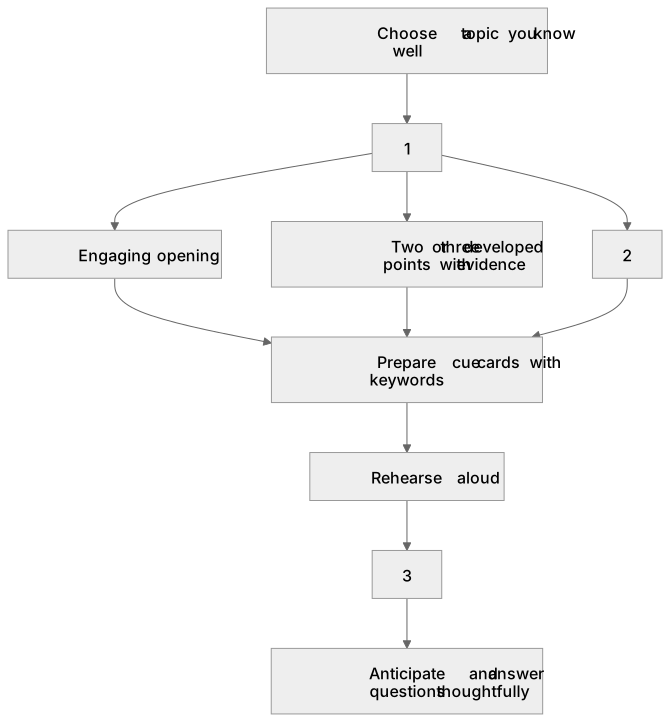
1Box 1
2Box 2
3Box 3
There is more to this lesson
The full lesson goes on to check your understanding and help you earn the marks. Create a free account to carry on, with your progress saved.
A week of Premium from your first lesson · Then the free plan continues · No card, no charge
Test your understanding of Assessment - Assessment Objectives and Weightings: AO7: Demonstrate presentation skills in a formal setting
Active recall beats re-reading. Take an instant quiz now to test what you’ve learned and lock it into long-term memory.
A week of Premium from your first lesson · Then the free plan continues · No card, no charge