Eduqas · GCSE · English Language
Course version: C700QS · Version from Mar 2026
AO6: Candidates must use a range of vocabulary and sentence structures for…
Full specification wording
Assessment - Assessment Objectives and Weightings: AO6: Candidates must use a range of vocabulary and sentence structures for clarity, purpose and effect, with accurate spelling and punctuation.
AO6 rewards deliberate language control rather than simply using long words.
Checked against the Eduqas C700QS specification (opens in a new tab) on .
- Point 8 of 11
- 4 key terms
Study notes
From the checked teaching notes for this specification point.
The idea
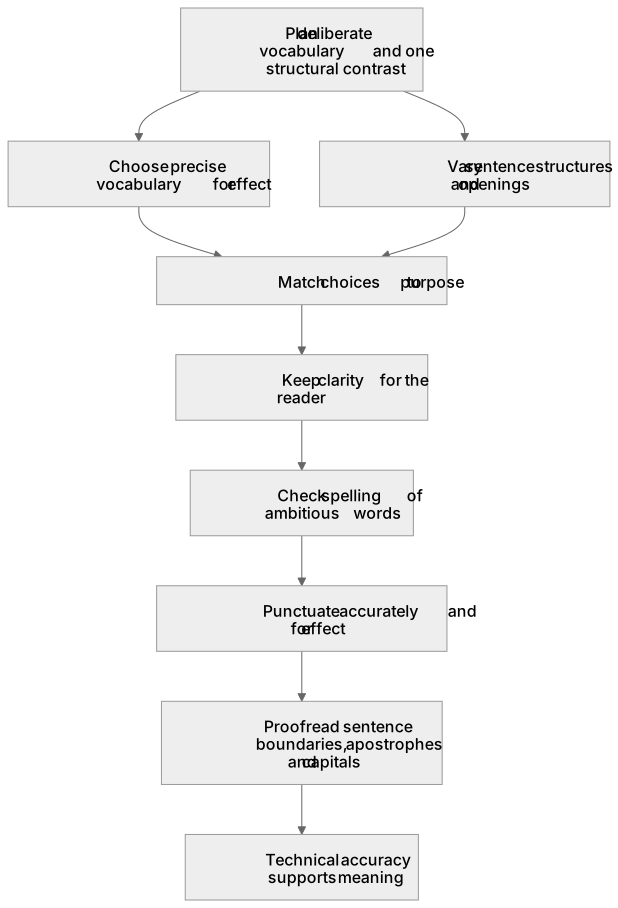
AO6 rewards deliberate language control rather than simply using long words. In a storm description, swap repeated phrases like "very big" for precise adjectives such as "vast", "towering" or "immense", and vary sentence structures. You might place a short simple sentence ("Thunder cracked overhead.") beside a complex one ("As the rain hammered the roof, the family huddled indoors.") to build tension. Match choices to purpose: persuade with rhetorical questions; inform with precise nouns. Check the spelling of ambitious words and punctuate for effect, using commas, semicolons, colons and dashes accurately. Proofread carefully for sentence boundaries, apostrophes and capital letters to ensure technical accuracy supports your meaning.
What earns the marks
- Vocabulary is chosen for precision and effect, not merely rarity: "the wind clawed at the shutters" beats "the wind was very bad".
- Sentence structures are varied deliberately: simple, compound and complex forms, varied openings, and controlled lengths that mirror tension or calm.
- Clarity is preserved: ambitious wording and complex syntax never obscure meaning for the reader.
- Purpose and effect are evident: language choices suit description, narration, persuasion or explanation as the task demands.
- Spelling of common and ambitious vocabulary is accurate, including irregular forms and homophones.
- Punctuation is accurate and used for effect: full stops, commas, apostrophes, speech punctuation, semicolons, colons and dashes.
- Technical accuracy supports communication: sentence demarcation, tense consistency and subject-verb agreement are secure.
Common mistakes and how to put them right
Padding with long, misused words.
Put it right: Choose words whose meaning and register you can control, then check them in a dictionary.
Monotonous sentence openings: every sentence begins with "The" or "I".
Put it right: Reorder clauses, begin with adverbs, prepositional phrases or verbs where effective.
Punctuation used decoratively: commas or exclamation marks scattered without grammatical purpose.
Put it right: Learn each mark's job and apply it only where the sentence requires it.
Exam tips
- Plan two or three deliberate vocabulary choices and one structural contrast before writing, then deploy them naturally.
- Leave three minutes to proofread for apostrophes, sentence boundaries and the spellings you personally find tricky.
- Read your work aloud in your head: if you stumble, the punctuation or syntax probably needs adjusting.
Try the lesson
The start of the Assessment - Assessment Objectives and Weightings: AO6: Candidates must use a range of vocabulary and sentence structures for clarity, purpose and effect, with accurate spelling and punctuation. lesson, made from checked teaching notes for this specification point.
Have a go first
Which of these sentences uses the most varied and effective vocabulary to describe a storm?
Listen
AO6 rewards deliberate language control rather than simply using long words. In a storm description, swap repeated phrases like "very big" for precise adjectives such as "vast", "towering" or "immense", and vary sentence structures. You might place a short simple sentence ("Thunder cracked overhead.") beside a complex one ("As the rain hammered the roof, the family huddled indoors.") to build tension. Match choices to purpose: persuade with rhetorical questions; inform with precise nouns. Check the spelling of ambitious words and punctuate for effect, using commas, semicolons, colons and dashes accurately. Proofread carefully for sentence boundaries, apostrophes and capital letters to ensure technical accuracy supports your meaning. A strong answer earns marks for these points. Vocabulary is chosen for precision and effect, not merely rarity: "the wind clawed at the shutters" beats "the wind was very bad". Sentence structures are varied deliberately: simple, compound and complex forms, varied openings, and controlled lengths that mirror tension or calm. Clarity is preserved: ambitious wording and complex syntax never obscure meaning for the reader. Purpose and effect are evident: language choices suit description, narration, persuasion or explanation as the task demands. A common slip: Padding with long, misused words: the writer inserts "plethora" or "myriad" without knowing their meaning. Instead, choose words whose meaning and register you can control, then check them in a dictionary. Exam tip: Plan two or three deliberate vocabulary choices and one structural contrast before writing, then deploy them naturally.
See it
Key words
Say what each word means before you turn the card.
Precision and range in vocabulary
Try answering aloud or in your head before turning the card.
Deliberate variety in sentence structure
Try answering aloud or in your head before turning the card.
Clarity for the reader
Try answering aloud or in your head before turning the card.
Technical accuracy in spelling and punctuation
Try answering aloud or in your head before turning the card.
See every definition
- Precision and range in vocabulary
- Choosing words for their exact meaning and effect rather than merely their rarity, so that ambitious wording never obscures meaning for the reader.
- Deliberate variety in sentence structure
- Using simple, compound and complex forms, varied openings and controlled lengths that mirror tension or calm, rather than monotonous openings.
- Clarity for the reader
- Preserving meaning so that ambitious wording and complex syntax never obscure it for the reader.
- Technical accuracy in spelling and punctuation
- Accurate spelling of common and ambitious vocabulary, including irregular forms and homophones, and punctuation that is accurate and used for effect.
Label the diagram
Some boxes have lost their names. Pick the right name for each number.
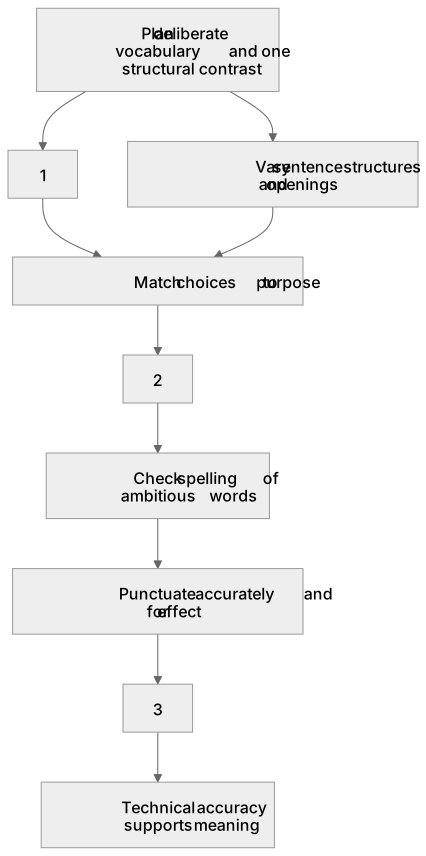
1Box 1
2Box 2
3Box 3
There is more to this lesson
The full lesson goes on to check your understanding and help you earn the marks. Create a free account to carry on, with your progress saved.
A week of Premium from your first lesson · Then the free plan continues · No card, no charge
Test your understanding of Assessment - Assessment Objectives and Weightings: AO6: Candidates must use a range of vocabulary and sentence structures for clarity, purpose and effect, with accurate spelling and punctuation.
Active recall beats re-reading. Take an instant quiz now to test what you’ve learned and lock it into long-term memory.
A week of Premium from your first lesson · Then the free plan continues · No card, no charge