Eduqas · GCSE · English Language
Course version: C700QS · Version from Mar 2026
Organise information and ideas, using structural and grammatical features…
Full specification wording
Assessment - Assessment Objectives and Weightings: Organise information and ideas, using structural and grammatical features to support coherence and cohesion of texts
This objective is about how a text holds together.
Checked against the Eduqas C700QS specification (opens in a new tab) on .
- Point 7 of 11
- 4 key terms
Study notes
From the checked teaching notes for this specification point.
The idea
This objective is about how a text holds together. Coherence is the logical order of ideas so a reader can follow the argument or narrative; cohesion is the linguistic glue that links sentences and paragraphs. Structure operates at whole-text level, for example an introduction, developed paragraphs and a conclusion, or a narrative that withholds then reveals. Grammar supports this through pronoun reference, tense consistency, connectives such as 'however' and 'therefore', and parallel constructions. In a persuasive article, open with a striking claim, develop one point per paragraph, and use discourse markers to guide the reader; in a story, use time shifts and repeated motifs to create shape.
What earns the marks
- Orders paragraphs logically so each idea builds on the previous one and the whole text moves towards a clear ending.
- Uses discourse markers and connectives accurately to signal addition, contrast, cause and consequence.
- Maintains grammatical cohesion through consistent tense, clear pronoun reference and controlled sentence structures.
- Links paragraphs explicitly, for example by echoing a key word or picking up the previous paragraph's idea.
- Shapes whole-text structure deliberately, such as a circular ending, a turning point or a counterargument before a conclusion.
- Uses punctuation to clarify relationships within and between sentences, including commas, semicolons and colons where appropriate.
Common mistakes and how to put them right
Listing points without links, producing a disjointed text.
Put it right by adding connectives and topic sentences that show the relationship between ideas.
Using a pronoun whose referent is unclear, such as 'it' with several possible nouns.
Put it right by naming the noun or restructuring the sentence.
Shifting tense without reason in a narrative.
Put it right by choosing a dominant tense and checking each verb.
Writing one long block of text.
Put it right by paragraphing around a single idea or stage and linking paragraphs.
Exam tips
- Plan a short paragraph-by-paragraph outline so the order of ideas is deliberate before you write.
- Begin each paragraph with a topic sentence that states its job in the argument or narrative.
- Use a small set of connectives accurately rather than many loosely, and check each one fits the logic.
- Read the finished piece backwards sentence by sentence to catch tense and pronoun slips.
Try the lesson
The start of the Assessment - Assessment Objectives and Weightings: Organise information and ideas, using structural and grammatical features to support coherence and cohesion of texts lesson, made from checked teaching notes for this specification point.
Have a go first
Which sentence uses a grammatical feature to correctly signal a contrast between two ideas?
Listen
This objective is about how a text holds together. Coherence is the logical order of ideas so a reader can follow the argument or narrative; cohesion is the linguistic glue that links sentences and paragraphs. Structure operates at whole-text level, for example an introduction, developed paragraphs and a conclusion, or a narrative that withholds then reveals. Grammar supports this through pronoun reference, tense consistency, connectives such as 'however' and 'therefore', and parallel constructions. In a persuasive article, open with a striking claim, develop one point per paragraph, and use discourse markers to guide the reader; in a story, use time shifts and repeated motifs to create shape. A strong answer earns marks for these points. Orders paragraphs logically so each idea builds on the previous one and the whole text moves towards a clear ending. Uses discourse markers and connectives accurately to signal addition, contrast, cause and consequence. Maintains grammatical cohesion through consistent tense, clear pronoun reference and controlled sentence structures. Links paragraphs explicitly, for example by echoing a key word or picking up the previous paragraph's idea. A common slip: Listing points without links, producing a disjointed text. Instead, adding connectives and topic sentences that show the relationship between ideas. Exam tip: Plan a short paragraph-by-paragraph outline so the order of ideas is deliberate before you write.
See it
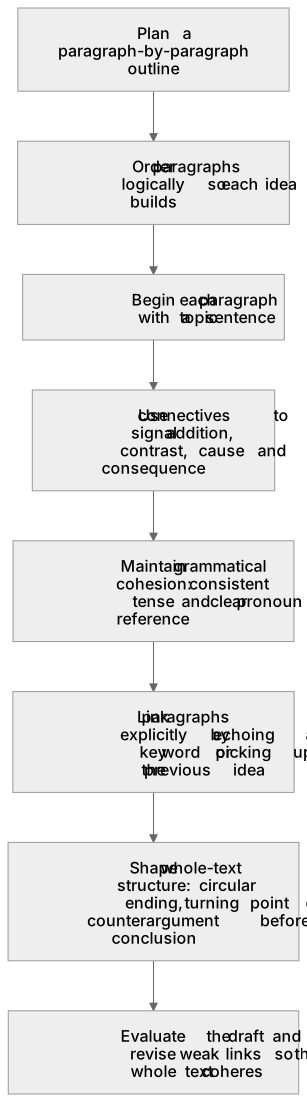
Put it in order
Put these steps in the order they happen.
- 1. Maintain grammatical cohesion: consistent tense and clear pronoun reference
- 2. Evaluate the draft and revise weak links so the whole text coheres
- 3. Link paragraphs explicitly by echoing a key word or picking up the previous idea
- 4. Plan a paragraph-by-paragraph outline
- 5. Order paragraphs logically so each idea builds
- 6. Shape whole-text structure: circular ending, turning point or counterargument before a conclusion
- 7. Begin each paragraph with a topic sentence
- 8. Use connectives to signal addition, contrast, cause and consequence
Key words
Say what each word means before you turn the card.
Coherence
Try answering aloud or in your head before turning the card.
Cohesion
Try answering aloud or in your head before turning the card.
Connectives
Try answering aloud or in your head before turning the card.
Pronoun reference
Try answering aloud or in your head before turning the card.
See every definition
- Coherence
- The logical order of ideas so a reader can follow the argument or narrative.
- Cohesion
- The linguistic glue that links sentences and paragraphs.
- Connectives
- Words such as 'however' and 'therefore' that link sentences and paragraphs.
- Pronoun reference
- A grammatical feature that supports cohesion, where a pronoun's referent must be clear.
Label the diagram
Some boxes have lost their names. Pick the right name for each number.
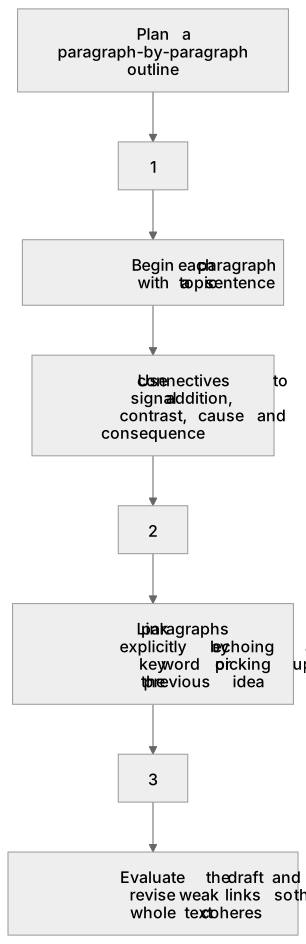
1Box 1
2Box 2
3Box 3
There is more to this lesson
The full lesson goes on to check your understanding and help you earn the marks. Create a free account to carry on, with your progress saved.
A week of Premium from your first lesson · Then the free plan continues · No card, no charge
Test your understanding of Assessment - Assessment Objectives and Weightings: Organise information and ideas, using structural and grammatical features to support coherence and cohesion of texts
Active recall beats re-reading. Take an instant quiz now to test what you’ve learned and lock it into long-term memory.
A week of Premium from your first lesson · Then the free plan continues · No card, no charge