Eduqas · GCSE · English Language
Course version: C700QS · Version from Mar 2026
Select and synthesise evidence from different texts
Full specification wording
Assessment - Assessment Objectives and Weightings: Select and synthesise evidence from different texts
Synthesis means combining relevant details from more than one text to produce a coherent, integrated response.
Checked against the Eduqas C700QS specification (opens in a new tab) on .
- Point 2 of 11
- 4 key terms
Study notes
From the checked teaching notes for this specification point.
The idea
Synthesis means combining relevant details from more than one text to produce a coherent, integrated response. You first select evidence by skimming and scanning each text for information that answers the question, then group related points across texts, and finally express the combined idea in your own words. For example, if Text A says a character feels nervous before a race and Text B says another character cannot eat before competing, you synthesise: both characters experience pre-event anxiety that affects their appetite. The skill is assessed by how accurately you choose evidence and how clearly you merge it, not by copying whole sentences. Use short quotations or precise references, and always link the texts explicitly with connectives such as similarly, whereas or both.
What earns the marks
- Selects only material that directly addresses the focus of the question from each text.
- Uses skimming to locate the relevant section and scanning to find precise words or phrases.
- Groups related ideas from different texts rather than listing them separately.
- Expresses the combined point in own words, using short quotations only as support.
- Makes the link between texts explicit with comparative or additive connectives.
- Maintains accuracy so that the synthesised point is not distorted by misreading.
Common mistakes and how to put them right
Copying a long sentence from one text and a long sentence from another without merging them.
Put it right by identifying the shared idea and writing one combined sentence.
Writing about each text in a separate paragraph with no connection.
Put it right by using connectives such as both, similarly or in contrast within each paragraph.
Selecting an interesting detail that does not answer the question.
Put it right: Re-reading the question and checking each piece of evidence against it.
Exam tips
- Underline the key words in the question before reading the texts so you know exactly what to select.
- Number the relevant lines in each text, then draw arrows between matching ideas to plan your synthesis.
- Keep quotations to three or four words and put the combined idea in your own words first.
Try the lesson
The start of the Assessment - Assessment Objectives and Weightings: Select and synthesise evidence from different texts lesson, made from checked teaching notes for this specification point.
Have a go first
Read the two texts below.
Text A: 'The new school uniform policy requires all students to wear blazers, which many find uncomfortable in summer.' Text B: 'Parents have complained that the mandatory blazers are too expensive to replace when children grow.'
Which statement best synthesises the evidence from both texts regarding the new blazers?
Listen
Synthesis means combining relevant details from more than one text to produce a coherent, integrated response. You first select evidence by skimming and scanning each text for information that answers the question, then group related points across texts, and finally express the combined idea in your own words. For example, if Text A says a character feels nervous before a race and Text B says another character cannot eat before competing, you synthesise: both characters experience pre-event anxiety that affects their appetite. The skill is assessed by how accurately you choose evidence and how clearly you merge it, not by copying whole sentences. Use short quotations or precise references, and always link the texts explicitly with connectives such as similarly, whereas or both. A strong answer earns marks for these points. Selects only material that directly addresses the focus of the question from each text. Uses skimming to locate the relevant section and scanning to find precise words or phrases. Groups related ideas from different texts rather than listing them separately. Expresses the combined point in own words, using short quotations only as support. A common slip: Copying a long sentence from one text and a long sentence from another without merging them. Instead, identifying the shared idea and writing one combined sentence. Exam tip: Underline the key words in the question before reading the texts so you know exactly what to select.
See it
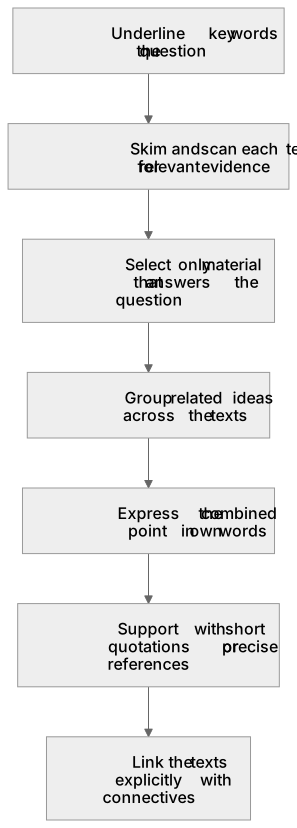
Put it in order
Put these steps in the order they happen.
- 1. Link the texts explicitly with connectives
- 2. Support with short quotations or precise references
- 3. Select only material that answers the question
- 4. Express the combined point in own words
- 5. Underline key words in the question
- 6. Skim and scan each text for relevant evidence
- 7. Group related ideas across the texts
Key words
Say what each word means before you turn the card.
Synthesis
Try answering aloud or in your head before turning the card.
Selection of relevant evidence
Try answering aloud or in your head before turning the card.
Precision of quotation
Try answering aloud or in your head before turning the card.
Coherent written expression
Try answering aloud or in your head before turning the card.
See every definition
- Synthesis
- Combining relevant details from more than one text to produce a coherent, integrated response.
- Selection of relevant evidence
- Skimming and scanning each text for information that answers the question, choosing only material that directly addresses its focus.
- Precision of quotation
- Using short quotations or precise references, kept to three or four words, only as support for a point expressed in your own words.
- Coherent written expression
- Expressing the combined idea in your own words and linking the texts explicitly with connectives such as similarly, whereas or both.
Label the diagram
Some boxes have lost their names. Pick the right name for each number.
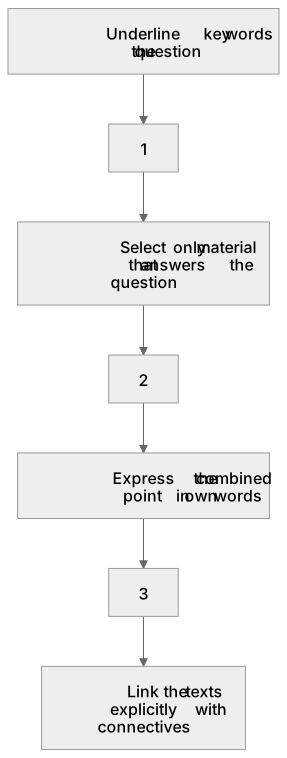
1Box 1
2Box 2
3Box 3
There is more to this lesson
The full lesson goes on to check your understanding and help you earn the marks. Create a free account to carry on, with your progress saved.
A week of Premium from your first lesson · Then the free plan continues · No card, no charge
Test your understanding of Assessment - Assessment Objectives and Weightings: Select and synthesise evidence from different texts
Active recall beats re-reading. Take an instant quiz now to test what you’ve learned and lock it into long-term memory.
A week of Premium from your first lesson · Then the free plan continues · No card, no charge