Eduqas · GCSE · English Language
Course version: C700QS · Version from Mar 2026
Spoken Language (Non-exam assessment): Achievement in Spoken Language will…
Full specification wording
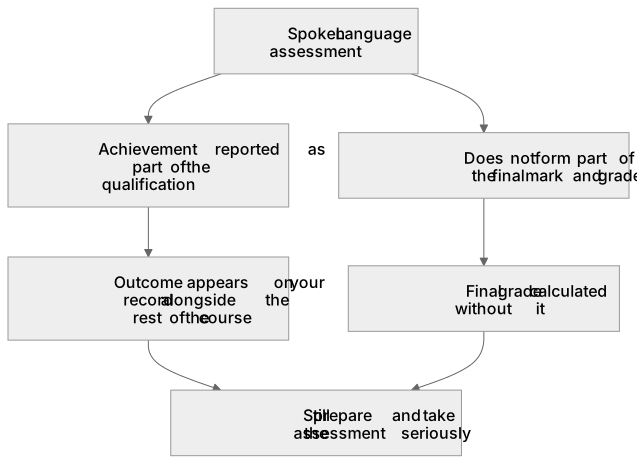
Component 3: Spoken Language (Non-exam assessment): Achievement in Spoken Language will be reported as part of the qualification, but it will not form part of the final mark and grade.
This row is course and assessment guidance, not an assessed answer target.
Checked against the Eduqas C700QS specification (opens in a new tab) on .
- Point 2 of 8
- 4 key terms
Study notes
From the checked teaching notes for this specification point.
The idea
This row is course and assessment guidance, not an assessed answer target. It tells you how Spoken Language sits inside the Eduqas GCSE English Language qualification. Your spoken performance is assessed and the outcome is reported as part of the qualification, so it appears on your record alongside the rest of the course. However, the Spoken Language result does not contribute to the final mark and does not change the final grade. Read the two halves separately: reported, but not counted. A useful method is to write two short sentences in your own notes, one for each half, then check you have not merged them into a single claim. The practical consequence is that you should still prepare and take the Spoken Language assessment seriously because it is reported, while understanding that your overall English Language grade is calculated without it.
Common mistakes and how to put them right
Assuming Spoken Language is ignored completely.
Put it right by noting it is assessed and reported, just not counted in the final mark and grade.
Assuming Spoken Language marks are added to the written components.
Put it right by separating 'reported as part of the qualification' from 'forms part of the final mark and grade'.
Treating this guidance row as an exam question to answer.
Put it right by using it to understand the qualification structure, not to rehearse a written response.
Exam tips
- Write the two claims separately in your notes: reported, and not counted, then check each against the statement.
- When revising the qualification structure, label Spoken Language as non-exam assessment reported separately from the graded components.
- Use this understanding to plan preparation: still rehearse your presentation because the outcome is reported.
- Check any summary you write does not imply the spoken result changes your final grade.
Try the lesson
The start of the Component 3: Spoken Language (Non-exam assessment): Achievement in Spoken Language will be reported as part of the qualification, but it will not form part of the final mark and grade. lesson, made from checked teaching notes for this specification point.
Have a go first
How is achievement in the Spoken Language component recorded in the final GCSE English Language results?
Listen
This row is course and assessment guidance, not an assessed answer target. It tells you how Spoken Language sits inside the Eduqas GCSE English Language qualification. Your spoken performance is assessed and the outcome is reported as part of the qualification, so it appears on your record alongside the rest of the course. However, the Spoken Language result does not contribute to the final mark and does not change the final grade. Read the two halves separately: reported, but not counted. A useful method is to write two short sentences in your own notes, one for each half, then check you have not merged them into a single claim. The practical consequence is that you should still prepare and take the Spoken Language assessment seriously because it is reported, while understanding that your overall English Language grade is calculated without it. A common slip: Assuming Spoken Language is ignored completely. Instead, noting it is assessed and reported, just not counted in the final mark and grade. Exam tip: Write the two claims separately in your notes: reported, and not counted, then check each against the statement.
See it
Key words
Say what each word means before you turn the card.
Qualification structure
Try answering aloud or in your head before turning the card.
Reporting of Spoken Language achievement
Try answering aloud or in your head before turning the card.
Separation of reported outcome from final mark and grade
Try answering aloud or in your head before turning the card.
Non-exam assessment
Try answering aloud or in your head before turning the card.
See every definition
- Qualification structure
- The way Spoken Language sits inside the Eduqas GCSE English Language qualification, with its achievement reported as part of the qualification.
- Reporting of Spoken Language achievement
- The spoken performance is assessed and the outcome is reported as part of the qualification, so it appears on your record alongside the rest of the course.
- Separation of reported outcome from final mark and grade
- The Spoken Language result does not contribute to the final mark and does not change the final grade, so it is reported but not counted.
- Non-exam assessment
- Spoken Language is non-exam assessment reported separately from the graded components when revising the qualification structure.
Label the diagram
Some boxes have lost their names. Pick the right name for each number.
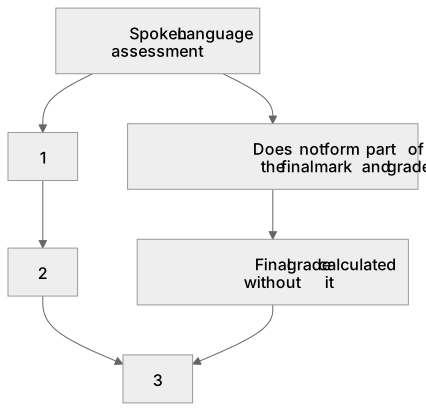
1Box 1
2Box 2
3Box 3
There is more to this lesson
The full lesson goes on to check your understanding and help you earn the marks. Create a free account to carry on, with your progress saved.
A week of Premium from your first lesson · Then the free plan continues · No card, no charge
Test your understanding of Component 3: Spoken Language (Non-exam assessment): Achievement in Spoken Language will be reported as part of the qualification, but it will not form part of the final mark and grade.
Active recall beats re-reading. Take an instant quiz now to test what you’ve learned and lock it into long-term memory.
A week of Premium from your first lesson · Then the free plan continues · No card, no charge