Eduqas · GCSE · English Language
Course version: C700QS · Version from Mar 2026
Spoken Language (Non-exam assessment): Presentations must be formal but…
Full specification wording
Component 3: Spoken Language (Non-exam assessment): Presentations must be formal but may take a wide variety of forms, including talks, debates, speeches and dialogues.
This row is course guidance for the Spoken Language presentation, not an assessed written answer.
Checked against the Eduqas C700QS specification (opens in a new tab) on .
- Point 3 of 8
- 4 key terms
Study notes
From the checked teaching notes for this specification point.
The idea
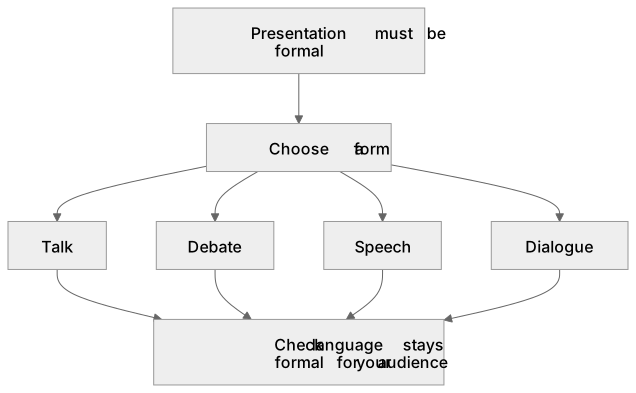
This row is course guidance for the Spoken Language presentation, not an assessed written answer. It sets two ideas that work together. First, the presentation must be formal: choose a register suited to an audience, avoid slang and casual filler, structure your points, and use Standard English appropriately. Second, form is flexible: a talk, a debate, a speech or a dialogue are all acceptable shapes. Read the statement as a constraint plus a choice. The constraint is formality; the choice is which form best carries your material. A practical method is to pick your form first, then check it still allows a formal register. For example, a dialogue can be formal if participants take structured turns and use considered language, whereas a chatty exchange would not meet the formality requirement. Plan, rehearse and deliver accordingly.
Common mistakes and how to put them right
Thinking only a solo talk is allowed.
Put it right by noting debates, speeches and dialogues are also acceptable forms.
Believing a relaxed or slangy style is fine because the form is flexible.
Put it right by keeping the formal register requirement in view.
Treating this guidance as a written exam question.
Put it right by using it to plan and deliver the spoken presentation.
Exam tips
- Choose your form (talk, debate, speech or dialogue) and then check the language stays formal for your audience.
- Rehearse the opening and closing so structure and register are controlled under pressure.
- If using dialogue, plan structured turns and formal wording rather than casual chat.
- Keep a short checklist: formal register, clear structure, chosen form justified by the content.
Try the lesson
The start of the Component 3: Spoken Language (Non-exam assessment): Presentations must be formal but may take a wide variety of forms, including talks, debates, speeches and dialogues. lesson, made from checked teaching notes for this specification point.
Have a go first
Which statement best describes the required style and permitted formats of a Spoken Language presentation?
Listen
This row is course guidance for the Spoken Language presentation, not an assessed written answer. It sets two ideas that work together. First, the presentation must be formal: choose a register suited to an audience, avoid slang and casual filler, structure your points, and use Standard English appropriately. Second, form is flexible: a talk, a debate, a speech or a dialogue are all acceptable shapes. Read the statement as a constraint plus a choice. The constraint is formality; the choice is which form best carries your material. A practical method is to pick your form first, then check it still allows a formal register. For example, a dialogue can be formal if participants take structured turns and use considered language, whereas a chatty exchange would not meet the formality requirement. Plan, rehearse and deliver accordingly. A common slip: Thinking only a solo talk is allowed. Instead, noting debates, speeches and dialogues are also acceptable forms. Exam tip: Choose your form (talk, debate, speech or dialogue) and then check the language stays formal for your audience.
See it
Key words
Say what each word means before you turn the card.
Formal register in spoken presentation
Try answering aloud or in your head before turning the card.
Flexibility of presentation form
Try answering aloud or in your head before turning the card.
Audience-appropriate language
Try answering aloud or in your head before turning the card.
Planning and delivery of non-exam assessment
Try answering aloud or in your head before turning the card.
See every definition
- Formal register in spoken presentation
- A register suited to an audience, avoiding slang and casual filler, structuring points and using Standard English appropriately.
- Flexibility of presentation form
- A talk, a debate, a speech or a dialogue are all acceptable shapes for the presentation.
- Audience-appropriate language
- Language kept formal for your audience, with slang and casual filler avoided.
- Planning and delivery of non-exam assessment
- Picking your form first, then checking it still allows a formal register, and planning, rehearsing and delivering accordingly.
Label the diagram
Some boxes have lost their names. Pick the right name for each number.
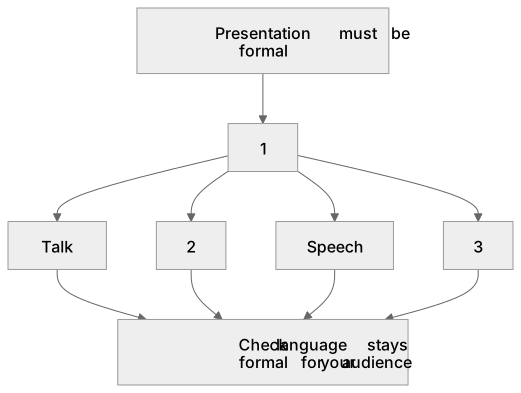
1Box 1
2Box 2
3Box 3
There is more to this lesson
The full lesson goes on to check your understanding and help you earn the marks. Create a free account to carry on, with your progress saved.
A week of Premium from your first lesson · Then the free plan continues · No card, no charge
Test your understanding of Component 3: Spoken Language (Non-exam assessment): Presentations must be formal but may take a wide variety of forms, including talks, debates, speeches and dialogues.
Active recall beats re-reading. Take an instant quiz now to test what you’ve learned and lock it into long-term memory.
A week of Premium from your first lesson · Then the free plan continues · No card, no charge