Eduqas · GCSE · English Language
Course version: C700QS · Version from Mar 2026
Spoken Language (Non-exam assessment): Candidates must identify the…
Full specification wording
Component 3: Spoken Language (Non-exam assessment): Candidates must identify the subject for their presentations in advance and agree with their teacher.
This is centre guidance for the Spoken Language non-exam assessment, not a task you perform under timed conditions.
Checked against the Eduqas C700QS specification (opens in a new tab) on .
- Point 4 of 8
- 4 key terms
Study notes
From the checked teaching notes for this specification point.
The idea
This is centre guidance for the Spoken Language non-exam assessment, not a task you perform under timed conditions. The requirement has two linked parts. First, you choose and identify a subject for your presentation before you begin preparing it in detail. Second, you agree that subject with your teacher, so the choice is confirmed rather than assumed. In practice you might draft two or three possible topics, note why each suits a spoken presentation, then discuss them with your teacher and record the agreed subject. Agreeing early protects you from building a whole presentation on a topic that is unsuitable or unmanageable. The teacher's role is to confirm the subject; the planning and delivery remain yours.
Common mistakes and how to put them right
Choosing a topic silently and starting full preparation without confirming it with the teacher.
Put it right: Identify the subject and secure the teacher's agreement before detailed planning.
Treating the teacher's agreement as the teacher writing or planning the presentation.
Put it right: The teacher confirms the subject; you still plan, organise and deliver it.
Leaving the subject vague, such as a broad field of interest, so it cannot be clearly identified.
Put it right: State a specific, identifiable subject that can be agreed.
Assuming the subject can be swapped at the last moment without discussion.
Put it right: Agree any change with the teacher before continuing preparation.
Exam tips
- Write down your proposed subject in one clear sentence and check it is specific enough to present.
- Discuss the proposal with your teacher early and note the agreed subject so your planning starts from a confirmed base.
- If you are unsure between options, prepare a short reason for each and ask your teacher which is more suitable before committing.
Try the lesson
The start of the Component 3: Spoken Language (Non-exam assessment): Candidates must identify the subject for their presentations in advance and agree with their teacher. lesson, made from checked teaching notes for this specification point.
Have a go first
According to the specification, what must a candidate do about the subject of their Spoken Language presentation before delivering it?
Listen
This is centre guidance for the Spoken Language non-exam assessment, not a task you perform under timed conditions. The requirement has two linked parts. First, you choose and identify a subject for your presentation before you begin preparing it in detail. Second, you agree that subject with your teacher, so the choice is confirmed rather than assumed. In practice you might draft two or three possible topics, note why each suits a spoken presentation, then discuss them with your teacher and record the agreed subject. Agreeing early protects you from building a whole presentation on a topic that is unsuitable or unmanageable. The teacher's role is to confirm the subject; the planning and delivery remain yours. A common slip: Choosing a topic silently and starting full preparation without confirming it with the teacher. Instead, identify the subject and secure the teacher's agreement before detailed planning. Exam tip: Write down your proposed subject in one clear sentence and check it is specific enough to present.
See it
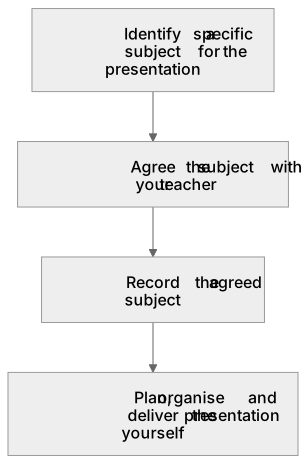
Put it in order
Put these steps in the order they happen.
- 1. Record the agreed subject
- 2. Plan, organise and deliver the presentation yourself
- 3. Agree the subject with your teacher
- 4. Identify a specific subject for the presentation
Key words
Say what each word means before you turn the card.
Advance identification of the presentation subject
Try answering aloud or in your head before turning the card.
Agreement of the subject with the teacher
Try answering aloud or in your head before turning the card.
Learner ownership of planning and delivery
Try answering aloud or in your head before turning the card.
Early confirmation to avoid wasted preparation
Try answering aloud or in your head before turning the card.
See every definition
- Advance identification of the presentation subject
- Choosing and identifying a subject for the presentation before detailed preparation begins.
- Agreement of the subject with the teacher
- Confirming the chosen subject with the teacher so the choice is confirmed rather than assumed.
- Learner ownership of planning and delivery
- The teacher confirms the subject, while planning, organising and delivering the presentation remain yours.
- Early confirmation to avoid wasted preparation
- Agreeing the subject early protects you from building a whole presentation on a topic that is unsuitable or unmanageable.
Label the diagram
Some boxes have lost their names. Pick the right name for each number.
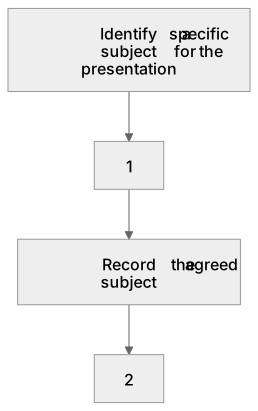
1Box 1
2Box 2
There is more to this lesson
The full lesson goes on to check your understanding and help you earn the marks. Create a free account to carry on, with your progress saved.
A week of Premium from your first lesson · Then the free plan continues · No card, no charge
Test your understanding of Component 3: Spoken Language (Non-exam assessment): Candidates must identify the subject for their presentations in advance and agree with their teacher.
Active recall beats re-reading. Take an instant quiz now to test what you’ve learned and lock it into long-term memory.
A week of Premium from your first lesson · Then the free plan continues · No card, no charge