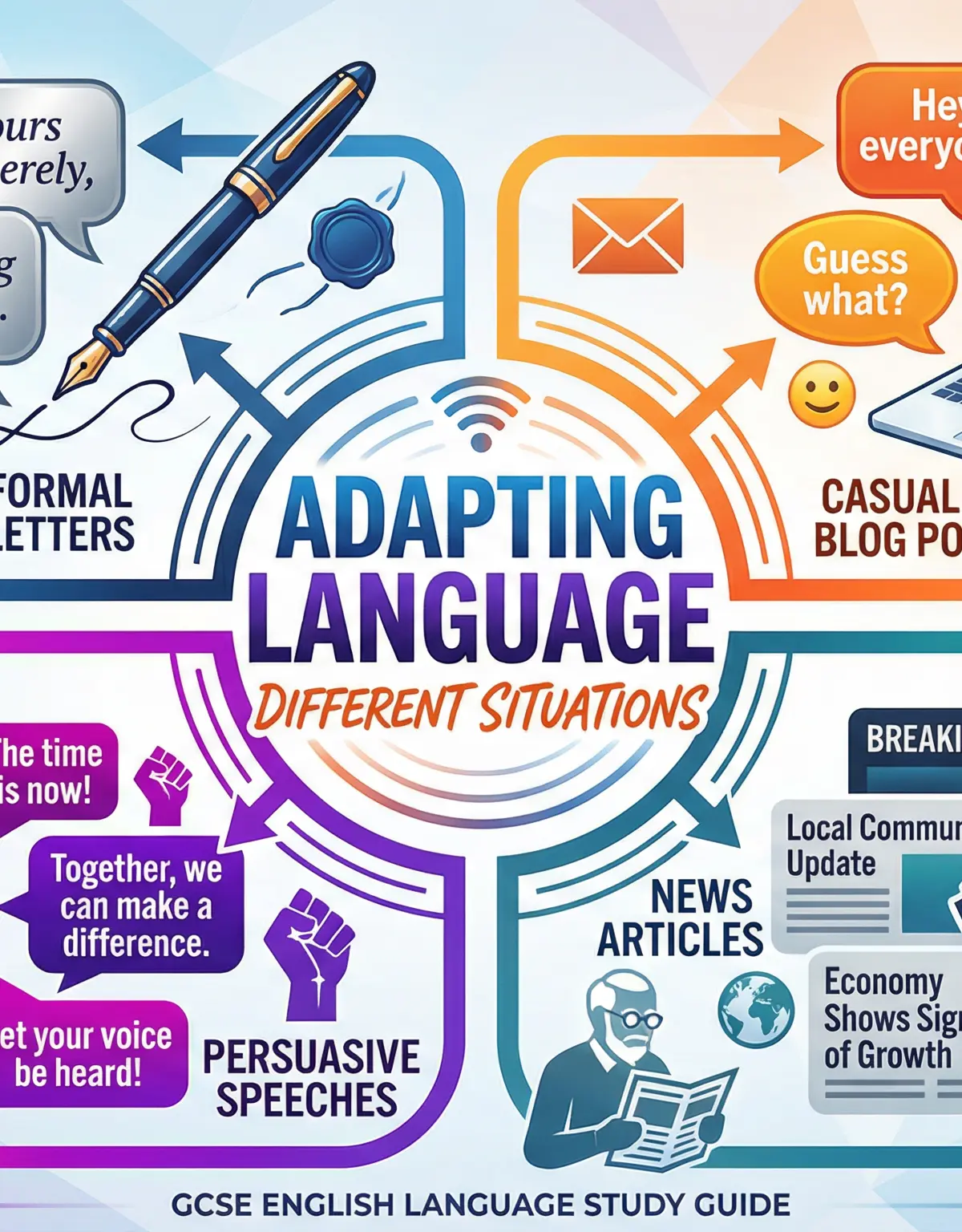
Adapting language for different situations

    This guide focuses on the crucial skill of adapting language for different situations (OCR J351, 3.4), which accounts for up to 50% of your exam marks. You will learn to manipulate tone, style, and register for specific audiences and purposes in your own writing (AO5/AO6) and analyse how professional writers achieve these effects (AO2).

    7
    Min Read
    3
    Examples
    5
    Questions
    0
    Key Terms
    🎙 Podcast Episode
    Adapting language for different situations
    0:00-0:00

    Study Notes

    header_image.png

    Overview

    Welcome to your guide on adapting language for different situations. In the OCR GCSE English Language exam, this isn't just a minor topic; it's the core skill that separates a good response from a great one. Examiners are looking for candidates who can demonstrate a sophisticated understanding of how language choices create specific effects on a reader. This involves both your ability to analyse unseen texts and your skill in crafting your own writing for a designated genre, audience, and purpose (GAP). Mastering this will give you a significant advantage across both Paper 1 and Paper 2.

    adapting_language_podcast.wav

    Reading Skills

    Identifying Information & Ideas

    In the reading sections, you'll be presented with unseen 20th and 21st-century texts. Your first task is to understand what the text is about, both explicitly (what is directly stated) and implicitly (what is suggested or hinted at). For example, a writer might explicitly state, "The man was angry," or they might imply it through language choices: "His knuckles whitened as he gripped the table, his jaw set like stone." Credit is given for identifying these subtle clues.

    Analysing Language

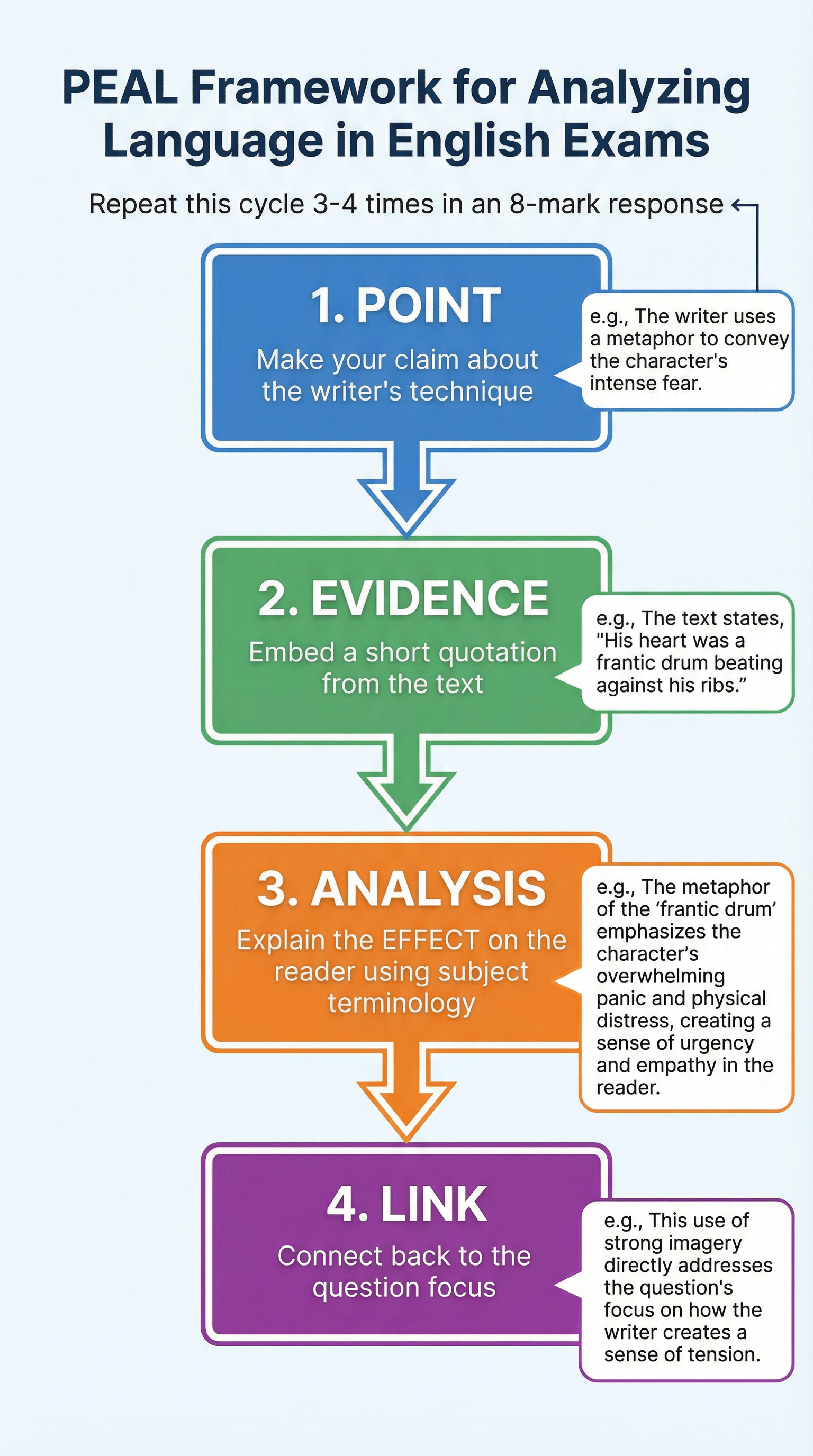
    This is where you move beyond what the text says to how it says it. You need to identify specific language features and, crucially, analyse their effect on the reader. Simply spotting a metaphor is not enough; you must explain why the writer chose that specific metaphor and what it makes the reader think, feel, or imagine. Use the PEAL framework to structure your analysis.
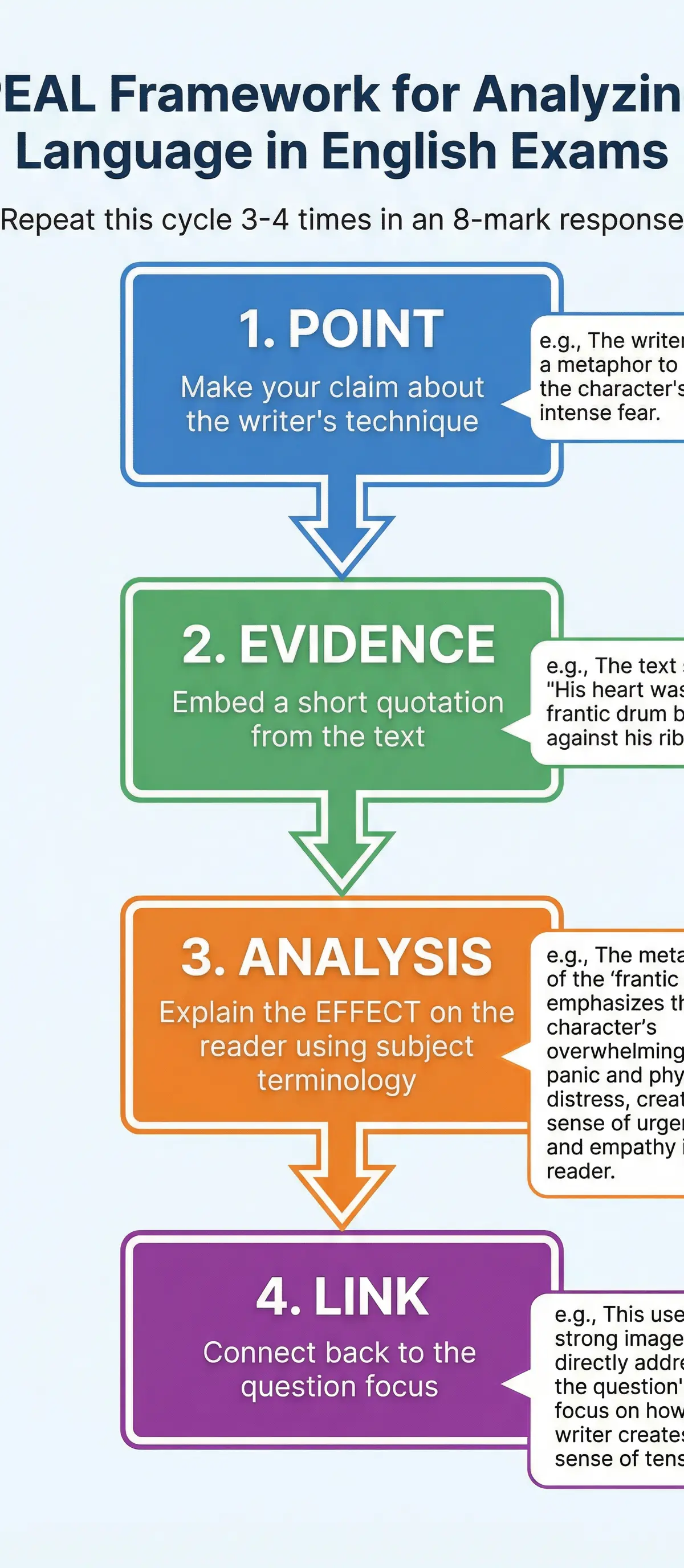
    analysis_framework.png

    Key Language Features to Identify

    FeatureDefinitionEffect on ReaderExample
    MetaphorA figure of speech where a word or phrase is applied to an object or action to which it is not literally applicable.Creates a powerful, often complex image in the reader's mind, adding layers of meaning."The classroom was a zoo."
    SimileA figure of speech involving the comparison of one thing with another thing of a different kind, used to make a description more emphatic or vivid (e.g., as brave as a lion).Makes a description more vivid and relatable by linking it to a familiar concept."He was as quiet as a mouse."
    Pathetic FallacyThe attribution of human feelings and responses to inanimate things or animals, especially in art and literature. Often used with weather.Creates a specific mood or atmosphere that reflects the emotional state of a character or the tone of the scene."The miserable rain fell, mirroring his despair."
    PersonificationThe attribution of a personal nature or human characteristics to something non-human.Brings an inanimate object to life, allowing the reader to connect with it on an emotional level."The wind whispered through the trees."
    AlliterationThe occurrence of the same letter or sound at the beginning of adjacent or closely connected words.Can create a specific sound effect (e.g., harsh or soft), draw attention to key words, and make a phrase more memorable."The slippery snake slithered silently."
    SibilanceA figure of speech in which a hissing sound is created within a group of words through the repetition of "s" sounds.Often creates a sinister, menacing, or soothing effect, depending on the context."The sea hissed and spat on the shore."
    JuxtapositionThe fact of two things being seen or placed close together with contrasting effect.Highlights the differences between two things, often to create a sense of conflict, irony, or drama."The pristine new houses overlooked the sprawling, polluted slums."
    Emotive LanguageWords and phrases deliberately chosen to make the reader feel a particular emotion.Aims to manipulate the reader's emotional response to persuade them or make them empathise with a character."The defenceless puppy was abandoned in the cold."

    Analysing Structure

    Structure refers to how a text is organised and put together. Examiners want to see that you can comment on the writer's structural choices and their impact on the overall meaning and effect. Consider:

    • Openings: How does the writer hook the reader in?
    • Shifts in Focus: Where does the narrative perspective or topic change, and why?
    • Sentence Length Variation: How are long, complex sentences contrasted with short, simple ones to control pace and tension?
    • Paragraph Structure: How are paragraphs used to group ideas or signal a change in time or place?
    • Cyclical Structure: Does the text end where it began? If so, what has changed?
    • Flashback/Foreshadowing: How does the writer manipulate time to build suspense or provide context?

    Evaluating Critically

    For higher marks, you need to evaluate how successfully the writer has used language and structure to achieve their purpose. This means forming a judgement and supporting it with evidence. Use phrases like, "The writer is highly effective in creating a sense of tension here..." or "To some extent, the writer's argument is convincing, but it is weakened by...". This shows you are an engaged and critical reader.

    Comparing Writers' Viewpoints

    In some questions, you will need to compare two texts. The key here is to focus on the writers' different perspectives and methods. Don't just list what each writer does. Directly compare them point-by-point. For example: "Whereas Writer A uses statistics to present a logical, factual argument, Writer B relies on emotive language to appeal to the reader's conscience."

    Writing Skills

    Creative Writing

    For narrative and descriptive tasks, the goal is to create a vivid and engaging world for your reader. The mantra is Show, Don't Tell. Instead of telling the reader a character is nervous, show them by describing their "trembling hands and a heart hammering against their ribs."

    • Sensory Description: Appeal to all five senses – sight, sound, smell, touch, and taste.
    • Varied Sentence Structures: Mix simple, compound, and complex sentences to create rhythm and pace.
    • Engaging Openings: Start with action, dialogue, or a mystery to hook the reader.
    • Satisfying Endings: Provide a sense of resolution, even if it's ambiguous.
    • One-Scene Rule: For short descriptive tasks, focus on a single moment in time. Don't try to tell a whole story.

    Transactional/Non-Fiction Writing

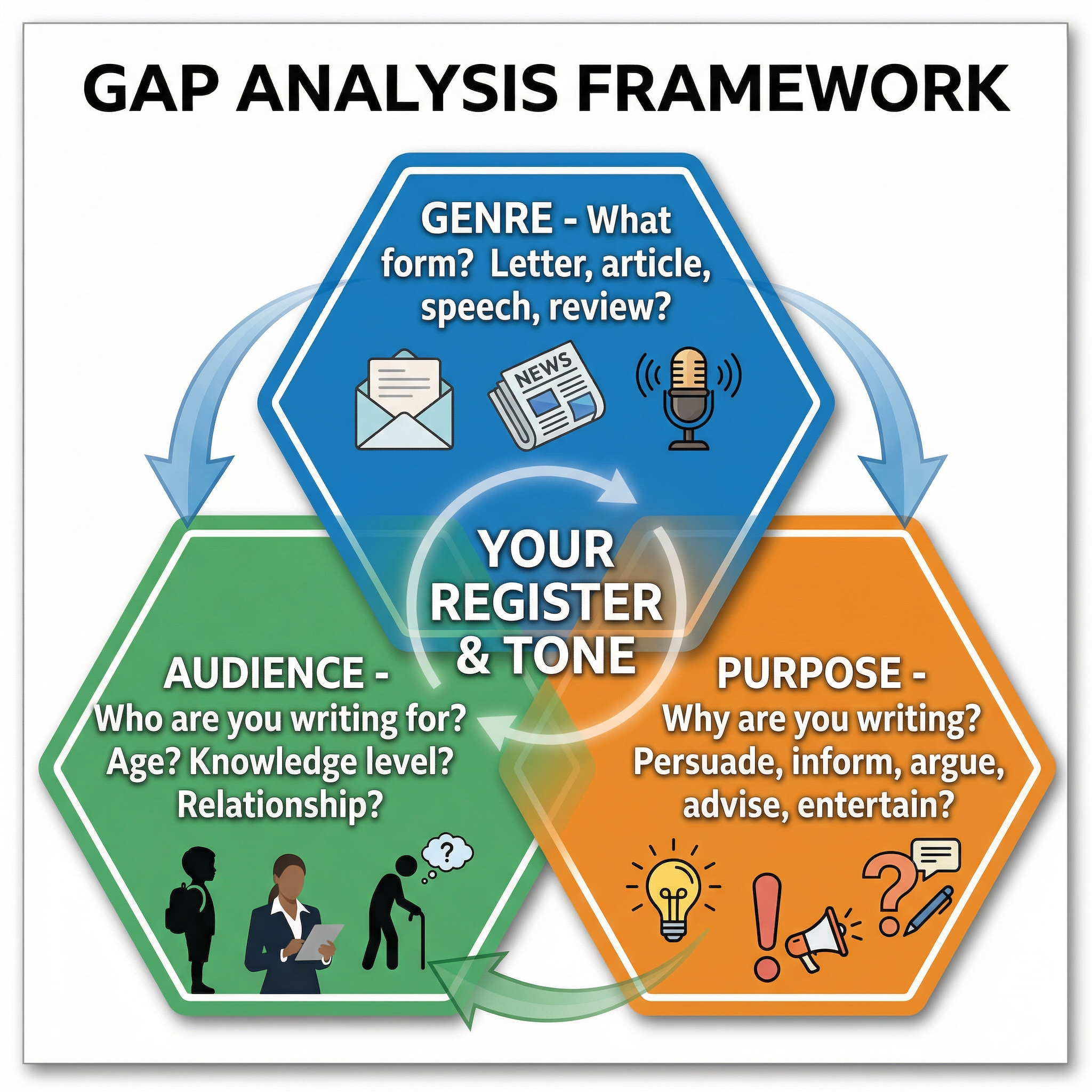
    This is where the GAP framework is your best friend. Before you write, you MUST identify your Genre, Audience, and Purpose. This will determine your register and tone.
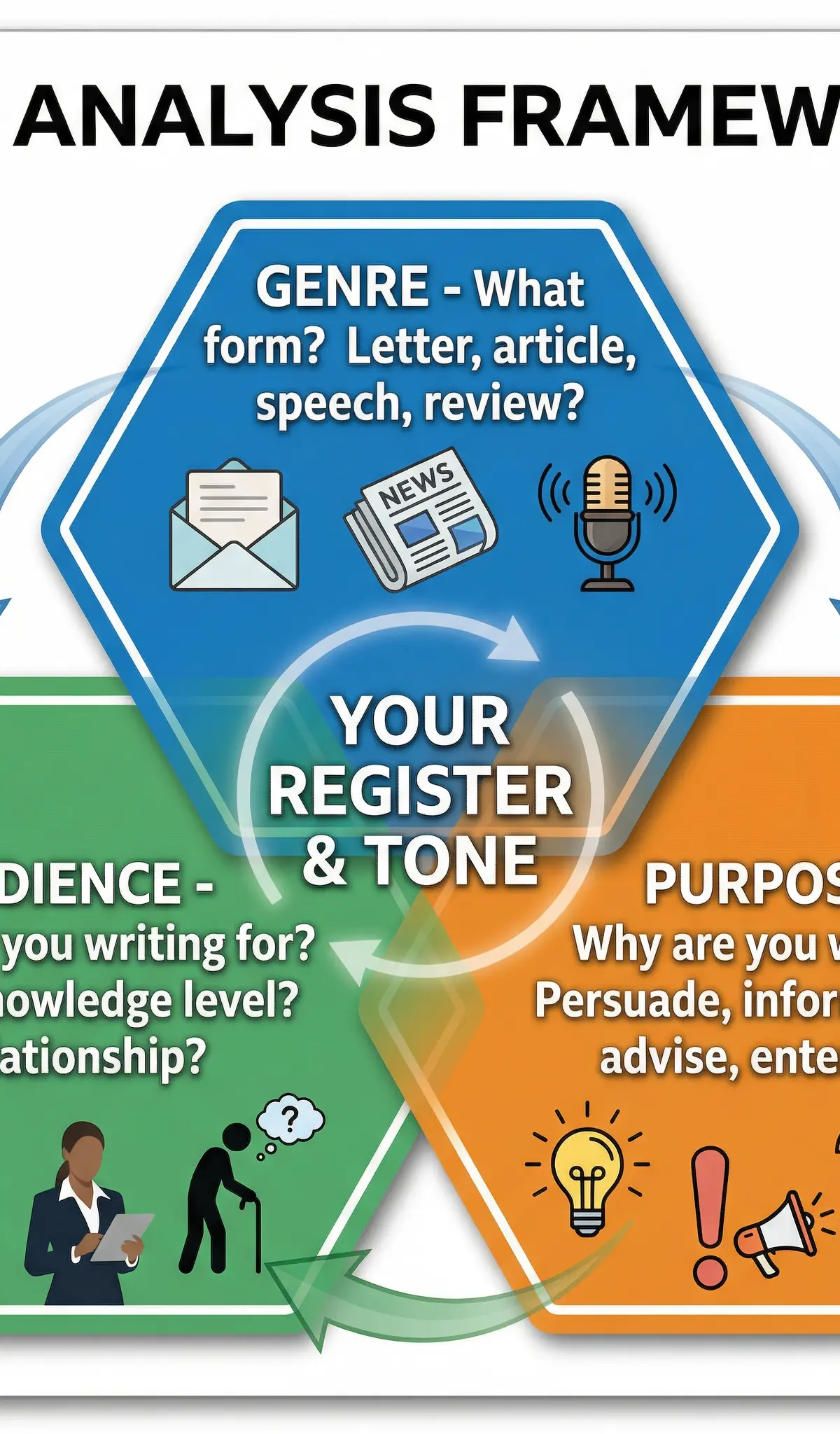
    gap_framework.png

    • Letters: Formal (Dear Sir/Madam, Yours faithfully) vs. Informal (Hi Tom, Best wishes).
    • Articles: A clear headline, a strapline, and an engaging, journalistic tone.
    • Speeches: Use rhetorical devices, direct address ("you"), and a clear sign-off.
    • Leaflets: Use subheadings, bullet points, and an informative, accessible tone.

    To make your writing persuasive, use the AFOREST mnemonic.

    Technical Accuracy (SPaG)

    Spelling, Punctuation, and Grammar (SPaG) are worth a significant number of marks (AO6). Poor accuracy can undermine an otherwise brilliant piece of writing. Aim to use ambitious punctuation correctly:

    • Semicolons (;): To link two closely related independent clauses.
    • Colons (:): To introduce a list, an explanation, or a quotation.
    • Dashes (-): To add dramatic emphasis or extra information.
    • Parenthetical Commas (, ,): To embed a subordinate clause within a sentence.
    Visual Resources

    2 diagrams and illustrations

    Diagram 1
    Diagram 2

    Worked Examples

    3 detailed examples with solutions and examiner commentary

    Practice Questions

    Test your understanding — click to reveal model answers

    Q1

    Question 1

    Q2

    Question 2

    Q3

    Write an article for your school website persuading students to take part in a fundraising event.",
    "marks": 24

    standard", "hint": "Remember GAP! Your audience is fellow students, your purpose is to persuade, and the genre is an online article. Use a friendly, enthusiastic tone and persuasive techniques (AFOREST).
    Q4

    Question 4

    Q5

    Question 5

    More English Language Study Guides

    View all

    Using Vocabulary and Sentence Structures

    OCR
    GCSE

    This guide focuses on mastering vocabulary and sentence structures for the OCR GCSE English Language exam. It covers how to analyse their effects in reading (AO2) and use them skilfully in writing (AO6) to maximise marks."

    Communicating Clearly and Effectively

    OCR
    GCSE

    This guide focuses on mastering OCR GCSE English Language Topic 2.4: Communicating Clearly and Effectively. It provides a comprehensive breakdown of the reading and writing skills required to excel in your exams, moving beyond simple feature-spotting to sophisticated analysis and production of language.

    Responding to Questions

    OCR
    GCSE

    This guide focuses on the core reading and writing skills for OCR GCSE English Language (J351). It breaks down how to analyse unseen texts for language and structure, evaluate writers' methods, compare perspectives, and produce high-impact creative and transactional writing under exam conditions.", "podcast_script": "OCR GCSE English Language: Responding to Questions - Educational Podcast Script Duration: Approximately 10 minutes Speaker: Female educator (warm, conversational, enthusiastic tone) [INTRO - 1 minute] Hello and welcome! I'm so glad you're here. Today we're diving into one of the most crucial skills for your OCR GCSE English Language exam: responding to questions effectively. Whether you're tackling Paper 1 or Paper 2, this skill is absolutely fundamental to your success. Now, I know what you might be thinking: "It's just answering questions, right? How hard can it be?" But here's the thing: the difference between a grade 5 and a grade 8 often comes down to how precisely you respond to what the examiner is actually asking. And that's exactly what we're going to master today. By the end of this session, you'll understand the key reading and writing skills tested in OCR English Language, you'll know exactly how to deconstruct different question types, and you'll have practical strategies to maximise your marks. So let's get started! [CORE CONCEPTS - 5 minutes] Let's begin with the foundation. OCR GCSE English Language is all about demonstrating your skills in reading and writing. Unlike English Literature, you're not analysing set texts or memorising quotes. Instead, you're showing examiners that you can read unseen texts critically and write with purpose and technical accuracy. The assessment objectives are your roadmap. AO1 is about identifying and synthesising information from texts. AO2 focuses on analysing how writers use language and structure. AO3 is all about comparing writers' viewpoints and perspectives. AO4 asks you to evaluate texts critically. And then we have AO5 and AO6 for your writing: AO5 rewards ambitious content and organisation, while AO6 assesses your technical accuracy—that's your spelling, punctuation, and grammar. Now, here's where candidates often go wrong: they treat every question the same way. But each question type demands a specific approach. Let me break this down for you. For reading questions, you need to master the "What-How-Why" framework. When a question asks you to analyse how a writer uses language, you can't just spot a metaphor and move on. That's what we call feature-spotting, and it won't get you beyond a Level 2. Instead, you need to identify WHAT technique the writer uses, quote it precisely and embed it in your sentence—that's the HOW—and then explain WHY it's effective, what impact it has on the reader. This is the difference between saying "the writer uses a metaphor" and saying "by describing the fog as a 'thick grey blanket, suffocating the city,' the writer creates a sense of oppression and claustrophobia, suggesting the city is being choked." Structure questions are another area where marks are lost. When you're asked about structure, the examiner wants you to discuss things like shifts in focus, changes in narrative perspective, sentence length variation, how the opening hooks the reader, or how the ending creates closure. Don't just retell the story—analyse the writer's structural choices and their effects. For comparison questions—and these are worth 10 marks on AO3—you must integrate your discussion. Don't write about Text A for three paragraphs and then Text B for three paragraphs. That's not comparison; that's two separate analyses. Instead, make conceptual links: both writers use emotive language, but Writer A employs it to evoke sympathy while Writer B uses it to provoke outrage. See the difference? Evaluation questions ask "to what extent do you agree" or "how far do you think the writer is successful." This is your chance to show critical thinking. Don't just agree with everything. A Level 4 response will offer a balanced view: "To some extent, the writer successfully creates tension through short, fragmented sentences. However, the reliance on clichéd imagery in the final paragraph undermines the overall impact." You're showing you can critique, not just summarise. Now let's talk about writing. Whether it's creative or transactional writing, the process is the same: plan, draft, and proofread. And I cannot stress this enough—planning is not optional. Five minutes spent planning will save you from rambling, repetitive writing. Identify your purpose, audience, and form. If you're writing a letter to your headteacher arguing for longer lunch breaks, your tone and vocabulary will be very different from a magazine article for teenagers on the same topic. For creative writing, remember the golden rule: show, don't tell. Don't write "she was angry." Write "her fists clenched, knuckles white, as she bit down on the words she wanted to scream." Use sensory details, vary your sentence structures, and create a compelling voice. For transactional writing, structure is king. Articles need headlines and subheadings. Speeches need direct address and rhetorical devices. Letters need formal openings and closings. And across all forms, use AFOREST: Alliteration, Facts, Opinions, Rhetorical questions, Emotive language, Statistics, and the rule of Three. These persuasive techniques will elevate your writing. [EXAM TIPS & COMMON MISTAKES - 2 minutes] Right, let's talk about the mistakes I see all the time—and how to avoid them. Mistake number one: not reading the question carefully. If the question says "analyse how the writer uses language in lines 10 to 20," don't analyse the whole text. You'll waste time and won't get extra marks. Be precise. Mistake number two: writing without a plan. I know you're under time pressure, but trust me, five minutes planning will result in a much stronger, more coherent response than 45 minutes of unplanned rambling. Mistake number three: feature-spotting. Saying "the writer uses alliteration" is not analysis. You need to explain the effect: "the sibilant sounds in 'slithering, silent serpent' create a sinister, threatening atmosphere." Mistake number four: not embedding quotations. Don't dump a long quote and then try to analyse it. Weave short, precise quotations into your own sentences. This shows you're in control of the evidence. Mistake number five: forgetting to proofread. Reserve five minutes at the end of the writing section to check for spelling errors, especially homophones like "their," "there," and "they're," and to fix any comma splices or run-on sentences. AO6 is worth 20% of your marks—don't throw those away. And here's a top tip for timing: you get roughly one mark per minute in English Language. A 4-mark question should take about 5 minutes. An 8-mark question, around 10 minutes. A 24-mark writing task, about 45 minutes including planning and proofreading. Stick to these timings and you won't run out of time. [QUICK-FIRE RECALL QUIZ - 1 minute] Alright, let's test your recall. I'll ask a question, and I want you to pause and answer it before I give you the answer. Ready? Question one: What does the acronym AFOREST stand for? [Pause] Answer: Alliteration, Facts, Opinions, Rhetorical questions, Emotive language, Statistics, and the rule of Three. Question two: What are the three steps in the What-How-Why analysis framework? [Pause] Answer: WHAT technique is used, HOW it's used—quote and embed it—and WHY it's effective, explaining the impact on the reader. Question three: How much time should you spend on a 24-mark writing question? [Pause] Answer: About 45 minutes, including 5 minutes for planning and 5 minutes for proofreading. Question four: Name two structural features you could analyse in a text. [Pause] Answer: Any two from: shifts in focus, changes in narrative perspective, sentence length variation, opening techniques, cyclical structure, use of flashback or foreshadowing, paragraph structure. Excellent! If you got those right, you're already on your way to exam success. [SUMMARY & SIGN-OFF - 1 minute] Let's recap what we've covered today. OCR GCSE English Language is all about demonstrating your reading and writing skills. For reading, use the What-How-Why framework, integrate your comparisons, and evaluate critically rather than just summarising. For writing, plan your response, match your tone to your audience and purpose, use persuasive techniques, and always proofread for technical accuracy. Remember: examiners reward precision, analysis, and technical control. Avoid feature-spotting, always embed your quotations, and manage your time carefully. You've got this. With practice and the right approach, you can absolutely achieve the grade you're aiming for. Keep practising, keep refining your skills, and remember—every mark counts. Thank you so much for listening, and best of luck with your revision. Now go and show those examiners what you're capable of! [END]"

    Writing for Audience, Purpose and Form

    OCR
    GCSE

    Writing for Audience, Purpose and Form is a core skill assessed in OCR GCSE English Language Component 02, Section B (Transactional Writing). Candidates must demonstrate sophisticated control of tone, register, and style (AO5) tailored precisely to the specified recipient, whether formal or informal, while maintaining technical accuracy (AO6). Mastering this skill is essential for earning top marks in the writing section.

    Organising Information and Ideas

    OCR
    GCSE

    This guide focuses on mastering AO5, the crucial skill of organising information and ideas for the OCR GCSE English Language exam. Candidates will learn to consciously structure their writing for sophistication and coherence, moving beyond simple sequencing to earn top marks."

    Evaluating Texts Critically

    OCR
    GCSE

    Evaluating Texts Critically is the cornerstone of Assessment Objective 4 (AO4) in OCR GCSE English Language, worth 20% of your overall grade. This skill requires you to form a critical judgement on how effectively a writer achieves specific effects through their choices of language, structure, and tone. Primarily assessed in Paper 2, Question 4, candidates must respond to a statement about a text and argue 'how far' they agree, using judicious evidence and evaluative language to demonstrate sophisticated literary judgement.