OCR · GCSE · English Language
Adapting Tone, Style and Register
Adapting tone, style, and register is a core skill in OCR GCSE English Language, tested across both Component 01 (fiction reading) and Component 02 (non-fiction reading and transactional writing). Candidates must analyse how writers manipulate these elements to influence readers (AO2) and demonstrate their own ability to adapt voice for specific audiences and purposes (AO5, worth 30% of total marks)."
- 16 min read
- 3 worked examples
- 5 practice questions
Study Notes

Overview
In OCR GCSE English Language (J351), tone, style, and register are not abstract literary concepts — they are practical tools that writers use to connect with their audience and achieve their purpose. Whether you're analysing an extract from a 19th-century novel in Component 01 or writing a persuasive article for Component 02, your ability to identify, analyse, and adapt these elements will determine your success.
Tone refers to the writer's attitude or emotional stance towards the subject matter and reader. It might be serious, humorous, sarcastic, sympathetic, indignant, nostalgic, or didactic. Tone is created through word choice, sentence structure, and the cumulative effect of language features.
Style is the writer's distinctive approach to communication, encompassing vocabulary sophistication, sentence complexity, use of figurative language, and overall aesthetic. A tabloid journalist has a very different style from a broadsheet columnist, even when covering the same story.
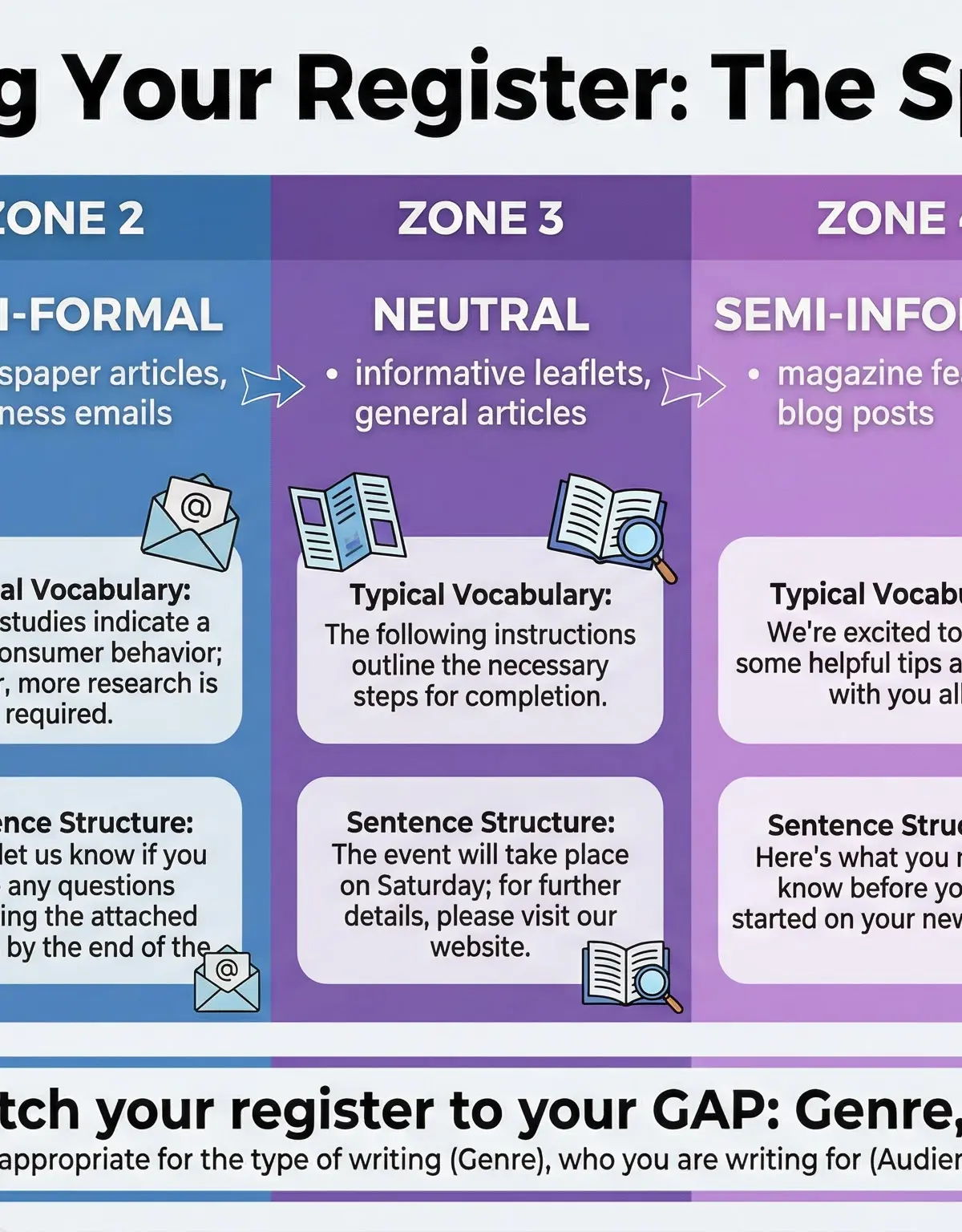
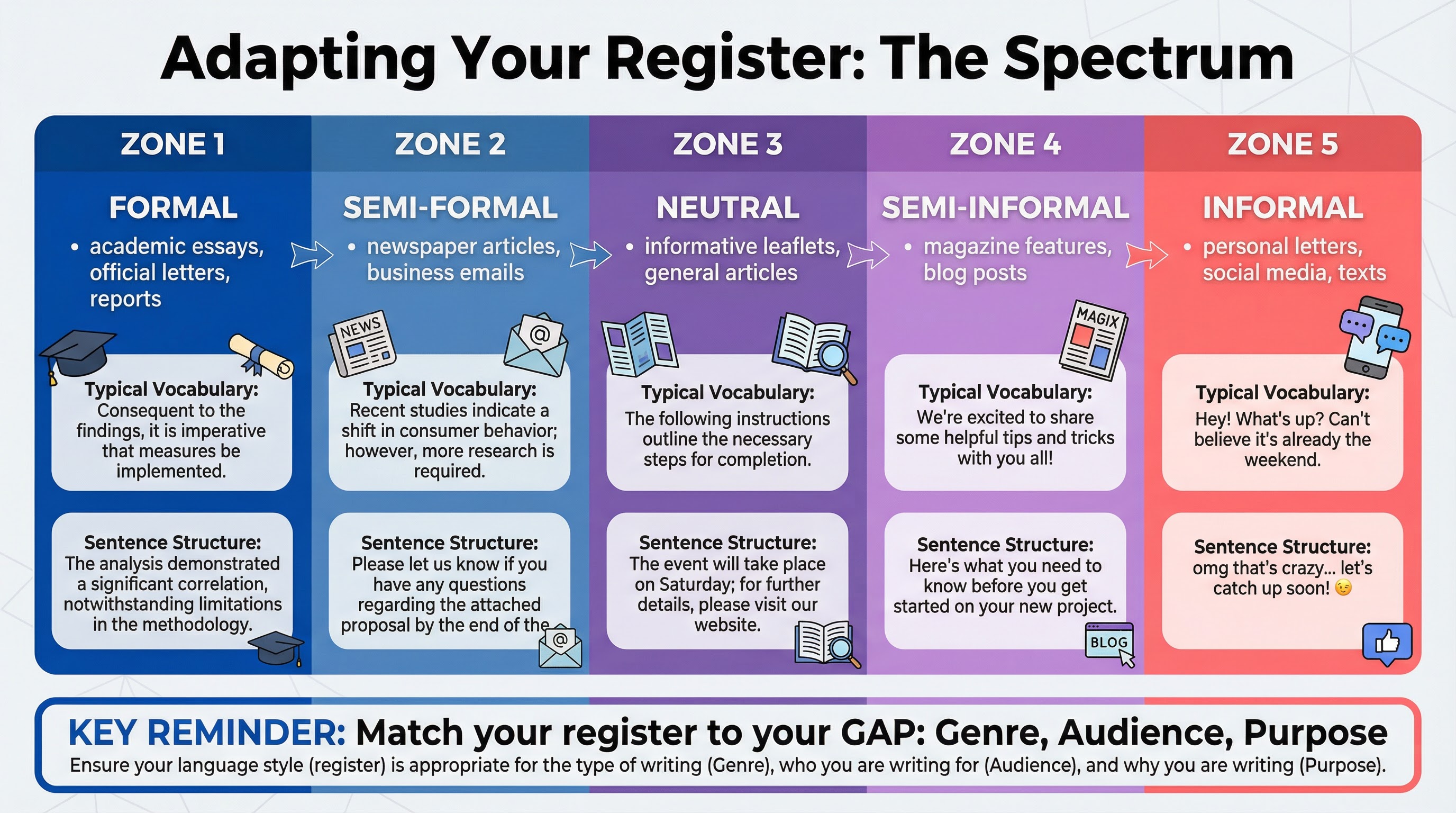
Register is the level of formality in language, ranging from highly formal (academic essays, official correspondence) through semi-formal (newspaper articles, business emails) to informal (personal letters, social media posts). Register is determined by lexical choices, grammatical structures, and adherence to standard conventions.
In the exam, you face a dual challenge. In reading questions, you must identify how writers use tone, style, and register to achieve specific effects on their audience. In writing tasks, you must consciously adapt your own tone, style, and register to suit the Genre, Audience, and Purpose (GAP) specified in the question. This skill accounts for 30% of your total marks through AO5 (Content and Organisation) and significantly influences AO2 (Analysis) marks in reading responses.
Reading Skills: Analysing Tone, Style, and Register
Identifying Tone in Texts
Examiners reward candidates who move beyond generic descriptions like "the tone is good" or "the writing flows well." Instead, you must use precise, sophisticated vocabulary to describe tone. Consider this spectrum of tonal descriptors:
| Tone Category | Precise Descriptors | Typical Context |
|---|---|---|
| Serious/Formal | Authoritative, didactic, solemn, grave, sombre, austere | Academic writing, official reports, serious journalism |
| Critical/Negative | Sardonic, contemptuous, indignant, scathing, derisive, caustic | Opinion pieces, satirical writing, critical reviews |
| Emotional/Personal | Melancholic, nostalgic, wistful, poignant, elegiac, emotive | Memoirs, personal essays, charity appeals |
| Positive/Engaging | Enthusiastic, optimistic, celebratory, ebullient, effusive | Promotional material, inspirational speeches |
| Neutral/Detached | Objective, dispassionate, clinical, matter-of-fact, impartial | News reports, scientific writing, informative texts |
| Humorous | Satirical, ironic, whimsical, playful, tongue-in-cheek | Comedy writing, light-hearted features |
When analysing tone, always ask: What is the writer's attitude towards the subject? How does the writer want the reader to feel? Then, identify the specific language choices that create this tone.
Analysing Language Features That Create Tone
Tone is not created by a single technique — it emerges from the cumulative effect of multiple language choices. Here are key features to identify:
| Feature | Definition | Effect on Tone | Example |
|---|---|---|---|
| Lexical Choice | The specific words a writer selects | Formal vocabulary creates an authoritative tone; colloquial language creates an informal, accessible tone | "Commence" vs "start"; "offspring" vs "kids" |
| Connotation | The emotional associations of words beyond their literal meaning | Positive connotations create an optimistic tone; negative connotations create a critical or pessimistic tone | "Slim" (positive) vs "scrawny" (negative) |
| Emotive Language | Words deliberately chosen to provoke an emotional response | Creates a passionate, persuasive, or sympathetic tone | "Heartbreaking", "devastating", "inspiring" |
| Figurative Language | Metaphors, similes, personification | Can create vivid, dramatic, poetic, or humorous tones depending on the imagery | "The city was a concrete jungle" (harsh tone) |
| Hyperbole | Deliberate exaggeration for effect | Often creates a humorous, satirical, or emphatic tone | "I've told you a million times!" |
| Rhetorical Questions | Questions asked for effect, not requiring an answer | Creates an engaging, challenging, or persuasive tone | "How can we stand by and do nothing?" |
| Repetition | Repeating words or phrases for emphasis | Creates an emphatic, passionate, or insistent tone | "We must act. We must act now. We must act together." |
| Sentence Length | Varying or controlling sentence length | Short sentences create urgency or tension; long, complex sentences create a formal, thoughtful tone | "Stop. Listen. Think." vs elaborate, subordinated structures |

The PEAL Framework for Analysis
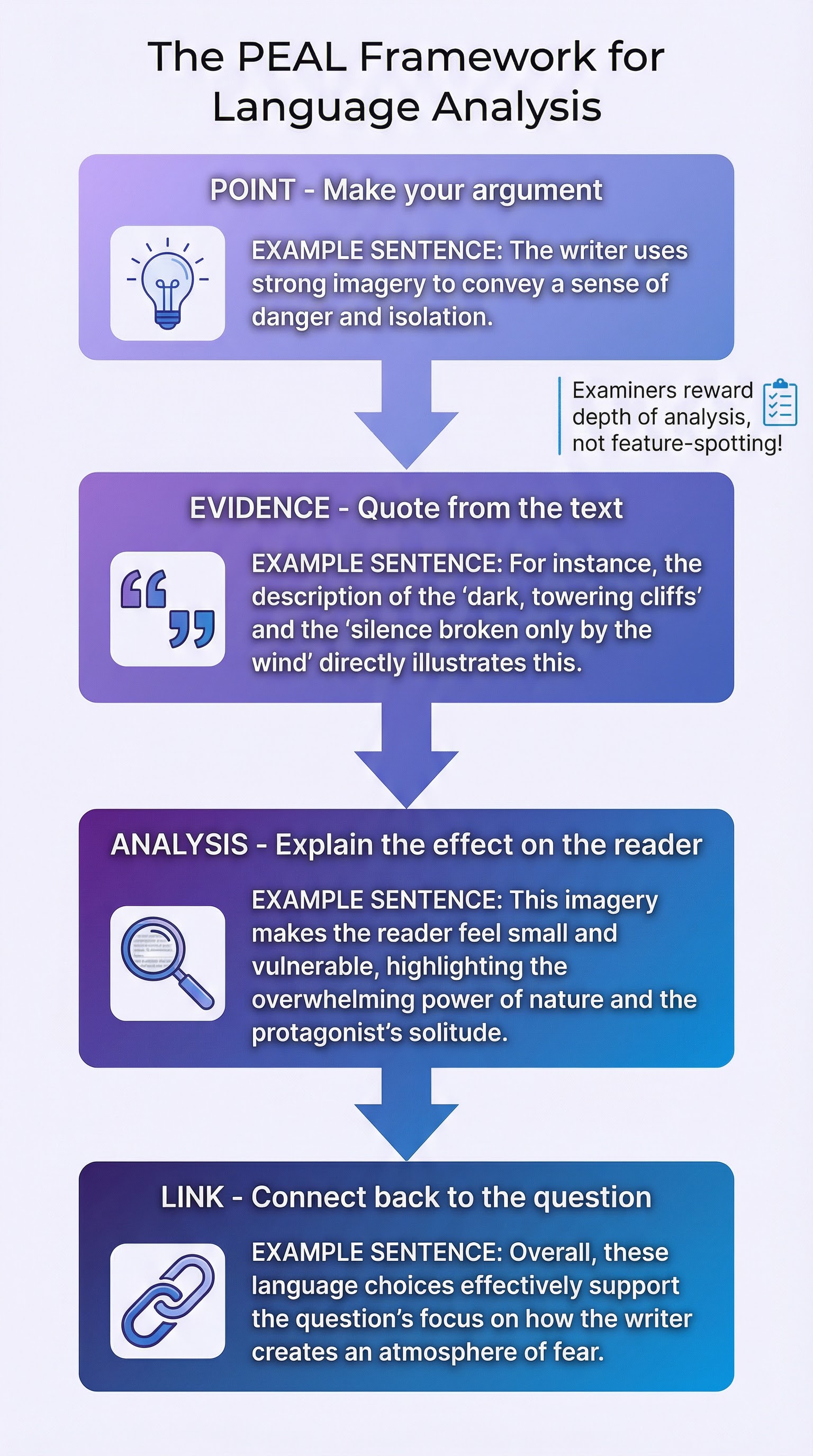
To earn top marks in reading analysis, structure your responses using the PEAL framework:
P - Point: Make a clear argument about the tone, style, or register and its effect.
E - Evidence: Provide a short, embedded quotation that illustrates your point.
A - Analysis: Explain how the language creates the effect and why the writer chose this approach. This is where you demonstrate perceptive understanding.
L - Link: Connect your analysis back to the question focus, showing how this contributes to the writer's overall purpose.
Examiners specifically look for the word "perceptive" when awarding top-band marks. This means going beyond surface-level observations to explain the deeper implications of language choices.
Identifying Tone Shifts
Sophisticated writers rarely maintain a single tone throughout a text. They shift tone strategically to maintain reader engagement and achieve different purposes within the same piece. Common tone shifts include:
- Humorous to serious: Hook the reader with an entertaining anecdote, then shift to a more earnest tone when presenting the main argument
- Objective to emotive: Begin with factual information to establish credibility, then shift to emotional language to persuade
- Optimistic to cautionary: Present positive possibilities, then shift to warn of consequences if action is not taken
- Personal to universal: Start with an individual story, then broaden to address wider societal issues
When you identify a tone shift, always explain where it occurs, how you know it has shifted (specific language changes), and why the writer makes this choice (the intended effect on the reader).
Analysing Register
Register is determined by several linguistic features:
-
Lexical formality: Formal register uses Latinate vocabulary ("commence", "utilise", "endeavour"), while informal register uses Anglo-Saxon alternatives ("start", "use", "try")
-
Grammatical structures: Formal register employs complex sentences with subordination; informal register uses simple, compound sentences and fragments
-
Contractions: Formal register avoids contractions ("do not", "cannot"); informal register embraces them ("don't", "can't")
-
Personal pronouns: Formal register often uses third person or passive voice; informal register uses first and second person ("I", "you")
-
Colloquialisms and slang: Formal register avoids these entirely; informal register may include them for authenticity
Comparing Tone, Style, and Register Across Texts
In Component 02, Question 3 requires you to compare how two writers convey their perspectives on a similar theme. This is where your understanding of tone, style, and register becomes crucial. Use this framework:
Step 1: Identify the tone of Text A (e.g., "Text A adopts an indignant, confrontational tone")
Step 2: Identify the tone of Text B (e.g., "In contrast, Text B uses a measured, persuasive tone")
Step 3: Compare the effectiveness of these different approaches (e.g., "While Text A's anger may alienate moderate readers, Text B's reasoned approach is more likely to convince a sceptical audience")
Always use comparative discourse markers: "whereas", "in contrast", "similarly", "conversely", "on the other hand".
Writing Skills: Adapting Your Own Tone, Style, and Register
The GAP Framework
Before you write a single word in your exam, identify the GAP:
G - Genre: What type of text are you writing? Each genre has specific conventions:
- Letter: Formal greeting ("Dear Sir/Madam") or informal ("Dear Sam"), appropriate sign-off, address if formal
- Article: Engaging headline, subheadings, direct address to reader, paragraphs with clear topic sentences
- Speech: Direct address ("Ladies and gentlemen", "Fellow students"), rhetorical devices, conversational tone
- Leaflet: Clear headings, bullet points for key information, persuasive language, call to action
- Essay: Formal register, structured argument, topic sentences, evidence-based reasoning
A - Audience: Who are you writing for? Your register MUST match your audience:
- Teenagers: Semi-informal register, contemporary references, engaging tone, avoid patronising language
- Adults (general): Neutral to semi-formal register, respectful tone, assume some prior knowledge
- Authority figures (headteacher, local councillor): Formal register, respectful tone, structured argument
- Specific individual: Adapt to relationship (formal for professional, informal for friend/family)
P - Purpose: Why are you writing? Your purpose determines your tone:
- Persuade: Passionate, urgent, or authoritative tone; use rhetorical devices (AFOREST)
- Argue: Balanced but assertive tone; acknowledge counterarguments; use logical connectives
- Inform: Clear, neutral tone; factual language; organised structure
- Advise: Supportive, encouraging tone; second person address; modal verbs ("you should", "you could")
- Entertain: Engaging, possibly humorous tone; varied sentence structures; vivid description
Maintaining Register Consistency
One of the most common mistakes that costs candidates marks is register slips — accidentally mixing formal and informal language within the same piece. Consider this example:
"Furthermore, the evidence demonstrates that kids shouldn't be allowed to use their phones in class because it's well annoying and they can't concentrate properly."
This sentence contains register slips:
- "Furthermore" and "demonstrates" are formal
- "kids" is informal (should be "students" or "pupils" in formal register)
- "well annoying" is colloquial (should be "highly distracting")
- "can't" is a contraction (should be "cannot" in formal register)
A consistent formal register would be:
"Furthermore, the evidence demonstrates that students should not be permitted to use mobile phones in class, as this is highly distracting and impairs their ability to concentrate."
A consistent informal register would be:
"Plus, it's pretty obvious that kids shouldn't be on their phones in lessons because it's really distracting and they can't focus."
Both are acceptable — the key is consistency.
AFOREST: Persuasive Techniques for Transactional Writing
When your purpose is to persuade, use the AFOREST framework to structure your language choices:
A - Alliteration: Repetition of initial consonant sounds for emphasis and memorability ("Stop the senseless suffering")
F - Facts: Concrete, verifiable information to establish credibility ("According to recent research, 73% of teenagers...")
O - Opinions: Your viewpoint, presented assertively ("It is clear that immediate action is required")
R - Rhetorical Questions: Questions that engage the reader and guide them towards your viewpoint ("How can we justify this injustice?")
E - Emotive Language: Words chosen to provoke an emotional response ("heartbreaking", "inspiring", "devastating")
S - Statistics: Numerical data to support your argument ("Research shows that 8 out of 10 experts agree...")
T - Three (Rule of): Grouping ideas in threes for rhythm and impact ("We must act now. We must act together. We must act decisively.")
Crafting an Appropriate Opening
Your opening sentence establishes your tone and register. Compare these openings for an article arguing that school uniform should be abolished:
Formal register: "The question of whether school uniform remains a necessary component of contemporary education has become increasingly contentious in recent years."
Semi-formal register: "School uniform has long been a topic of debate among students, parents, and educators alike."
Semi-informal register (appropriate for a student magazine): "Let's be honest: nobody actually enjoys wearing school uniform, do they?"
Each opening is appropriate for a different audience and publication. The key is to identify your GAP and commit to a register from the first sentence.
Proofreading for Register
In the final 5 minutes of your writing time, proofread specifically for register consistency. Check:
- Vocabulary: Are all your word choices at the same level of formality?
- Contractions: Have you used them consistently (informal) or avoided them entirely (formal)?
- Pronouns: Is your use of first/second/third person appropriate for your register?
- Sentence structures: Do they match your intended formality level?
- Colloquialisms: Have any slang terms crept in where they shouldn't be?
Exam Technique
Time Management
Component 01 (Fiction Reading and Creative Writing): 2 hours
- Section A (Reading): 60 minutes for 40 marks (approximately 1.5 minutes per mark)
- Section B (Creative Writing): 60 minutes for 40 marks
Component 02 (Non-Fiction Reading and Transactional Writing): 2 hours
- Section A (Reading): 60 minutes for 40 marks
- Section B (Transactional Writing): 60 minutes for 40 marks
For tone/style/register analysis questions (typically 8-10 marks), allocate 10-15 minutes including reading time.
For transactional writing tasks (24 marks for content and organisation, 16 marks for technical accuracy), allocate:
- 5 minutes: Planning (identify GAP, plan register, outline structure)
- 40 minutes: Writing
- 5 minutes: Proofreading (focus on register consistency and SPaG)
Question Approach by Command Word
"How does the writer use language to..." (AO2 - typically 8 marks)
- Identify the specific focus in the question (e.g., "create tension", "present the character", "influence the reader")
- Select 3-4 quotations that demonstrate different language techniques
- Use PEAL for each point: identify the technique, embed a short quotation, analyse the effect, link to the question
- Use sophisticated vocabulary to describe tone and effect
- Consider cumulative effects — how do multiple techniques work together?
"How does the writer use structure to..." (AO2 - typically 8 marks)
- Consider structural features: opening, shifts in focus, perspective changes, sentence length variation, paragraph structure, cyclical structure, foreshadowing, flashback
- Identify where the structural choice occurs ("At the opening...", "In the third paragraph, the writer shifts...")
- Explain how this structural choice creates tone or emphasis
- Link to the overall effect on the reader
"Evaluate how successfully the writer..." (AO4 - typically 20 marks)
- This requires critical judgement, not just analysis
- Consider both strengths and limitations of the writer's approach
- Use phrases like "To some extent...", "While the writer successfully...", "However, one might argue..."
- Evaluate the effectiveness of tone, style, and register in achieving the writer's purpose
- Support all judgements with embedded quotations
"Compare how the two writers convey..." (AO3 - typically 14 marks)
- Identify the viewpoint/perspective in each text
- Compare the tone used by each writer ("Text A adopts an indignant tone, whereas Text B uses a measured, persuasive approach")
- Compare the register and style
- Evaluate which approach is more effective and why
- Use comparative discourse markers throughout
"Write a [text type] in which you..." (AO5 & AO6 - 24 marks + 16 marks)
- Identify GAP before planning
- Decide on your register and write this at the top of your plan
- Plan your structure (opening hook, 3-4 developed points, satisfying conclusion)
- Write with your audience in mind — adapt your tone and vocabulary
- Use AFOREST techniques if persuading
- Vary sentence structures for effect
- Proofread for register consistency and technical accuracy
Common Pitfalls to Avoid
-
Feature-spotting without analysis: Saying "the writer uses a metaphor" earns no marks. You must explain the effect of the metaphor on tone and reader response.
-
Using generic, vague descriptions: "The tone is interesting" or "the style is effective" are meaningless. Use precise vocabulary.
-
Long, unembedded quotations: Don't copy out whole sentences. Select short, relevant phrases and embed them grammatically in your own sentences.
-
Retelling the text instead of analysing: Examiners know what the text says. They want to know what you think about how it's written.
-
Register slips in writing: Mixing formal and informal language in the same piece. Proofread specifically for this.
-
Ignoring the specified audience: Writing in the same way regardless of whether your audience is teenagers or the local council.
-
Writing without planning: Especially in transactional writing, 5 minutes of planning saves you from structural problems and register inconsistency.
-
Neglecting to proofread: The final 5 minutes can gain you several marks by catching errors and register slips.
Listen to the 10-minute study podcast above for a comprehensive audio overview of this topic, including exam strategies and common mistakes to avoid."
Worked Examples
3 worked examples — open one to explore the question and available guidance.
Practice Questions
Test your understanding — click to reveal model answers
Read the following opening from a charity appeal letter. Identify two ways the writer uses language to create an emotive tone. [4 marks]
Extract: 'Every night, thousands of children go to bed hungry, their small stomachs aching with emptiness. For just £3 a month, you could change a child's life forever.'
Hint: Look for specific word choices that are designed to make the reader feel sympathy or concern. Consider adjectives, verbs, and phrases that emphasise suffering or vulnerability.
How does the writer use language to create a humorous tone in this extract from a travel article? [8 marks]
Extract: 'I'd been promised a "rustic retreat" — what I got was a shed with delusions of grandeur. The "en-suite bathroom" turned out to be a bucket behind a curtain, while the "gourmet dining experience" consisted of a microwave and a prayer.'
Hint: Consider how the writer uses contrast between expectation and reality. Look at the quotation marks around certain phrases and what this suggests. Think about the use of exaggeration and personification.
You are a student representative. Write a letter to your headteacher suggesting improvements to the school canteen. Adapt your tone, style, and register appropriately. [24 marks]
Hint: This requires formal register (you're writing to an authority figure) but a respectful, constructive tone (you're making suggestions, not complaints). Use formal letter conventions: your address, date, their address, formal greeting, formal sign-off. Make specific, practical suggestions and explain their benefits.
Compare how the two writers convey their different attitudes towards social media. [14 marks]
Text A: 'Social media has revolutionised human connection. Never before have we been able to maintain friendships across continents, share ideas instantaneously, or mobilise communities for social change with such ease and efficiency.'
Text B: 'We've traded genuine human connection for a pale digital imitation. Behind the carefully curated posts and filtered selfies lies a generation more isolated, anxious, and disconnected than ever before.'
Hint: Identify the contrasting attitudes (Text A is positive about social media's benefits; Text B is critical of its negative effects). Compare the tone of each text. Look at lexical choices, metaphors, and how each writer presents their perspective. Use comparative discourse markers throughout.
Write an article for a broadsheet newspaper in which you argue that young people today face more pressure than previous generations. [24 marks]
Hint: Broadsheet newspaper = formal to semi-formal register, sophisticated vocabulary, complex sentences, balanced argument acknowledging counterarguments. Your audience is educated adults, so avoid oversimplification. Use AFOREST techniques but in a measured, authoritative way rather than overly emotive.
Test your understanding of Adapting Tone, Style and Register
Active recall beats re-reading. Take an instant quiz now to test what you’ve learned and lock it into long-term memory.
7 days Premium · Then free forever · No card, no charge