Pearson Edexcel · GCSE · English Language
Course version: 1EN0 · Version from Mar 2026
AO1: Identify and interpret explicit and implicit information and ideas;…
Full specification wording
Assessment Objectives: AO1: Identify and interpret explicit and implicit information and ideas; Select and synthesise evidence from different texts
AO1 covers two linked skills.
Checked against the Pearson Edexcel 1EN0 specification (opens in a new tab) on .
- Point 1 of 9
- 4 key terms
Study notes
From the checked teaching notes for this specification point.
The idea
AO1 covers two linked skills. First, you retrieve what a text states directly (explicit) and work out what is suggested but not stated (implicit), such as a character's fear shown through hesitation rather than named emotion. Second, when two texts are set together, you choose relevant evidence from each and combine it into a coherent whole, showing where the texts agree, differ or add to each other. For example, if Text A says a city is crowded and Text B describes its quiet parks, synthesis might state that both present the city as varied, supporting this with one quotation from each. Interpretation means explaining what the evidence shows, not just copying it.
What earns the marks
- Locates explicit information accurately, for example a stated fact, name, place or event, and uses it to answer the question directly.
- Interprets implicit meaning by inferring ideas, attitudes or feelings from details such as word choice, actions or tone, and explains how the inference is reached.
- Selects concise, relevant evidence rather than copying long sections, choosing quotations or close references that best support the point being made.
- Synthesises material from different texts by grouping related ideas, comparing viewpoints and combining evidence into a unified response rather than treating each text separately.
- Maintains focus on the question throughout, avoiding retelling the whole text and keeping interpretation linked to the stated focus.
Common mistakes and how to put them right
Copying long chunks of the text instead of selecting short, relevant evidence.
Put it right: Choose a brief quotation or line reference and then explain what it shows.
Treating inference as guesswork by asserting an idea with no textual basis.
Put it right: Anchor every inference in a specific detail from the text.
Writing about each text in separate paragraphs with no connection.
Put it right: Organise by idea and draw evidence from both texts within the same point.
Exam tips
- Read the question first, then read the texts with that focus, underlining only details that answer it.
- Use short embedded quotations and follow each with an explanatory clause beginning 'which suggests' or 'this implies'.
- When two texts are provided, plan briefly by listing shared and differing ideas before writing, so synthesis is built into your structure.
Try the lesson
The start of the Assessment Objectives: AO1: Identify and interpret explicit and implicit information and ideas; Select and synthesise evidence from different texts lesson, made from checked teaching notes for this specification point.
Have a go first
Which of these is an example of explicit information in a text?
Listen
AO1 covers two linked skills. First, you retrieve what a text states directly (explicit) and work out what is suggested but not stated (implicit), such as a character's fear shown through hesitation rather than named emotion. Second, when two texts are set together, you choose relevant evidence from each and combine it into a coherent whole, showing where the texts agree, differ or add to each other. For example, if Text A says a city is crowded and Text B describes its quiet parks, synthesis might state that both present the city as varied, supporting this with one quotation from each. Interpretation means explaining what the evidence shows, not just copying it. A strong answer earns marks for these points. Locates explicit information accurately, for example a stated fact, name, place or event, and uses it to answer the question directly. Interprets implicit meaning by inferring ideas, attitudes or feelings from details such as word choice, actions or tone, and explains how the inference is reached. Selects concise, relevant evidence rather than copying long sections, choosing quotations or close references that best support the point being made. Synthesises material from different texts by grouping related ideas, comparing viewpoints and combining evidence into a unified response rather than treating each text separately. A common slip: Copying long chunks of the text instead of selecting short, relevant evidence. Instead, choose a brief quotation or line reference and then explain what it shows. Exam tip: Read the question first, then read the texts with that focus, underlining only details that answer it.
See it
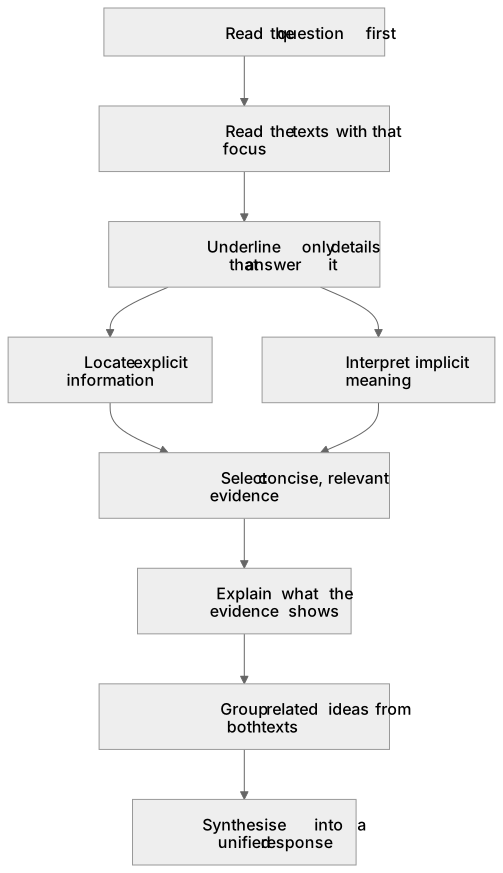
Key words
Say what each word means before you turn the card.
Explicit retrieval
Try answering aloud or in your head before turning the card.
Inference and interpretation
Try answering aloud or in your head before turning the card.
Evidence selection
Try answering aloud or in your head before turning the card.
Synthesis across texts
Try answering aloud or in your head before turning the card.
See every definition
- Explicit retrieval
- Locating information that a text states directly, such as a stated fact, name, place or event, and using it to answer the question directly.
- Inference and interpretation
- Working out ideas, attitudes or feelings that are suggested but not stated, and explaining what the evidence shows rather than just copying it.
- Evidence selection
- Choosing concise, relevant evidence such as brief quotations or close references that best support the point being made, rather than copying long sections.
- Synthesis across texts
- Combining material from different texts by grouping related ideas, comparing viewpoints and drawing evidence from both texts within the same point.
Label the diagram
Some boxes have lost their names. Pick the right name for each number.
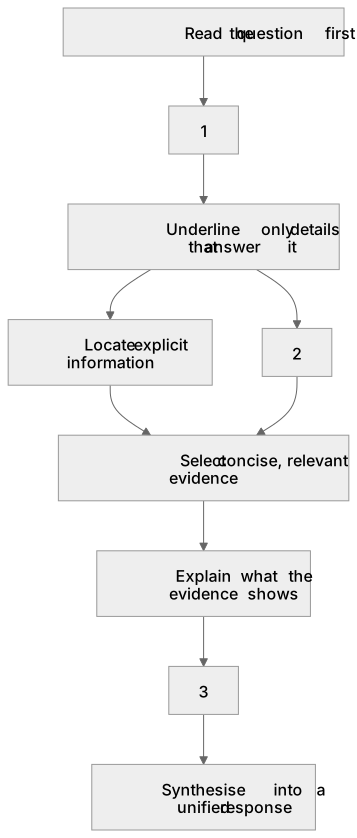
1Box 1
2Box 2
3Box 3
There is more to this lesson
The full lesson goes on to check your understanding and help you earn the marks. Create a free account to carry on, with your progress saved.
A week of Premium from your first lesson · Then the free plan continues · No card, no charge
Test your understanding of Assessment Objectives: AO1: Identify and interpret explicit and implicit information and ideas; Select and synthesise evidence from different texts
Active recall beats re-reading. Take an instant quiz now to test what you’ve learned and lock it into long-term memory.
A week of Premium from your first lesson · Then the free plan continues · No card, no charge