Pearson Edexcel · GCSE · English Language
Course version: 1EN0 · Version from Mar 2026
AO2: Explain, comment on and analyse how writers use language and…
Full specification wording
Assessment Objectives: AO2: Explain, comment on and analyse how writers use language and structure to achieve effects and influence readers, using relevant subject terminology to support their views
AO2 asks you to move beyond spotting features and explain how a writer's choices create effects on the reader.
Checked against the Pearson Edexcel 1EN0 specification (opens in a new tab) on .
- Point 2 of 9
- 4 key terms
Study notes
From the checked teaching notes for this specification point.
The idea
AO2 asks you to move beyond spotting features and explain how a writer's choices create effects on the reader. Language covers word classes, imagery, figurative devices and connotation; structure covers sentence forms, paragraphing, openings and endings, shifts in focus, and patterns across a text. Analysis means zooming in on a specific choice, exploring its connotations, and linking it to the writer's purpose or the reader's response. For example, a short minor sentence after long descriptive sentences can jolt the reader, mirroring a character's shock. Relevant subject terminology, such as metaphor, sibilance, caesura or cyclical structure, should be used precisely to support your point, not listed for its own sake.
What earns the marks
- Explains how a specific language choice, such as a verb, adjective or image, creates a particular effect or association for the reader.
- Comments on structural choices, including sentence length, paragraphing, narrative perspective or shifts in time and focus, and links them to meaning.
- Analyses rather than identifies, exploring connotations and layers of meaning in a quotation and connecting them to the writer's intentions.
- Uses subject terminology accurately and selectively, applying terms such as semantic field, juxtaposition or anaphora only where they clarify the analysis.
- Supports views with well-chosen textual evidence, embedding quotations smoothly and explaining how each supports the interpretation offered.
Common mistakes and how to put them right
Feature spotting, where a device is named but no effect is explained.
Put it right: State what the device does and how it shapes the reader's understanding.
Retelling the plot or paraphrasing the quotation instead of analysing the writer's methods.
Put it right: Focus on word-level choices and their connotations.
Using terminology incorrectly, such as calling repetition 'alliteration' or a simile a 'metaphor'.
Put it right: Check definitions and apply terms only when certain.
Exam tips
- Choose two or three rich quotations and analyse them deeply rather than commenting briefly on many.
- Build analysis with the sequence: choice, connotation, effect, link to purpose or reader.
- Comment on structure by tracking a pattern across the whole text, such as how the opening image returns changed at the end.
Try the lesson
The start of the Assessment Objectives: AO2: Explain, comment on and analyse how writers use language and structure to achieve effects and influence readers, using relevant subject terminology to support their views lesson, made from checked teaching notes for this specification point.
Have a go first
Read this extract from the end of a chapter. The narrator has just described a long, noisy chase through crowded streets. The final paragraph reads: 'The crowd roared behind me. My lungs burned. My legs kept moving. Then everything stopped.' What is the most likely effect of the final short sentence in this context?
Listen
AO2 asks you to move beyond spotting features and explain how a writer's choices create effects on the reader. Language covers word classes, imagery, figurative devices and connotation; structure covers sentence forms, paragraphing, openings and endings, shifts in focus, and patterns across a text. Analysis means zooming in on a specific choice, exploring its connotations, and linking it to the writer's purpose or the reader's response. For example, a short minor sentence after long descriptive sentences can jolt the reader, mirroring a character's shock. Relevant subject terminology, such as metaphor, sibilance, caesura or cyclical structure, should be used precisely to support your point, not listed for its own sake. A strong answer earns marks for these points. Explains how a specific language choice, such as a verb, adjective or image, creates a particular effect or association for the reader. Comments on structural choices, including sentence length, paragraphing, narrative perspective or shifts in time and focus, and links them to meaning. Analyses rather than identifies, exploring connotations and layers of meaning in a quotation and connecting them to the writer's intentions. Uses subject terminology accurately and selectively, applying terms such as semantic field, juxtaposition or anaphora only where they clarify the analysis. A common slip: Feature spotting, where a device is named but no effect is explained. Instead, state what the device does and how it shapes the reader's understanding. Exam tip: Choose two or three rich quotations and analyse them deeply rather than commenting briefly on many.
See it
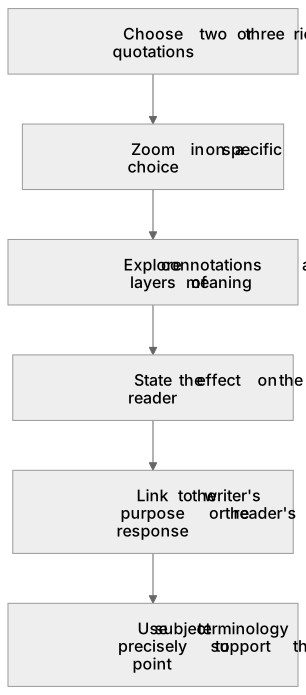
Put it in order
Put these steps in the order they happen.
- 1. Explore connotations and layers of meaning
- 2. Zoom in on a specific choice
- 3. Choose two or three rich quotations
- 4. Use subject terminology precisely to support the point
- 5. Link to the writer's purpose or the reader's response
- 6. State the effect on the reader
Key words
Say what each word means before you turn the card.
Language analysis
Try answering aloud or in your head before turning the card.
Structural analysis
Try answering aloud or in your head before turning the card.
Reader effect
Try answering aloud or in your head before turning the card.
Precise subject terminology
Try answering aloud or in your head before turning the card.
See every definition
- Language analysis
- Zooming in on a specific word choice, such as a verb, adjective or image, and exploring its connotations to explain the effect or association created for the reader.
- Structural analysis
- Commenting on choices such as sentence forms, paragraphing, openings and endings, shifts in focus and patterns across a text, and linking them to meaning.
- Reader effect
- The response a writer's choice creates in the reader, which analysis links to the writer's purpose, as when a short minor sentence can jolt the reader.
- Precise subject terminology
- Terms such as metaphor, sibilance, caesura or cyclical structure, used accurately and selectively to support a point rather than listed for its own sake.
Label the diagram
Some boxes have lost their names. Pick the right name for each number.
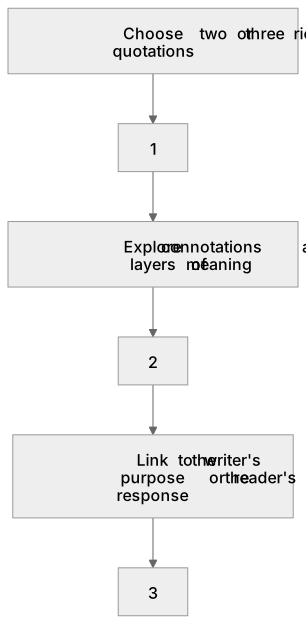
1Box 1
2Box 2
3Box 3
There is more to this lesson
The full lesson goes on to check your understanding and help you earn the marks. Create a free account to carry on, with your progress saved.
A week of Premium from your first lesson · Then the free plan continues · No card, no charge
Test your understanding of Assessment Objectives: AO2: Explain, comment on and analyse how writers use language and structure to achieve effects and influence readers, using relevant subject terminology to support their views
Active recall beats re-reading. Take an instant quiz now to test what you’ve learned and lock it into long-term memory.
A week of Premium from your first lesson · Then the free plan continues · No card, no charge