Pearson Edexcel · GCSE · English Language
Course version: 1EN0 · Version from Mar 2026
Non-fiction and Transactional Writing - 2.2 Writing: 2.2.1 produce clear…
Full specification wording
Component 2: Non-fiction and Transactional Writing - 2.2 Writing: 2.2.1 produce clear and coherent text: write accurately and effectively for different purposes and audiences: to describe, narrate, explain, instruct, give and respond to information, and argue; select vocabulary, grammar, form, and structural and organisational features judiciously to reflect audience, purpose and context; use language imaginatively and creatively; using information provided by others to write in different forms; maintaining a consistent point of view; maintaining coherence and consistency across a text
This covers transactional writing.
Checked against the Pearson Edexcel 1EN0 specification (opens in a new tab) on .
- Point 1 of 2
- 4 key terms
Study notes
From the checked teaching notes for this specification point.
The idea
This covers transactional writing. Match your writing to a stated purpose (to describe, narrate, explain, instruct, give and respond to information, or argue), audience and context. Choose form, vocabulary, grammar and structure deliberately. A formal complaint letter needs a clear sequence, while a travel article requires you to use language imaginatively and creatively. When a task supplies source material, reshape that information into the required form rather than copying it. Accuracy in spelling, punctuation and grammar is vital. Coherence comes from linking ideas logically, keeping tense and viewpoint stable, and closing appropriately.
What earns the marks
- Adapts register, tone and vocabulary to the specified audience, purpose, form and context.
- Organises the text with a clear opening, logically sequenced paragraphs and an appropriate ending.
- Uses a range of sentence structures and punctuation for deliberate effect, including accurate complex sentences.
- Shapes information from a source into a new form, selecting relevant detail rather than reproducing it wholesale.
- Sustains a consistent viewpoint and tense, avoiding confusing shifts in person or time frame.
- Uses cohesive devices such as connectives, pronouns and repetition to link paragraphs and ideas.
- Writes accurately and effectively to describe, narrate, explain, instruct, give and respond to information, or argue.
- Uses language imaginatively and creatively to engage the reader, even in transactional forms like articles or speeches.
Common mistakes and how to put them right
Writing in a chatty register for a formal task.
Put it right: Identify the audience and context first, then choose vocabulary and sentence style that suit that reader.
Copying sentences from the source material.
Put it right: Note key facts, then rewrite them in your own words and in the required form.
Switching between 'I', 'you' and 'they' without reason.
Put it right: Decide the viewpoint in planning and check each paragraph for consistency.
Writing dry, unengaging text.
Put it right: Use language imaginatively and creatively where appropriate to maintain reader interest.
Exam tips
- Spend a few minutes planning the form, audience, purpose, context and paragraph order before writing.
- Leave time to proofread for spelling, punctuation and grammar, as accuracy is assessed.
- Look for opportunities to use language imaginatively and creatively, such as a powerful opening hook in an article.
Try the lesson
The start of the Component 2: Non-fiction and Transactional Writing - 2.2 Writing: 2.2.1 produce clear and coherent text: write accurately and effectively for different purposes and audiences: to describe, narrate, explain, instruct, give and respond to information, and argue; select vocabulary, grammar, form, and structural and organisational features judiciously to reflect audience, purpose and context; use language imaginatively and creatively; using information provided by others to write in different forms; maintaining a consistent point of view; maintaining coherence and consistency across a text lesson, made from checked teaching notes for this specification point.
Have a go first
A student is writing a letter to the head teacher arguing for a longer lunch break. Which opening is most appropriate for this audience and purpose?
Listen
This covers transactional writing. Match your writing to a stated purpose (to describe, narrate, explain, instruct, give and respond to information, or argue), audience and context. Choose form, vocabulary, grammar and structure deliberately. A formal complaint letter needs a clear sequence, while a travel article requires you to use language imaginatively and creatively. When a task supplies source material, reshape that information into the required form rather than copying it. Accuracy in spelling, punctuation and grammar is vital. Coherence comes from linking ideas logically, keeping tense and viewpoint stable, and closing appropriately. A strong answer earns marks for these points. Adapts register, tone and vocabulary to the specified audience, purpose, form and context. Organises the text with a clear opening, logically sequenced paragraphs and an appropriate ending. Uses a range of sentence structures and punctuation for deliberate effect, including accurate complex sentences. Shapes information from a source into a new form, selecting relevant detail rather than reproducing it wholesale. A common slip: Writing in a chatty register for a formal task. Instead, identify the audience and context first, then choose vocabulary and sentence style that suit that reader. Exam tip: Spend a few minutes planning the form, audience, purpose, context and paragraph order before writing.
See it
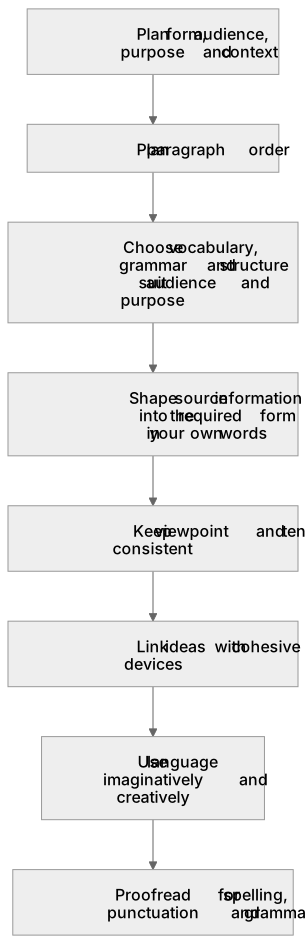
Put it in order
Put these steps in the order they happen.
- 1. Keep viewpoint and tense consistent
- 2. Proofread for spelling, punctuation and grammar
- 3. Link ideas with cohesive devices
- 4. Plan form, audience, purpose and context
- 5. Plan paragraph order
- 6. Use language imaginatively and creatively
- 7. Choose vocabulary, grammar and structure to suit audience and purpose
- 8. Shape source information into the required form in your own words
Key words
Say what each word means before you turn the card.
Audience, purpose and context
Try answering aloud or in your head before turning the card.
Form and register
Try answering aloud or in your head before turning the card.
Coherence and cohesion
Try answering aloud or in your head before turning the card.
Imaginative and creative language
Try answering aloud or in your head before turning the card.
See every definition
- Audience, purpose and context
- The reader being written for, the reason for writing and the situation, which together shape vocabulary, grammar, form and structure.
- Form and register
- The required shape of the writing and the tone and vocabulary chosen to suit the specified audience, purpose and context.
- Coherence and cohesion
- Linking ideas logically with connectives, pronouns and repetition, keeping tense and viewpoint stable and closing appropriately.
- Imaginative and creative language
- Language used creatively to engage the reader, even in transactional forms like articles or speeches.
Label the diagram
Some boxes have lost their names. Pick the right name for each number.
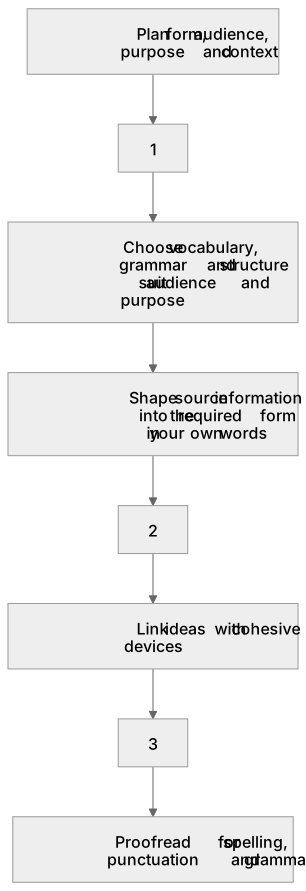
1Box 1
2Box 2
3Box 3
There is more to this lesson
The full lesson goes on to check your understanding and help you earn the marks. Create a free account to carry on, with your progress saved.
A week of Premium from your first lesson · Then the free plan continues · No card, no charge
Test your understanding of Component 2: Non-fiction and Transactional Writing - 2.2 Writing: 2.2.1 produce clear and coherent text: write accurately and effectively for different purposes and audiences: to describe, narrate, explain, instruct, give and respond to information, and argue; select vocabulary, grammar, form, and structural and organisational features judiciously to reflect audience, purpose and context; use language imaginatively and creatively; using information provided by others to write in different forms; maintaining a consistent point of view; maintaining coherence and consistency across a text
Active recall beats re-reading. Take an instant quiz now to test what you’ve learned and lock it into long-term memory.
A week of Premium from your first lesson · Then the free plan continues · No card, no charge