Pearson Edexcel · GCSE · English Language
Course version: 1EN0 · Version from Mar 2026
Non-fiction and Transactional Writing - 2.2 Writing: 2.2.2 write for…
Full specification wording
Component 2: Non-fiction and Transactional Writing - 2.2 Writing: 2.2.2 write for impact: select, organise and emphasise facts, ideas and key points; cite evidence and quotation effectively and pertinently to support views; create emotional impact; use language creatively, imaginatively and persuasively, including rhetorical devices (such as rhetorical questions, antithesis, parenthesis).
Writing for impact means shaping every choice around your reader and purpose.
Checked against the Pearson Edexcel 1EN0 specification (opens in a new tab) on .
- Point 2 of 2
- 4 key terms
Study notes
From the checked teaching notes for this specification point.
The idea
Writing for impact means shaping every choice around your reader and purpose. First, select only the most relevant facts, ideas and key points, then organise them so the most important comes first or last, and emphasise it through repetition, short sentences or direct address. Cite evidence and quotation pertinently: choose a statistic, expert comment or brief quotation that directly supports your view, and weave it into your own sentence rather than bolting it on. Create emotional impact by choosing words with strong connotations, using anecdote or a vivid example, and varying sentence length. Use language creatively, imaginatively and persuasively, for example a rhetorical question to involve the reader, antithesis to sharpen a contrast, and parenthesis to add a punchy aside. Always keep tone consistent with audience and form.
What earns the marks
- Selects facts, ideas and key points that are directly relevant to the task, audience and purpose, discarding material that does not serve the argument.
- Organises material logically and deliberately, for example moving from problem to solution or building to a climactic final point, so the reader can follow and remember the message.
- Emphasises key points through techniques such as repetition, short emphatic sentences, direct address or a striking statistic placed at a paragraph boundary.
- Cites evidence and quotation pertinently, embedding a brief quotation or statistic into a sentence so that it clearly supports the stated view rather than appearing as decoration.
- Creates emotional impact through connotation, anecdote, imagery or a direct appeal that makes the reader feel concern, sympathy, anger or hope.
- Uses language creatively, imaginatively and persuasively, including rhetorical devices such as rhetorical questions, antithesis and parenthesis, matched to audience and form.
- Maintains a consistent tone and register appropriate to the specified audience, purpose and text type, such as a speech, article or letter.
Common mistakes and how to put them right
Listing many points without selecting or emphasising any.
Put it right: Choose two or three key points and develop each with evidence, then emphasise the most important through repetition or a short sentence.
Quoting evidence without linking it to the argument.
Put it right: Introduce the quotation, then explain in the same sentence how it supports your view.
Using rhetorical devices randomly, such as a rhetorical question in a formal report where it disrupts tone.
Put it right: Match each device to audience and form, and use it only where it strengthens the point.
Exam tips
- Spend a few minutes planning: note your audience, purpose and form, then select the three strongest points and order them for impact before you write.
- Embed quotations and statistics inside your own sentences, and follow each with a short clause explaining why it matters.
- Leave time to proofread for tone, paragraph logic and device choice, checking that every rhetorical question, antithesis or parenthesis earns its place.
Try the lesson
The start of the Component 2: Non-fiction and Transactional Writing - 2.2 Writing: 2.2.2 write for impact: select, organise and emphasise facts, ideas and key points; cite evidence and quotation effectively and pertinently to support views; create emotional impact; use language creatively, imaginatively and persuasively, including rhetorical devices (such as rhetorical questions, antithesis, parenthesis). lesson, made from checked teaching notes for this specification point.
Have a go first
Which sentence uses a rhetorical question to create impact in a persuasive article?
Listen
Writing for impact means shaping every choice around your reader and purpose. First, select only the most relevant facts, ideas and key points, then organise them so the most important comes first or last, and emphasise it through repetition, short sentences or direct address. Cite evidence and quotation pertinently: choose a statistic, expert comment or brief quotation that directly supports your view, and weave it into your own sentence rather than bolting it on. Create emotional impact by choosing words with strong connotations, using anecdote or a vivid example, and varying sentence length. Use language creatively, imaginatively and persuasively, for example a rhetorical question to involve the reader, antithesis to sharpen a contrast, and parenthesis to add a punchy aside. Always keep tone consistent with audience and form. A strong answer earns marks for these points. Selects facts, ideas and key points that are directly relevant to the task, audience and purpose, discarding material that does not serve the argument. Organises material logically and deliberately, for example moving from problem to solution or building to a climactic final point, so the reader can follow and remember the message. Emphasises key points through techniques such as repetition, short emphatic sentences, direct address or a striking statistic placed at a paragraph boundary. Cites evidence and quotation pertinently, embedding a brief quotation or statistic into a sentence so that it clearly supports the stated view rather than appearing as decoration. A common slip: Listing many points without selecting or emphasising any: the writing feels flat. Instead, choose two or three key points and develop each with evidence, then emphasise the most important through repetition or a short sentence. Exam tip: Spend a few minutes planning: note your audience, purpose and form, then select the three strongest points and order them for impact before you write.
See it
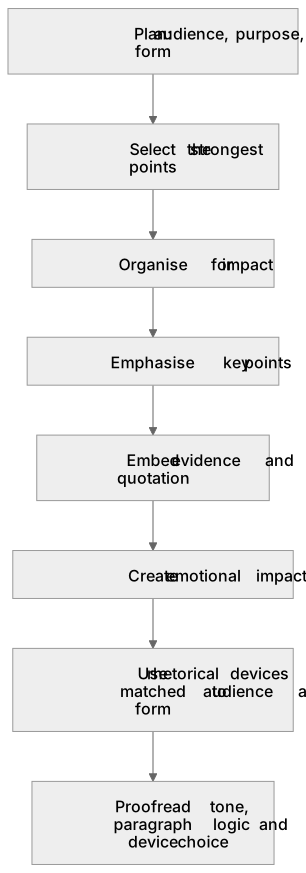
Put it in order
Put these steps in the order they happen.
- 1. Embed evidence and quotation
- 2. Proofread tone, paragraph logic and device choice
- 3. Create emotional impact
- 4. Plan: audience, purpose, form
- 5. Select the strongest points
- 6. Use rhetorical devices matched to audience and form
- 7. Organise for impact
- 8. Emphasise key points
Key words
Say what each word means before you turn the card.
Audience and purpose
Try answering aloud or in your head before turning the card.
Selection and organisation of material
Try answering aloud or in your head before turning the card.
Persuasive and rhetorical technique
Try answering aloud or in your head before turning the card.
Emotional impact and reader engagement
Try answering aloud or in your head before turning the card.
See every definition
- Audience and purpose
- Shaping every choice around your reader and purpose, keeping tone consistent with audience and form.
- Selection and organisation of material
- Choosing only the most relevant facts, ideas and key points, then organising them so the most important comes first or last.
- Persuasive and rhetorical technique
- Using language creatively, imaginatively and persuasively, including rhetorical questions, antithesis and parenthesis, matched to audience and form.
- Emotional impact and reader engagement
- Creating emotional impact by choosing words with strong connotations, using anecdote or a vivid example, and varying sentence length.
Label the diagram
Some boxes have lost their names. Pick the right name for each number.
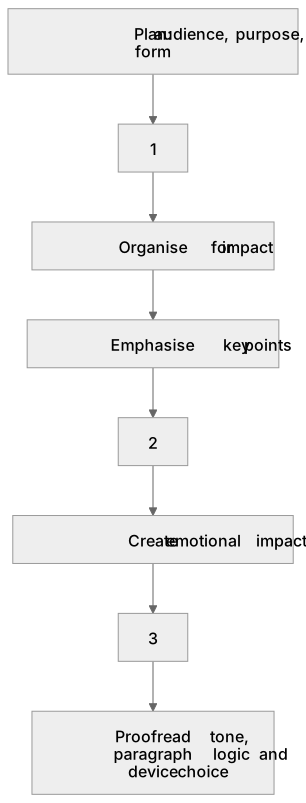
1Box 1
2Box 2
3Box 3
There is more to this lesson
The full lesson goes on to check your understanding and help you earn the marks. Create a free account to carry on, with your progress saved.
A week of Premium from your first lesson · Then the free plan continues · No card, no charge
Test your understanding of Component 2: Non-fiction and Transactional Writing - 2.2 Writing: 2.2.2 write for impact: select, organise and emphasise facts, ideas and key points; cite evidence and quotation effectively and pertinently to support views; create emotional impact; use language creatively, imaginatively and persuasively, including rhetorical devices (such as rhetorical questions, antithesis, parenthesis).
Active recall beats re-reading. Take an instant quiz now to test what you’ve learned and lock it into long-term memory.
A week of Premium from your first lesson · Then the free plan continues · No card, no charge