Pearson Edexcel · GCSE · English Language
Course version: 1EN0 · Version from Mar 2026
Presenting information and ideas: selecting and organising information and…
Full specification wording
Spoken Language Endorsement - 3.1 Spoken language: 3.1.1 presenting information and ideas: selecting and organising information and ideas effectively and persuasively for prepared spoken presentations; planning effectively for different purposes and audiences; making presentations and speeches
A prepared spoken presentation requires you to select material that suits your purpose and audience, organise it so listeners can follow it, and deliver it persuasively.
Checked against the Pearson Edexcel 1EN0 specification (opens in a new tab) on .
- Point 1 of 3
- 3 key terms
Study notes
From the checked teaching notes for this specification point.
The idea
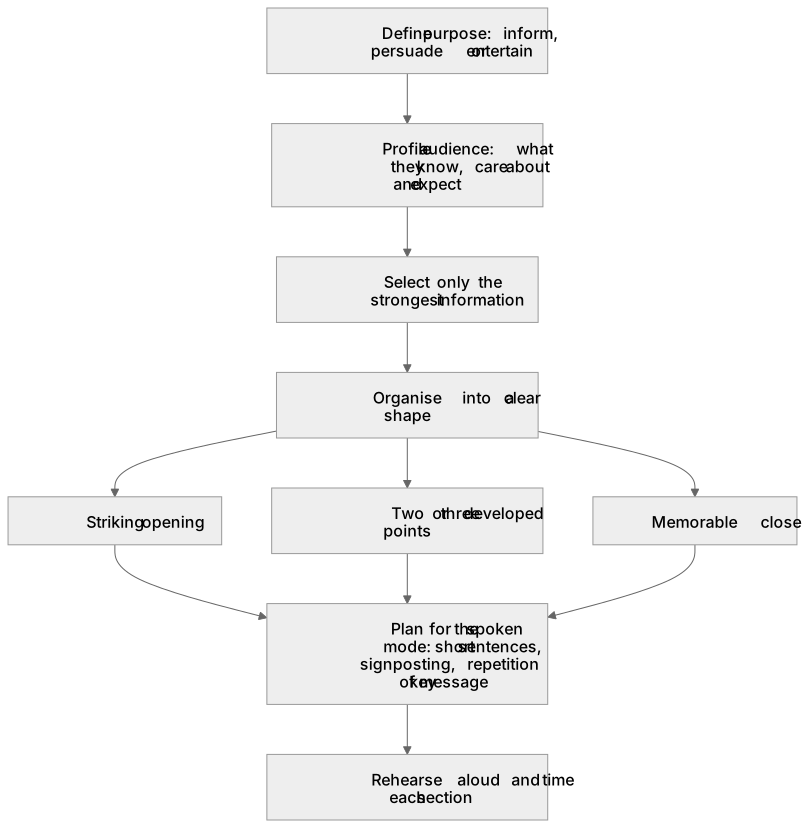
A prepared spoken presentation requires you to select material that suits your purpose and audience, organise it so listeners can follow it, and deliver it persuasively. Start by defining your purpose—to inform, persuade or entertain—and profile your audience: what they know, what they care about, and what tone they expect. Select only the strongest information, then organise it into a clear shape such as a striking opening, two or three developed points, and a memorable close. Plan for the spoken mode: use short sentences, signposting phrases such as 'first' and 'finally', and deliberate repetition of your key message. Rehearse aloud, timing each section, to ensure you are making presentations and speeches effectively and confidently.
What earns the marks
- Selects information and ideas that are relevant, accurate and suited to the stated purpose, avoiding irrelevant detail that would distract listeners.
- Organises the presentation with a clear overall shape, such as an engaging opening, logically sequenced main points and a deliberate conclusion.
- Uses signposting and connectives to guide listeners through the talk, for example 'first', 'in contrast' and 'to conclude'.
- Adapts content, vocabulary and tone to the needs and expectations of the specified audience, explaining or omitting material as appropriate.
- Presents persuasively where required, using rhetorical devices, direct address or a call to action to influence the audience.
- Delivers the presentation audibly and clearly, making speeches with appropriate pace, pauses and emphasis to communicate meaning.
Common mistakes and how to put them right
Reading a script word for word.
Put it right: Reduce the script to cue cards with key words and rehearse aloud until the ideas, not the exact words, are secure.
Including too much information so the talk overruns and listeners lose the main message.
Put it right: Select two or three main points and cut anything that does not directly support them.
Ignoring the audience by using unexplained jargon or an unsuitable tone.
Put it right: Profile the audience during planning and define or replace terms they would not know.
Exam tips
- Plan with a simple three-column grid: purpose, audience and structure, then draft only the key words for each section.
- Rehearse aloud with a timer and record yourself once to check audibility, pace and whether your main message is clear.
Try the lesson
The start of the Spoken Language Endorsement - 3.1 Spoken language: 3.1.1 presenting information and ideas: selecting and organising information and ideas effectively and persuasively for prepared spoken presentations; planning effectively for different purposes and audiences; making presentations and speeches lesson, made from checked teaching notes for this specification point.
Have a go first
When preparing a spoken presentation, which action best helps you organise information for your audience?
Listen
A prepared spoken presentation requires you to select material that suits your purpose and audience, organise it so listeners can follow it, and deliver it persuasively. Start by defining your purpose—to inform, persuade or entertain—and profile your audience: what they know, what they care about, and what tone they expect. Select only the strongest information, then organise it into a clear shape such as a striking opening, two or three developed points, and a memorable close. Plan for the spoken mode: use short sentences, signposting phrases such as 'first' and 'finally', and deliberate repetition of your key message. Rehearse aloud, timing each section, to ensure you are making presentations and speeches effectively and confidently. A strong answer earns marks for these points. Selects information and ideas that are relevant, accurate and suited to the stated purpose, avoiding irrelevant detail that would distract listeners. Organises the presentation with a clear overall shape, such as an engaging opening, logically sequenced main points and a deliberate conclusion. Uses signposting and connectives to guide listeners through the talk, for example 'first', 'in contrast' and 'to conclude'. Adapts content, vocabulary and tone to the needs and expectations of the specified audience, explaining or omitting material as appropriate. A common slip: Reading a script word for word: delivery becomes flat and eye contact is lost. Instead, reduce the script to cue cards with key words and rehearse aloud until the ideas, not the exact words, are secure. Exam tip: Plan with a simple three-column grid: purpose, audience and structure, then draft only the key words for each section.
See it
Key words
Say what each word means before you turn the card.
Purpose and audience
Try answering aloud or in your head before turning the card.
Selection and organisation of spoken material
Try answering aloud or in your head before turning the card.
Persuasive presentation
Try answering aloud or in your head before turning the card.
See every definition
- Purpose and audience
- Planning effectively for different purposes and audiences, shaping content, tone and structure to suit them.
- Selection and organisation of spoken material
- Selecting and organising information and ideas effectively and persuasively for a prepared spoken presentation.
- Persuasive presentation
- Presenting persuasively where required, using rhetorical devices, direct address or a call to action to influence the audience.
Label the diagram
Some boxes have lost their names. Pick the right name for each number.
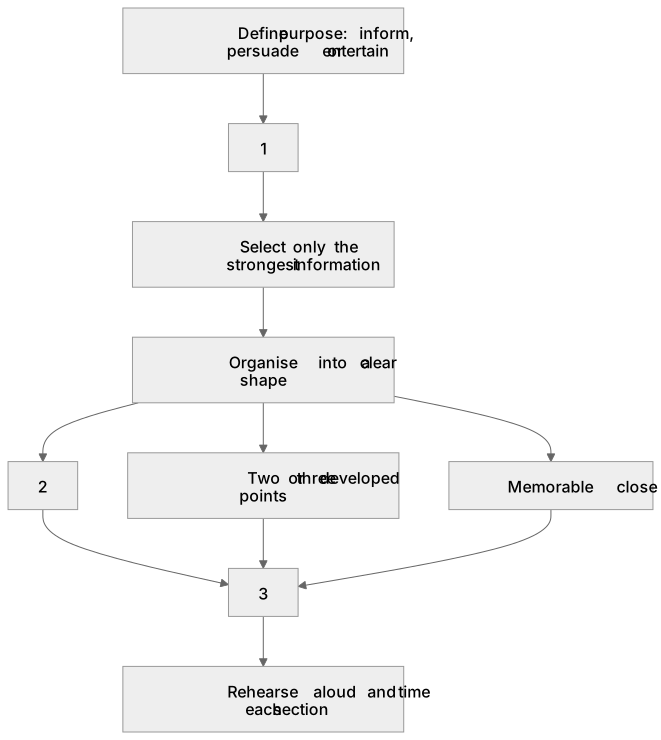
1Box 1
2Box 2
3Box 3
There is more to this lesson
The full lesson goes on to check your understanding and help you earn the marks. Create a free account to carry on, with your progress saved.
A week of Premium from your first lesson · Then the free plan continues · No card, no charge
Test your understanding of Spoken Language Endorsement - 3.1 Spoken language: 3.1.1 presenting information and ideas: selecting and organising information and ideas effectively and persuasively for prepared spoken presentations; planning effectively for different purposes and audiences; making presentations and speeches
Active recall beats re-reading. Take an instant quiz now to test what you’ve learned and lock it into long-term memory.
A week of Premium from your first lesson · Then the free plan continues · No card, no charge