Pearson Edexcel · GCSE · English Language
Course version: 1EN0 · Version from Mar 2026
Responding to spoken language: listening to and responding appropriately…
Full specification wording
Spoken Language Endorsement - 3.1 Spoken language: 3.1.2 responding to spoken language: listening to and responding appropriately to any questions and feedback
This skill is about active listening during the Spoken Language Endorsement.
Checked against the Pearson Edexcel 1EN0 specification (opens in a new tab) on .
- Point 2 of 3
- 4 key terms
Study notes
From the checked teaching notes for this specification point.
The idea
This skill is about active listening during the Spoken Language Endorsement. You must show that you can follow what others say, then answer questions and act on feedback in a way that fits the discussion. In practice, this means tracking the speaker's main point, pausing briefly to think, and giving a relevant reply rather than a rehearsed speech. For example, if a listener asks, 'You said social media helps teenagers stay connected — but what about its effect on sleep?', you could reply, 'That is a fair challenge; while it keeps friendships going, late-night scrolling can reduce sleep, so balance matters.' You also respond to feedback by adjusting your point, adding evidence or clarifying a term. The assessor observes whether your contributions are relevant, thoughtful and responsive across the task, not just at the start.
What earns the marks
- Listens attentively to questions and feedback without interrupting or talking over others.
- Gives answers that directly address the question asked, rather than repeating a prepared point.
- Uses brief thinking time or clarifying questions such as 'Do you mean...?' to check understanding before replying.
- Responds to feedback by developing, qualifying or politely challenging a point with a reason or example.
- Adapts tone and vocabulary to the audience and purpose of the discussion when replying.
Common mistakes and how to put them right
Ignoring the question and returning to a memorised script.
Put it right by noting the key word in the question and answering that first.
Giving a one-word or very short reply that closes the discussion.
Put it right by adding a reason, example or follow-up question.
Treating disagreement as rudeness.
Put it right by using polite frames such as 'I see your point, but...' or 'That is true, however...'.
Exam tips
- Practise with a partner who asks unpredictable questions so you rehearse thinking on your feet.
- Use a simple mental checklist: listen, pause, answer the actual question, then add one detail.
- If you mishear, ask for repetition politely; this shows active listening rather than weakness.
Try the lesson
The start of the Spoken Language Endorsement - 3.1 Spoken language: 3.1.2 responding to spoken language: listening to and responding appropriately to any questions and feedback lesson, made from checked teaching notes for this specification point.
Have a go first
In a group discussion, a speaker asks you a direct question about your opinion. What is the most appropriate way to respond?
Listen
This skill is about active listening during the Spoken Language Endorsement. You must show that you can follow what others say, then answer questions and act on feedback in a way that fits the discussion. In practice, this means tracking the speaker's main point, pausing briefly to think, and giving a relevant reply rather than a rehearsed speech. For example, if a listener asks, 'You said social media helps teenagers stay connected — but what about its effect on sleep?', you could reply, 'That is a fair challenge; while it keeps friendships going, late-night scrolling can reduce sleep, so balance matters. You also respond to feedback by adjusting your point, adding evidence or clarifying a term. The assessor observes whether your contributions are relevant, thoughtful and responsive across the task, not just at the start. A strong answer earns marks for these points. Listens attentively to questions and feedback without interrupting or talking over others. Gives answers that directly address the question asked, rather than repeating a prepared point. Uses brief thinking time or clarifying questions such as 'Do you mean...?' to check understanding before replying. Responds to feedback by developing, qualifying or politely challenging a point with a reason or example. A common slip: Ignoring the question and returning to a memorised script. Instead, noting the key word in the question and answering that first. Exam tip: Practise with a partner who asks unpredictable questions so you rehearse thinking on your feet.
See it
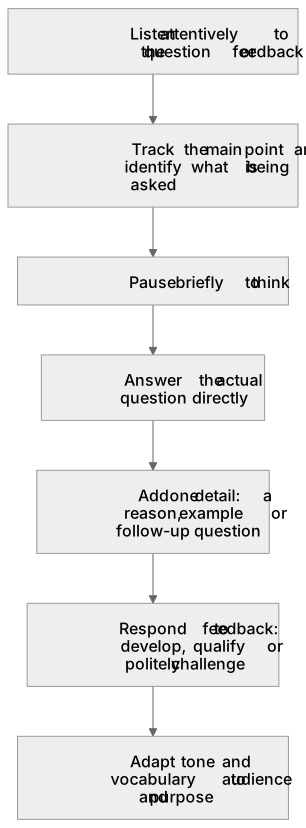
Put it in order
Put these steps in the order they happen.
- 1. Adapt tone and vocabulary to audience and purpose
- 2. Respond to feedback: develop, qualify or politely challenge
- 3. Pause briefly to think
- 4. Add one detail: a reason, example or follow-up question
- 5. Listen attentively to the question or feedback
- 6. Track the main point and identify what is being asked
- 7. Answer the actual question directly
Key words
Say what each word means before you turn the card.
Active listening
Try answering aloud or in your head before turning the card.
Relevance and clarity
Try answering aloud or in your head before turning the card.
Turn-taking and respect
Try answering aloud or in your head before turning the card.
Adapting to feedback
Try answering aloud or in your head before turning the card.
See every definition
- Active listening
- Following what others say during the Spoken Language Endorsement, tracking the speaker's main point and asking for repetition politely if you mishear.
- Relevance and clarity
- Giving answers that directly address the question asked rather than repeating a prepared point, and adding a reason, example or follow-up question.
- Turn-taking and respect
- Listening attentively to questions and feedback without interrupting or talking over others, and using polite frames when disagreeing.
- Adapting to feedback
- Responding to feedback by developing, qualifying or politely challenging a point with a reason or example, or by clarifying a term.
Label the diagram
Some boxes have lost their names. Pick the right name for each number.
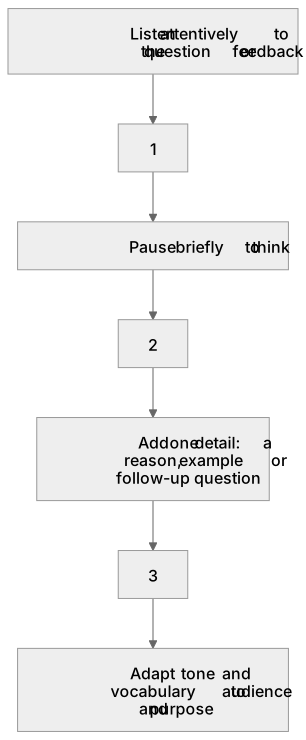
1Box 1
2Box 2
3Box 3
There is more to this lesson
The full lesson goes on to check your understanding and help you earn the marks. Create a free account to carry on, with your progress saved.
A week of Premium from your first lesson · Then the free plan continues · No card, no charge
Test your understanding of Spoken Language Endorsement - 3.1 Spoken language: 3.1.2 responding to spoken language: listening to and responding appropriately to any questions and feedback
Active recall beats re-reading. Take an instant quiz now to test what you’ve learned and lock it into long-term memory.
A week of Premium from your first lesson · Then the free plan continues · No card, no charge