AQA · A-Level · English Literature
Course version: 7717 · Version from Sept 2026
At the centre of all set texts are stories which primarily amuse, where…
Full specification wording
Aspects of comedy: At the centre of all set texts are stories which primarily amuse, where the discomfort of characters generally excites laughter rather than concern and where no great disaster occurs.
This strand defines comedy by its dominant effect: it amuses, and the characters' awkwardness tends to produce laughter rather than anxiety.
Checked against the AQA 7717 specification (opens in a new tab) on .
- Point 1 of 18
- 4 key terms
Study notes
From the checked teaching notes for this specification point.
The idea
This strand defines comedy by its dominant effect: it amuses, and the characters' awkwardness tends to produce laughter rather than anxiety. Crucially, no great disaster occurs, so the stakes stay survivable. That does not mean nothing matters; embarrassment, confusion and social friction are real within the world of the play, but they are framed for comic release. To analyse this, identify moments of discomfort, then show how language, timing, misunderstanding or dramatic irony turns them into humour. Consider how endings restore or rearrange social order, often through marriage, reunion or forgiveness. A useful method is to compare a tense scene with its resolution, explaining why the audience laughs rather than grieves.
What earns the marks
- Explains how a set text primarily amuses, identifying comic techniques such as wit, misunderstanding, disguise, repetition or dramatic irony.
- Analyses characters' discomfort and shows how it is framed to excite laughter rather than serious concern.
- Demonstrates that no great disaster occurs, considering how threats are contained, reversed or resolved by the ending.
- Distinguishes comedy from tragedy by effect and stakes, without claiming that comedy lacks serious ideas.
- Uses close reference to language, structure and staging to show how comic effects are created and sustained.
- Considers how comic endings restore, expose or complicate social order, for example through marriage, reunion or forgiveness.
Common mistakes and how to put them right
Assuming comedy means the play is trivial or has no serious purpose.
Put it right by showing how amusement can carry social comment.
Treating every unhappy moment as evidence of tragedy.
Put it right by explaining how the text contains or resolves discomfort so laughter dominates.
Ignoring the audience's role and describing only characters' feelings.
Put it right by analysing how comic technique directs the audience's response.
Exam tips
- Quote precisely from comic exchanges and comment on timing, pace or staging as well as wording.
- Use the phrase no great disaster occurs as a test: show how potential catastrophe is averted or defused.
- Balance laughter with seriousness, arguing how comic discomfort can reveal social norms or human folly.
Try the lesson
The start of the Aspects of comedy: At the centre of all set texts are stories which primarily amuse, where the discomfort of characters generally excites laughter rather than concern and where no great disaster occurs. lesson, made from checked teaching notes for this specification point.
Have a go first
In the genre of comedy, how is the discomfort or misfortune of characters typically presented to ensure the narrative remains primarily amusing?
Listen
This strand defines comedy by its dominant effect: it amuses, and the characters' awkwardness tends to produce laughter rather than anxiety. Crucially, no great disaster occurs, so the stakes stay survivable. That does not mean nothing matters; embarrassment, confusion and social friction are real within the world of the play, but they are framed for comic release. To analyse this, identify moments of discomfort, then show how language, timing, misunderstanding or dramatic irony turns them into humour. Consider how endings restore or rearrange social order, often through marriage, reunion or forgiveness. A useful method is to compare a tense scene with its resolution, explaining why the audience laughs rather than grieves. A strong answer earns marks for these points. Explains how a set text primarily amuses, identifying comic techniques such as wit, misunderstanding, disguise, repetition or dramatic irony. Analyses characters' discomfort and shows how it is framed to excite laughter rather than serious concern. Demonstrates that no great disaster occurs, considering how threats are contained, reversed or resolved by the ending. Distinguishes comedy from tragedy by effect and stakes, without claiming that comedy lacks serious ideas. A common slip: Assuming comedy means the play is trivial or has no serious purpose. Instead, showing how amusement can carry social comment. Exam tip: Quote precisely from comic exchanges and comment on timing, pace or staging as well as wording.
See it
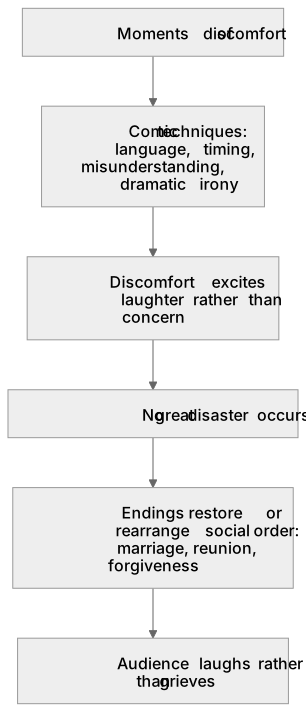
Put it in order
Put these steps in the order they happen.
- 1. Discomfort excites laughter rather than concern
- 2. Comic techniques: language, timing, misunderstanding, dramatic irony
- 3. Moments of discomfort
- 4. Audience laughs rather than grieves
- 5. Endings restore or rearrange social order: marriage, reunion, forgiveness
- 6. No great disaster occurs
Key words
Say what each word means before you turn the card.
Comic amusement and laughter
Try answering aloud or in your head before turning the card.
Discomfort contained rather than disastrous
Try answering aloud or in your head before turning the card.
Social order and comic resolution
Try answering aloud or in your head before turning the card.
Human folly and social satire
Try answering aloud or in your head before turning the card.
See every definition
- Comic amusement and laughter
- The dominant effect of comedy, in which the discomfort of characters generally excites laughter rather than concern.
- Discomfort contained rather than disastrous
- Embarrassment, confusion and social friction are real within the world of the play but are framed for comic release, so the stakes stay survivable.
- Social order and comic resolution
- Endings restore or rearrange social order, often through marriage, reunion or forgiveness.
- Human folly and social satire
- Amusement can carry social comment, revealing social norms or human folly rather than being trivial.
Label the diagram
Some boxes have lost their names. Pick the right name for each number.
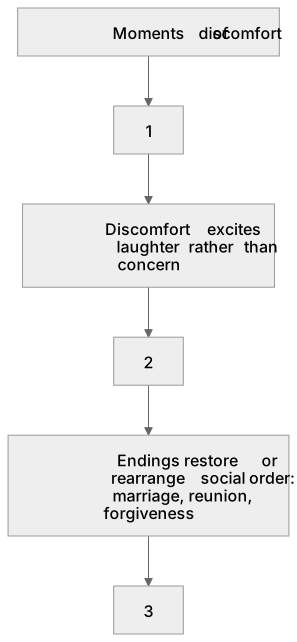
1Box 1
2Box 2
3Box 3
There is more to this lesson
The full lesson goes on to check your understanding and help you earn the marks. Create a free account to carry on, with your progress saved.
A week of Premium from your first lesson · Then the free plan continues · No card, no charge
Test your understanding of Aspects of comedy: At the centre of all set texts are stories which primarily amuse, where the discomfort of characters generally excites laughter rather than concern and where no great disaster occurs.
Active recall beats re-reading. Take an instant quiz now to test what you’ve learned and lock it into long-term memory.
A week of Premium from your first lesson · Then the free plan continues · No card, no charge