AQA · A-Level · English Literature
Course version: 7717 · Version from Sept 2026
All texts contain a love interest for the protagonist and marriage is a…
Full specification wording
Aspects of comedy: All texts contain a love interest for the protagonist and marriage is a focal point.
Comedy conventionally moves from disruption towards resolution, and the love interest supplies the emotional and structural pull that drives this movement.
Checked against the AQA 7717 specification (opens in a new tab) on .
- Point 2 of 18
- 2 key terms
Study notes
From the checked teaching notes for this specification point.
The idea
Comedy conventionally moves from disruption towards resolution, and the love interest supplies the emotional and structural pull that drives this movement. The protagonist's desire creates obstacles, misunderstandings and rivalries, while marriage functions as the public settlement that restores social order. In Twelfth Night, Viola's concealed love for Orsino and the confusion with Sebastian generate the plot's momentum, and the multiple unions at the close resolve mistaken identity. In The Taming of the Shrew, Petruchio's courtship of Katherina and Bianca's suitors frame marriage as both prize and negotiation.
What earns the marks
- Explains how the love interest generates the central conflict and sustains audience anticipation across the play.
- Analyses how marriage operates as a structural resolution that restores or reorders the social world.
- Uses close reference to courtship dialogue, stage business or soliloquy to show how desire is dramatised.
- Considers whether the ending affirms marriage or exposes its tensions, using textual evidence rather than assertion.
- Connects the convention to the wider comic pattern of disruption, confusion and renewed stability.
Common mistakes and how to put them right
Treating the love interest as mere decoration rather than a structural driver.
Put it right by showing how desire creates obstacles and choices that shape the plot.
Assuming every marriage at the close is straightforwardly happy.
Put it right by examining tone, silence or unresolved tension in the final scene.
Retelling the courtship without analysing language.
Put it right by quoting and commenting on imagery, register or dramatic timing.
Exam tips
- Plan around a clear argument about how courtship and marriage shape comic structure, not a plot summary.
- Select two or three precise moments and analyse them closely rather than listing many events.
- Use subject terminology such as resolution, complication and dramatic irony to frame your analysis.
Try the lesson
The start of the Aspects of comedy: All texts contain a love interest for the protagonist and marriage is a focal point. lesson, made from checked teaching notes for this specification point.
Have a go first
In the study of traditional comedic literature, what is the typical structural significance of marriage?
Listen
Comedy conventionally moves from disruption towards resolution, and the love interest supplies the emotional and structural pull that drives this movement. The protagonist's desire creates obstacles, misunderstandings and rivalries, while marriage functions as the public settlement that restores social order. In Twelfth Night, Viola's concealed love for Orsino and the confusion with Sebastian generate the plot's momentum, and the multiple unions at the close resolve mistaken identity. In The Taming of the Shrew, Petruchio's courtship of Katherina and Bianca's suitors frame marriage as both prize and negotiation. A strong answer earns marks for these points. Explains how the love interest generates the central conflict and sustains audience anticipation across the play. Analyses how marriage operates as a structural resolution that restores or reorders the social world. Uses close reference to courtship dialogue, stage business or soliloquy to show how desire is dramatised. Considers whether the ending affirms marriage or exposes its tensions, using textual evidence rather than assertion. A common slip: Treating the love interest as mere decoration rather than a structural driver. Instead, showing how desire creates obstacles and choices that shape the plot. Exam tip: Plan around a clear argument about how courtship and marriage shape comic structure, not a plot summary.
See it
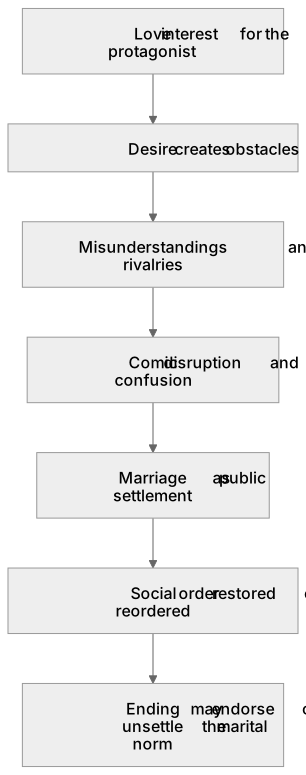
Put it in order
Put these steps in the order they happen.
- 1. Ending may endorse or unsettle the marital norm
- 2. Social order restored or reordered
- 3. Misunderstandings and rivalries
- 4. Marriage as public settlement
- 5. Love interest for the protagonist
- 6. Desire creates obstacles
- 7. Comic disruption and confusion
Key words
Say what each word means before you turn the card.
Courtship and desire
Try answering aloud or in your head before turning the card.
Marriage and social order
Try answering aloud or in your head before turning the card.
See every definition
- Courtship and desire
- The protagonist's love interest supplies the emotional and structural pull that drives the movement from disruption towards resolution, creating obstacles, misunderstandings and rivalries.
- Marriage and social order
- The public settlement that restores social order, functioning as a structural resolution that restores or reorders the social world.
Label the diagram
Some boxes have lost their names. Pick the right name for each number.
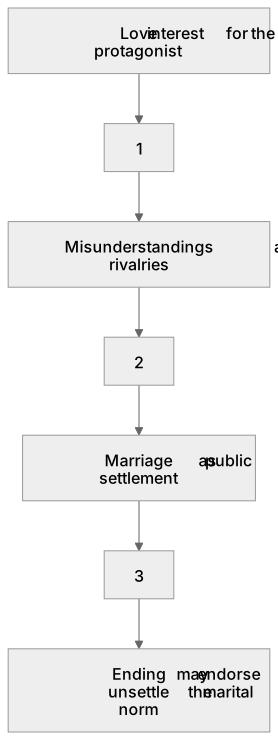
1Box 1
2Box 2
3Box 3
There is more to this lesson
The full lesson goes on to check your understanding and help you earn the marks. Create a free account to carry on, with your progress saved.
A week of Premium from your first lesson · Then the free plan continues · No card, no charge
Test your understanding of Aspects of comedy: All texts contain a love interest for the protagonist and marriage is a focal point.
Active recall beats re-reading. Take an instant quiz now to test what you’ve learned and lock it into long-term memory.
A week of Premium from your first lesson · Then the free plan continues · No card, no charge