AQA · A-Level · English Literature
Course version: 7717 · Version from Sept 2026
Shakespeare: William Shakespeare: The Taming of the Shrew
Full specification wording
Aspects of comedy - Set texts: Shakespeare: William Shakespeare: The Taming of the Shrew
The Taming of the Shrew is studied as a Shakespearean comedy through the lens of aspects of comedy, so your reading must connect the play's structure, language and dramatic methods to comic…
Checked against the AQA 7717 specification (opens in a new tab) on .
- Point 1 of 2
- 4 key terms
Study notes
From the checked teaching notes for this specification point.
The idea
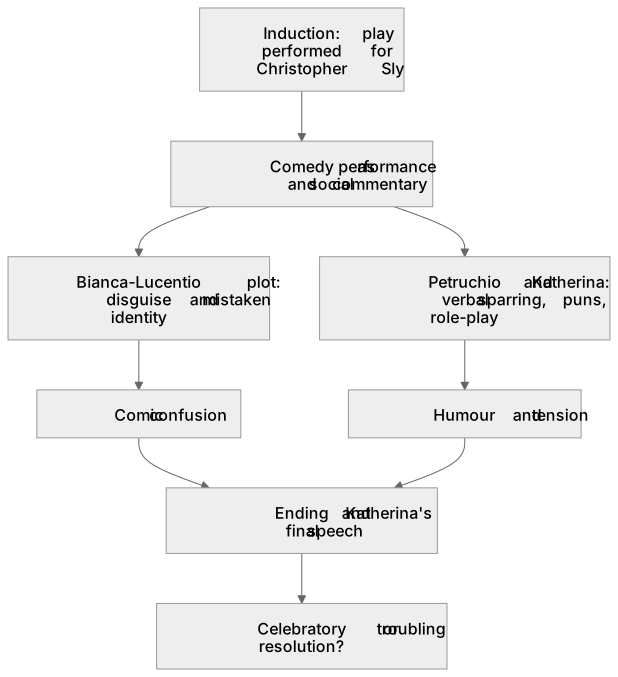
The Taming of the Shrew is studied as a Shakespearean comedy through the lens of aspects of comedy, so your reading must connect the play's structure, language and dramatic methods to comic conventions such as mistaken identity, disguise, courtship, disruption and resolution. The Induction frames the main action as a play performed for Christopher Sly, which invites you to consider comedy as performance and social commentary. The Bianca-Lucentio plot uses disguise and romantic intrigue, while Petruchio and Katherina's relationship raises questions about power, gender and whether the ending is celebratory or troubling. You should analyse how Shakespeare creates humour through wordplay, farce, role-play and audience address, and evaluate how different productions or critical readings shape meaning.
What earns the marks
- Analyse how the Induction establishes comedy as performance and frames the audience's expectations of the main plot.
- Examine the use of disguise and mistaken identity in the Bianca-Lucentio subplot and its contribution to comic confusion.
- Discuss how Petruchio and Katherina's verbal sparring uses puns, double meanings and role-play to generate both humour and tension.
- Evaluate the significance of the play's ending, including Katherina's final speech, in relation to comic resolution and gender politics.
- Connect dramatic methods such as soliloquy, aside, stage direction and structural juxtaposition to the play's comic effects.
- Use relevant contextual ideas about early modern marriage, social order and theatre to illuminate the play without reducing it to background information.
Common mistakes and how to put them right
Treating the play as a straightforward romantic comedy and ignoring its darker or ambiguous elements.
Put it right by weighing evidence for both celebratory and critical readings.
Describing Petruchio and Katherina's relationship only in modern terms without considering early modern expectations of marriage and household order.
Put it right by situating claims in the play's historical and theatrical context.
Quoting lines without analysing Shakespeare's language choices.
Put it right by zooming in on specific words, images or rhetorical patterns and explaining their comic effect.
Exam tips
- Plan your response around the assessment objective for aspects of comedy, ensuring every paragraph links methods to comic conventions and meanings.
- Use precise textual references, including act and scene, and integrate short quotations into your sentences rather than listing them.
- When discussing the ending, present a clear line of argument and acknowledge alternative interpretations to show evaluative depth.
Try the lesson
The start of the Aspects of comedy - Set texts: Shakespeare: William Shakespeare: The Taming of the Shrew lesson, made from checked teaching notes for this specification point.
Have a go first
In The Taming of the Shrew, which character is Baptista's younger daughter, sought after by several suitors?
Listen
The Taming of the Shrew is studied as a Shakespearean comedy through the lens of aspects of comedy, so your reading must connect the play's structure, language and dramatic methods to comic conventions such as mistaken identity, disguise, courtship, disruption and resolution. The Induction frames the main action as a play performed for Christopher Sly, which invites you to consider comedy as performance and social commentary. The Bianca-Lucentio plot uses disguise and romantic intrigue, while Petruchio and Katherina's relationship raises questions about power, gender and whether the ending is celebratory or troubling. You should analyse how Shakespeare creates humour through wordplay, farce, role-play and audience address, and evaluate how different productions or critical readings shape meaning. A strong answer earns marks for these points. Analyse how the Induction establishes comedy as performance and frames the audience's expectations of the main plot. Examine the use of disguise and mistaken identity in the Bianca-Lucentio subplot and its contribution to comic confusion. Discuss how Petruchio and Katherina's verbal sparring uses puns, double meanings and role-play to generate both humour and tension. Evaluate the significance of the play's ending, including Katherina's final speech, in relation to comic resolution and gender politics. A common slip: Treating the play as a straightforward romantic comedy and ignoring its darker or ambiguous elements. Instead, weighing evidence for both celebratory and critical readings. Exam tip: Plan your response around the assessment objective for aspects of comedy, ensuring every paragraph links methods to comic conventions and meanings.
See it
Key words
Say what each word means before you turn the card.
Comedy as performance and metatheatre
Try answering aloud or in your head before turning the card.
Disguise, identity and social role-play
Try answering aloud or in your head before turning the card.
Gender, power and marriage
Try answering aloud or in your head before turning the card.
Language, wit and verbal conflict
Try answering aloud or in your head before turning the card.
See every definition
- Comedy as performance and metatheatre
- The Induction frames the main action as a play performed for Christopher Sly, inviting consideration of comedy as performance and social commentary.
- Disguise, identity and social role-play
- The Bianca-Lucentio plot uses disguise and romantic intrigue, contributing to comic confusion through mistaken identity.
- Gender, power and marriage
- Petruchio and Katherina's relationship raises questions about power, gender and whether the ending is celebratory or troubling.
- Language, wit and verbal conflict
- Petruchio and Katherina's verbal sparring uses puns, double meanings and role-play to generate both humour and tension.
Label the diagram
Some boxes have lost their names. Pick the right name for each number.
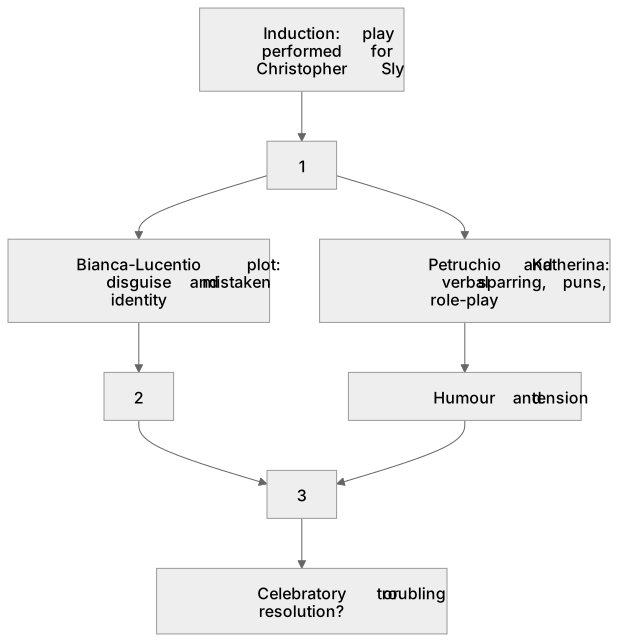
1Box 1
2Box 2
3Box 3
There is more to this lesson
The full lesson goes on to check your understanding and help you earn the marks. Create a free account to carry on, with your progress saved.
A week of Premium from your first lesson · Then the free plan continues · No card, no charge
Test your understanding of Aspects of comedy - Set texts: Shakespeare: William Shakespeare: The Taming of the Shrew
Active recall beats re-reading. Take an instant quiz now to test what you’ve learned and lock it into long-term memory.
A week of Premium from your first lesson · Then the free plan continues · No card, no charge