AQA · A-Level · English Literature
Course version: 7717 · Version from Sept 2026
Shakespeare: William Shakespeare: Twelfth Night
Full specification wording
Aspects of comedy - Set texts: Shakespeare: William Shakespeare: Twelfth Night
Twelfth Night is studied as a Shakespearean comedy through aspects of comedy, so your analysis should explore how mistaken identity, disguise and desire drive both humour and melancholy.
Checked against the AQA 7717 specification (opens in a new tab) on .
- Point 2 of 2
- 4 key terms
Study notes
From the checked teaching notes for this specification point.
The idea
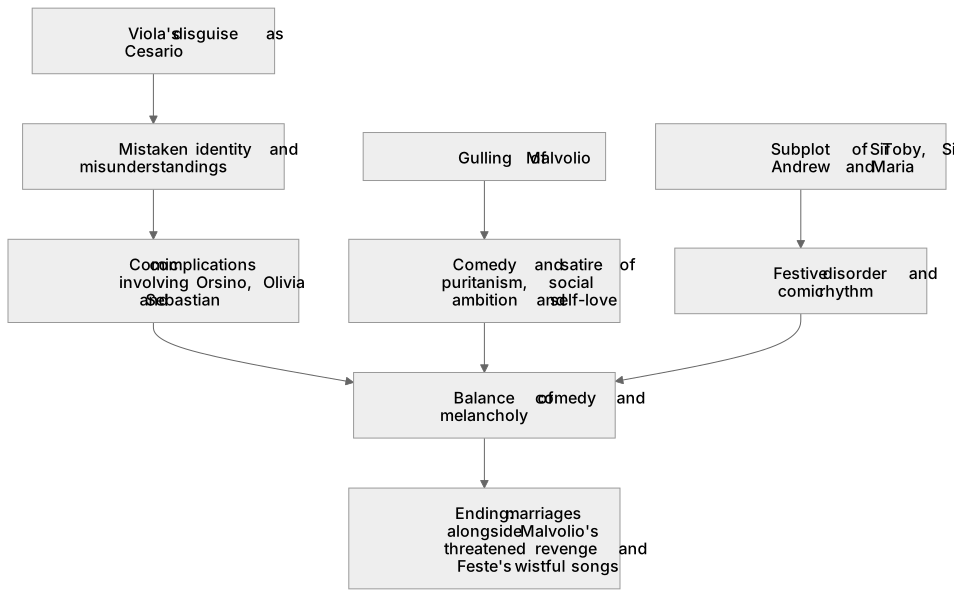
Twelfth Night is studied as a Shakespearean comedy through aspects of comedy, so your analysis should explore how mistaken identity, disguise and desire drive both humour and melancholy. Viola's disguise as Cesario creates a chain of misunderstandings involving Orsino, Olivia and Sebastian, while Malvolio's gulling and the subplot of Sir Toby, Sir Andrew and Maria provide festive disorder and social satire. The play's title and Illyrian setting evoke holiday misrule, yet the ending's marriages coexist with Malvolio's threatened revenge and Feste's wistful songs. You should examine how Shakespeare manipulates language, structure and stagecraft to balance laughter with reflection on love, gender and social ambition.
What earns the marks
- Analyse how Viola's disguise generates dramatic irony, mistaken identity and comic complications across the main plot.
- Examine the gulling of Malvolio as a source of comedy and as satire of puritanism, social ambition and self-love.
- Discuss how the subplot of Sir Toby, Sir Andrew and Maria contributes to festive disorder and the play's comic rhythm.
- Evaluate the balance between comedy and melancholy, including Feste's role and the unresolved threat of Malvolio's revenge.
- Connect Shakespeare's use of prose and verse, songs and asides to the creation of comic tone and character.
- Use contextual ideas about early modern gender, service and festivity to deepen interpretation of the play's comic concerns.
Common mistakes and how to put them right
Reducing the play to a simple romantic comedy and overlooking its darker, melancholic or satirical elements.
Put it right by tracing how humour and sadness coexist.
Treating Malvolio only as a victim or only as a figure of fun without considering how the play invites both responses.
Put it right by analysing the language and staging of his humiliation.
Ignoring the significance of Feste and the songs.
Put it right by examining how music, wit and commentary shape the audience's emotional response.
Exam tips
- Anchor each paragraph in a clear aspect of comedy, such as disguise, misrule or resolution, and link it to Shakespeare's methods.
- Use short embedded quotations and precise references to support your argument without losing analytical momentum.
- Show awareness of alternative readings, especially of Malvolio and the ending, to demonstrate evaluative sophistication.
Try the lesson
The start of the Aspects of comedy - Set texts: Shakespeare: William Shakespeare: Twelfth Night lesson, made from checked teaching notes for this specification point.
Have a go first
In Twelfth Night, which character survives a shipwreck at the start of the play and believes her brother has drowned?
Listen
Twelfth Night is studied as a Shakespearean comedy through aspects of comedy, so your analysis should explore how mistaken identity, disguise and desire drive both humour and melancholy. Viola's disguise as Cesario creates a chain of misunderstandings involving Orsino, Olivia and Sebastian, while Malvolio's gulling and the subplot of Sir Toby, Sir Andrew and Maria provide festive disorder and social satire. The play's title and Illyrian setting evoke holiday misrule, yet the ending's marriages coexist with Malvolio's threatened revenge and Feste's wistful songs. You should examine how Shakespeare manipulates language, structure and stagecraft to balance laughter with reflection on love, gender and social ambition. A strong answer earns marks for these points. Analyse how Viola's disguise generates dramatic irony, mistaken identity and comic complications across the main plot. Examine the gulling of Malvolio as a source of comedy and as satire of puritanism, social ambition and self-love. Discuss how the subplot of Sir Toby, Sir Andrew and Maria contributes to festive disorder and the play's comic rhythm. Evaluate the balance between comedy and melancholy, including Feste's role and the unresolved threat of Malvolio's revenge. A common slip: Reducing the play to a simple romantic comedy and overlooking its darker, melancholic or satirical elements. Instead, tracing how humour and sadness coexist. Exam tip: Anchor each paragraph in a clear aspect of comedy, such as disguise, misrule or resolution, and link it to Shakespeare's methods.
See it
Key words
Say what each word means before you turn the card.
Disguise, gender and desire
Try answering aloud or in your head before turning the card.
Festivity, misrule and social order
Try answering aloud or in your head before turning the card.
Folly, wit and self-knowledge
Try answering aloud or in your head before turning the card.
Comedy, melancholy and resolution
Try answering aloud or in your head before turning the card.
See every definition
- Disguise, gender and desire
- Viola's disguise as Cesario creates a chain of misunderstandings involving Orsino, Olivia and Sebastian, driving both humour and melancholy.
- Festivity, misrule and social order
- The play's title and Illyrian setting evoke holiday misrule, while the subplot of Sir Toby, Sir Andrew and Maria provides festive disorder and social satire.
- Folly, wit and self-knowledge
- The gulling of Malvolio is a source of comedy and a satire of puritanism, social ambition and self-love.
- Comedy, melancholy and resolution
- The ending's marriages coexist with Malvolio's threatened revenge and Feste's wistful songs, balancing laughter with reflection.
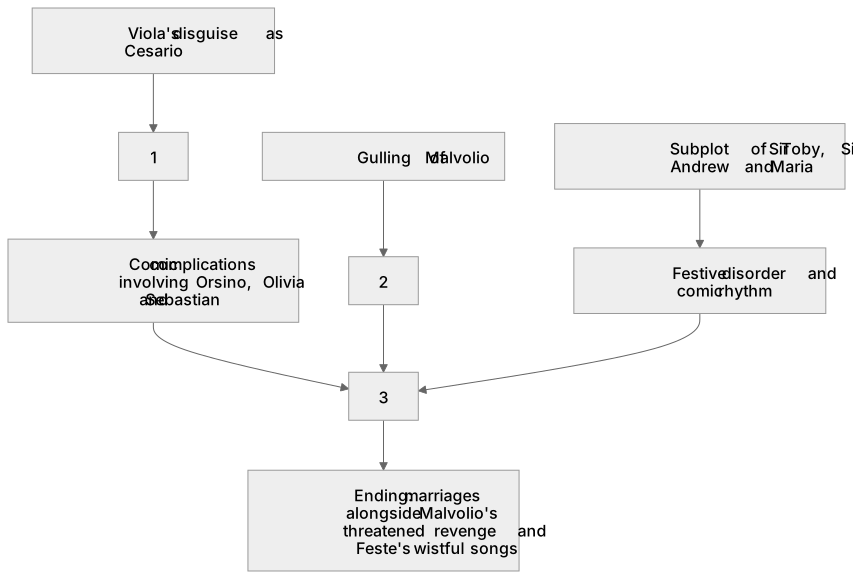
Label the diagram
Some boxes have lost their names. Pick the right name for each number.
1Box 1
2Box 2
3Box 3
There is more to this lesson
The full lesson goes on to check your understanding and help you earn the marks. Create a free account to carry on, with your progress saved.
A week of Premium from your first lesson · Then the free plan continues · No card, no charge
Test your understanding of Aspects of comedy - Set texts: Shakespeare: William Shakespeare: Twelfth Night
Active recall beats re-reading. Take an instant quiz now to test what you’ve learned and lock it into long-term memory.
A week of Premium from your first lesson · Then the free plan continues · No card, no charge