AQA · A-Level · English Literature
Course version: 7717 · Version from Sept 2026
Aspects of comedy: the sense that all will end well and that fortune smiles
Comedy often leaves an audience with the conviction that events are bending towards a happy outcome, and that chance or luck is kindly disposed towards the characters.
Checked against the AQA 7717 specification (opens in a new tab) on .
- Point 9 of 18
- 4 key terms
Study notes
From the checked teaching notes for this specification point.
The idea
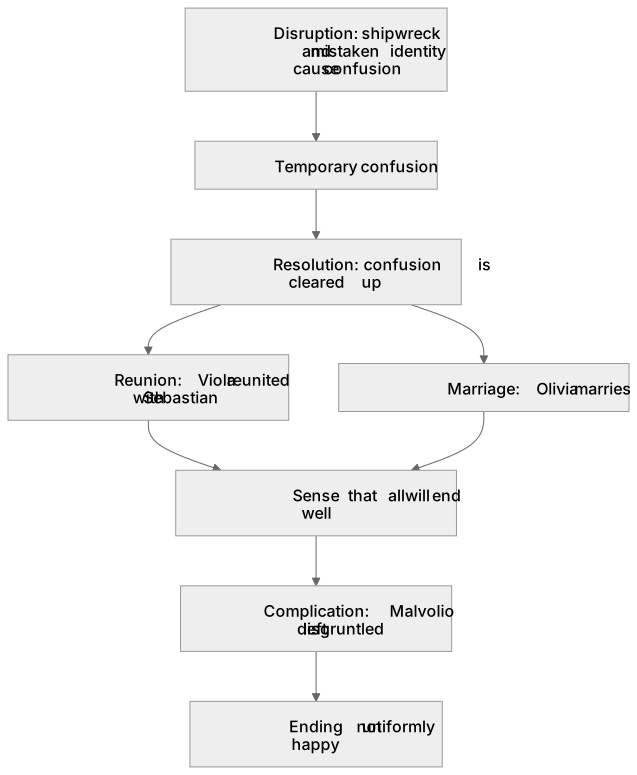
Comedy often leaves an audience with the conviction that events are bending towards a happy outcome, and that chance or luck is kindly disposed towards the characters. This is not the same as saying nothing goes wrong; rather, disruptions are temporary and are resolved. In Twelfth Night, shipwreck and mistaken identity cause confusion, yet Viola is reunited with Sebastian and Olivia marries. The ending feels earned because earlier confusion is cleared up. They should also notice when the sense is complicated, for example where a character such as Malvolio is left disgruntled, so the ending is not uniformly happy. Assessment asks candidates to analyse how such effects are produced and to weigh them against darker elements.
What earns the marks
- Explains that the phrase describes a prevailing mood or trajectory in comedy rather than a guarantee that every character benefits.
- Analyses how resolution, reunion, marriage or forgiveness generate the impression that matters will end well.
- Examines the role of chance, coincidence or fortunate timing in bringing about the happy outcome.
- Uses textual detail, such as a reconciliation scene or a closing speech, to support the claim about fortune smiling.
- Considers complications, such as an unresolved or punished figure, and judges how far they qualify the overall sense of good fortune.
Common mistakes and how to put them right
Treating the statement as a claim that every character is happy at the end.
Put it right: Distinguish the overall comic trajectory from individual outcomes.
Assuming that a happy ending is simply asserted rather than constructed.
Put it right: Identify the structural and linguistic means by which it is produced.
Confusing the sense that fortune smiles with the idea that characters deserve their good fortune.
Put it right: Separate luck or providence from moral desert.
Exam tips
- Anchor each point about good fortune in a specific moment, then explain how that moment shapes the audience's expectation.
- Use the wording of the statement to frame your argument, but move quickly to evidence and analysis rather than repeating it.
- When an ending is mixed, argue about degree and effect instead of declaring the play simply happy or simply sad.
Try the lesson
The start of the Aspects of comedy: the sense that all will end well and that fortune smiles lesson, made from checked teaching notes for this specification point.
Have a go first
In a comedy, a character survives a shipwreck and is reunited with a lost sibling by apparent chance. Which aspect of comedy does this outcome most clearly illustrate?
Listen
Comedy often leaves an audience with the conviction that events are bending towards a happy outcome, and that chance or luck is kindly disposed towards the characters. This is not the same as saying nothing goes wrong; rather, disruptions are temporary and are resolved. In Twelfth Night, shipwreck and mistaken identity cause confusion, yet Viola is reunited with Sebastian and Olivia marries. The ending feels earned because earlier confusion is cleared up. They should also notice when the sense is complicated, for example where a character such as Malvolio is left disgruntled, so the ending is not uniformly happy. Assessment asks candidates to analyse how such effects are produced and to weigh them against darker elements. A strong answer earns marks for these points. Explains that the phrase describes a prevailing mood or trajectory in comedy rather than a guarantee that every character benefits. Analyses how resolution, reunion, marriage or forgiveness generate the impression that matters will end well. Examines the role of chance, coincidence or fortunate timing in bringing about the happy outcome. Uses textual detail, such as a reconciliation scene or a closing speech, to support the claim about fortune smiling. A common slip: Treating the statement as a claim that every character is happy at the end. Instead, distinguish the overall comic trajectory from individual outcomes. Exam tip: Anchor each point about good fortune in a specific moment, then explain how that moment shapes the audience's expectation.
See it
Key words
Say what each word means before you turn the card.
Resolution and reconciliation
Try answering aloud or in your head before turning the card.
Fortune, chance and providence
Try answering aloud or in your head before turning the card.
Marriage and reunion
Try answering aloud or in your head before turning the card.
Comic mood and tonal balance
Try answering aloud or in your head before turning the card.
See every definition
- Resolution and reconciliation
- The clearing up of earlier confusion and the bringing together of characters, which helps to create the impression that matters will end well.
- Fortune, chance and providence
- The role of luck, coincidence or fortunate timing in bringing about the happy outcome, which is separate from moral desert.
- Marriage and reunion
- Plot events such as Viola being reunited with Sebastian and Olivia marrying, which generate the impression that matters will end well.
- Comic mood and tonal balance
- A prevailing mood or trajectory in comedy that is not a guarantee every character benefits, since an unresolved or punished figure may qualify the overall sense of good fortune.
Label the diagram
Some boxes have lost their names. Pick the right name for each number.
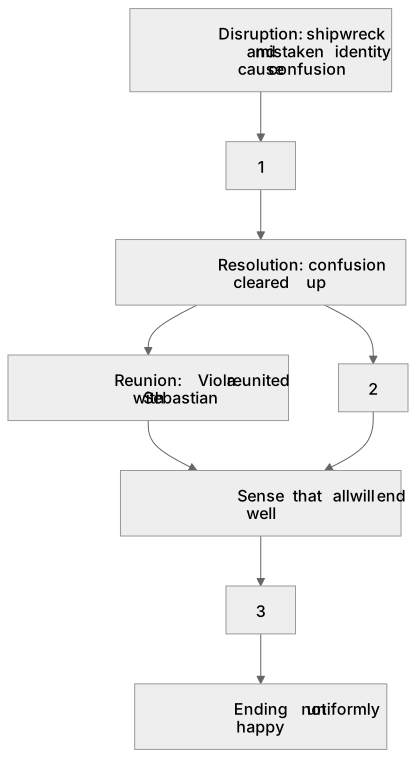
1Box 1
2Box 2
3Box 3
There is more to this lesson
The full lesson goes on to check your understanding and help you earn the marks. Create a free account to carry on, with your progress saved.
A week of Premium from your first lesson · Then the free plan continues · No card, no charge
Test your understanding of Aspects of comedy: the sense that all will end well and that fortune smiles
Active recall beats re-reading. Take an instant quiz now to test what you’ve learned and lock it into long-term memory.
A week of Premium from your first lesson · Then the free plan continues · No card, no charge