AQA · A-Level · English Literature
Course version: 7717 · Version from Sept 2026
The role of the comic villain, or rival, who directly affects the fortune…
Full specification wording
Aspects of comedy: the role of the comic villain, or rival, who directly affects the fortune of the hero or heroine, who causes some disruption to the cheerful mood but whose power is finally curtailed
The comic villain or rival is a blocking figure: someone whose schemes or social power directly alter the hero's or heroine's fortunes.
Checked against the AQA 7717 specification (opens in a new tab) on .
- Point 8 of 18
Study notes
From the checked teaching notes for this specification point.
The idea
The comic villain or rival is a blocking figure: someone whose schemes or social power directly alter the hero's or heroine's fortunes. Identify what the figure wants, how that desire obstructs the protagonist, and by what means the disruption is created. Consider the tone of the disruption: is it menacing, absurd, or both? Then examine the curtailment of power. Is the villain exposed, outwitted, married off, banished, or simply absorbed into the festive ending? Ask whether the curtailment feels complete or whether a residue of threat survives, since that shapes whether the comedy closes in confidence or unease.
What earns the marks
- Identify the comic villain or rival precisely and explain the mechanism by which that figure affects the protagonist's fortune.
- Analyse how the figure disrupts the cheerful mood, noting whether the disruption is threatening, ridiculous, or a blend of both.
- Examine the moment or process by which the figure's power is curtailed, and assess how complete that curtailment is.
- Consider the villain's function in the plot's moral economy: what does the comedy endorse by defeating or containing this figure?
- Compare how different texts handle the removal of the blocking figure and what that reveals about each comedy's values.
Common mistakes and how to put them right
Labelling a character a villain without evidence of direct impact on the protagonist's fortunes.
Put it right by citing a specific action that changes the hero's or heroine's situation.
Assuming the villain's defeat is total.
Put it right by examining whether any threat, influence, or social power remains at the close.
Ignoring comic tone and treating the villain only as a serious threat.
Put it right by analysing how absurdity or wit qualifies the danger.
Exam tips
- Choose two or three moments that show the villain's power rising and falling, and organise your answer around that movement.
- Comment on language used about or by the villain to show how the text guides audience judgement.
- When comparing, contrast the method of curtailment, such as exposure versus forgiveness, and link it to each play's comic vision.
Try the lesson
The start of the Aspects of comedy: the role of the comic villain, or rival, who directly affects the fortune of the hero or heroine, who causes some disruption to the cheerful mood but whose power is finally curtailed lesson, made from checked teaching notes for this specification point.
Have a go first
In a comedy, which description best fits the comic villain or rival?
Listen
The comic villain or rival is a blocking figure: someone whose schemes or social power directly alter the hero's or heroine's fortunes. Identify what the figure wants, how that desire obstructs the protagonist, and by what means the disruption is created. Consider the tone of the disruption: is it menacing, absurd, or both? Then examine the curtailment of power. Is the villain exposed, outwitted, married off, banished, or simply absorbed into the festive ending? Ask whether the curtailment feels complete or whether a residue of threat survives, since that shapes whether the comedy closes in confidence or unease. A strong answer earns marks for these points. Identify the comic villain or rival precisely and explain the mechanism by which that figure affects the protagonist's fortune. Analyse how the figure disrupts the cheerful mood, noting whether the disruption is threatening, ridiculous, or a blend of both. Examine the moment or process by which the figure's power is curtailed, and assess how complete that curtailment is. Consider the villain's function in the plot's moral economy: what does the comedy endorse by defeating or containing this figure? A common slip: Labelling a character a villain without evidence of direct impact on the protagonist's fortunes. Instead, citing a specific action that changes the hero's or heroine's situation. Exam tip: Choose two or three moments that show the villain's power rising and falling, and organise your answer around that movement.
See it
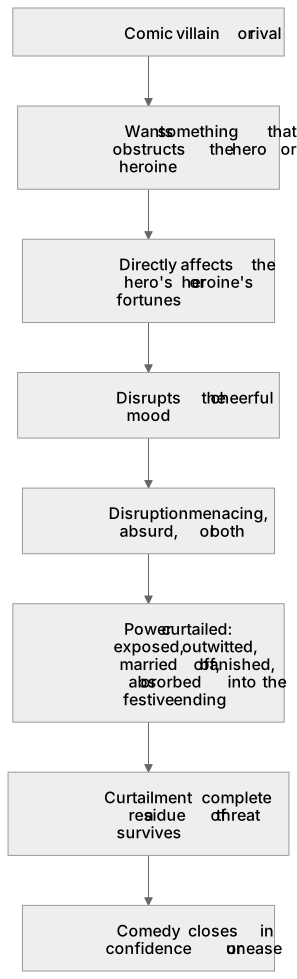
Put it in order
Put these steps in the order they happen.
- 1. Disruption menacing, absurd, or both
- 2. Comedy closes in confidence or unease
- 3. Power curtailed: exposed, outwitted, married off, banished, or absorbed into the festive ending
- 4. Comic villain or rival
- 5. Wants something that obstructs the hero or heroine
- 6. Curtailment complete or a residue of threat survives
- 7. Directly affects the hero's or heroine's fortunes
- 8. Disrupts the cheerful mood
Label the diagram
Some boxes have lost their names. Pick the right name for each number.
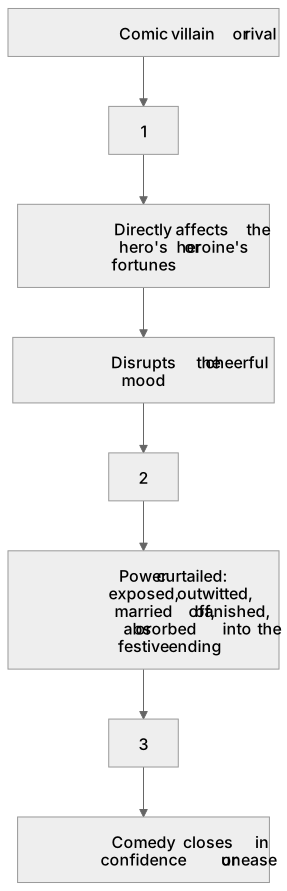
1Box 1
2Box 2
3Box 3
There is more to this lesson
The full lesson goes on to check your understanding and help you earn the marks. Create a free account to carry on, with your progress saved.
A week of Premium from your first lesson · Then the free plan continues · No card, no charge
Test your understanding of Aspects of comedy: the role of the comic villain, or rival, who directly affects the fortune of the hero or heroine, who causes some disruption to the cheerful mood but whose power is finally curtailed
Active recall beats re-reading. Take an instant quiz now to test what you’ve learned and lock it into long-term memory.
A week of Premium from your first lesson · Then the free plan continues · No card, no charge