AQA · A-Level · English Literature
Course version: 7717 · Version from Sept 2026
The use of disguise, escapes and discovery, elements of the supernatural
Full specification wording
Aspects of comedy: the use of disguise, escapes and discovery, elements of the supernatural
Comedy often turns on disguise, escape and discovery, and on supernatural elements that unsettle ordinary rules.
Checked against the AQA 7717 specification (opens in a new tab) on .
- Point 13 of 18
- 4 key terms
Study notes
From the checked teaching notes for this specification point.
The idea
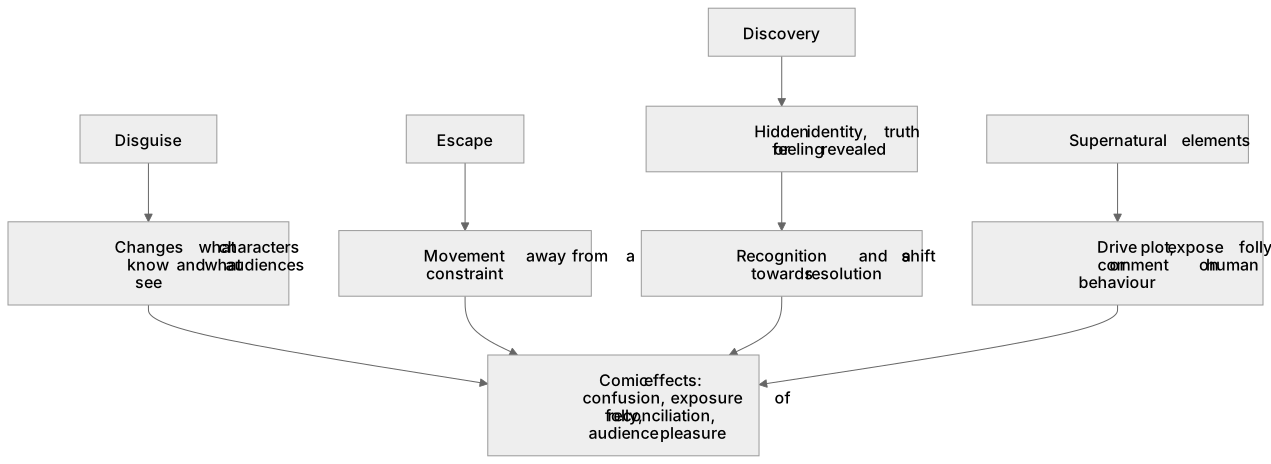
Comedy often turns on disguise, escape and discovery, and on supernatural elements that unsettle ordinary rules. Disguise changes what characters know and what audiences see: a woman may dress as a man, a servant may impersonate a master, or a character may hide behind a mask or a false name. Escape follows when a character slips free of a constraint, such as a forced marriage, a prison, a household or a social role. Discovery is the moment when hidden identity, truth or feeling is revealed, often producing recognition and a shift towards resolution. Supernatural elements, including fairies, ghosts, spirits, magic or prophetic dreams, can drive plot, expose folly or comment on human behaviour. When analysing, track who disguises, why they escape, what is discovered and how the supernatural affects the comic world.
What earns the marks
- Explains how disguise creates dramatic irony because the audience knows more than some characters on stage.
- Analyses escape as a movement away from constraint, showing what social or personal pressure the character is avoiding.
- Examines discovery as a turning point that changes relationships and moves the action towards resolution.
- Discusses supernatural elements as agents of plot, comment or atmosphere rather than as mere decoration.
- Uses precise textual evidence, such as a specific disguise, escape route, revelation or supernatural appearance, to support the argument.
- Connects these devices to wider comic effects, including confusion, exposure of folly, reconciliation and audience pleasure.
Common mistakes and how to put them right
Retelling the plot instead of analysing how disguise, escape, discovery and the supernatural create meaning.
Put it right by linking each device to its effect on characters, audience or theme.
Treating the supernatural as evidence that the play is not a comedy.
Put it right by explaining how supernatural elements can intensify comic confusion or expose human weakness.
Assuming every disguise is comic simply because it is a disguise.
Put it right by distinguishing between disguises that generate laughter and those that create danger, sympathy or social critique.
Exam tips
- Plan by grouping evidence under the four strands: disguise, escape, discovery and the supernatural.
- Embed short quotations and refer to specific moments rather than describing whole scenes.
- Use subject terminology such as dramatic irony, recognition, masquerade and metatheatre where it sharpens the analysis.
Try the lesson
The start of the Aspects of comedy: the use of disguise, escapes and discovery, elements of the supernatural lesson, made from checked teaching notes for this specification point.
Have a go first
In comedy, a character who swaps clothes with someone of a different social rank in order to move freely through a household is making use of which convention?
Listen
Comedy often turns on disguise, escape and discovery, and on supernatural elements that unsettle ordinary rules. Disguise changes what characters know and what audiences see: a woman may dress as a man, a servant may impersonate a master, or a character may hide behind a mask or a false name. Escape follows when a character slips free of a constraint, such as a forced marriage, a prison, a household or a social role. Discovery is the moment when hidden identity, truth or feeling is revealed, often producing recognition and a shift towards resolution. Supernatural elements, including fairies, ghosts, spirits, magic or prophetic dreams, can drive plot, expose folly or comment on human behaviour. When analysing, track who disguises, why they escape, what is discovered and how the supernatural affects the comic world. A strong answer earns marks for these points. Explains how disguise creates dramatic irony because the audience knows more than some characters on stage. Analyses escape as a movement away from constraint, showing what social or personal pressure the character is avoiding. Examines discovery as a turning point that changes relationships and moves the action towards resolution. Discusses supernatural elements as agents of plot, comment or atmosphere rather than as mere decoration. A common slip: Retelling the plot instead of analysing how disguise, escape, discovery and the supernatural create meaning. Instead, linking each device to its effect on characters, audience or theme. Exam tip: Plan by grouping evidence under the four strands: disguise, escape, discovery and the supernatural.
See it
Key words
Say what each word means before you turn the card.
Disguise
Try answering aloud or in your head before turning the card.
Escape
Try answering aloud or in your head before turning the card.
Discovery
Try answering aloud or in your head before turning the card.
Supernatural elements
Try answering aloud or in your head before turning the card.
See every definition
- Disguise
- A device that changes what characters know and what audiences see, as when a woman dresses as a man, a servant impersonates a master, or a character hides behind a mask or false name.
- Escape
- A movement away from a constraint, such as a forced marriage, a prison, a household or a social role, showing what social or personal pressure the character is avoiding.
- Discovery
- The moment when hidden identity, truth or feeling is revealed, often producing recognition and a shift towards resolution.
- Supernatural elements
- Fairies, ghosts, spirits, magic or prophetic dreams that can drive plot, expose folly or comment on human behaviour.
Label the diagram
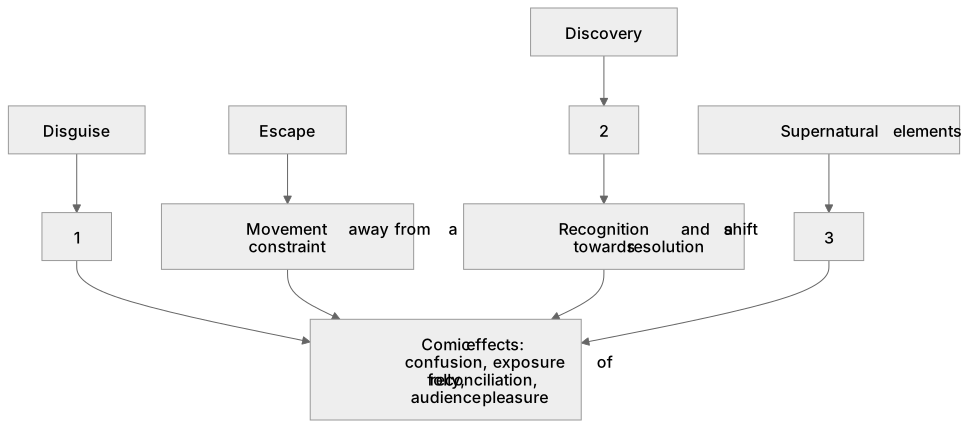
Some boxes have lost their names. Pick the right name for each number.
1Box 1
2Box 2
3Box 3
There is more to this lesson
The full lesson goes on to check your understanding and help you earn the marks. Create a free account to carry on, with your progress saved.
A week of Premium from your first lesson · Then the free plan continues · No card, no charge
Test your understanding of Aspects of comedy: the use of disguise, escapes and discovery, elements of the supernatural
Active recall beats re-reading. Take an instant quiz now to test what you’ve learned and lock it into long-term memory.
A week of Premium from your first lesson · Then the free plan continues · No card, no charge