AQA · A-Level · English Literature
Course version: 7717 · Version from Sept 2026
The structural patterning of the text as it moves from disorder to order,…
Full specification wording
Aspects of comedy: the structural patterning of the text as it moves from disorder to order, incorporating rule and misrule, how competition between characters is set up and resolved, how opposites are contrasted and reconciled, leading to comic resolutions
Comedy often follows a structural pattern from disorder to order.
Checked against the AQA 7717 specification (opens in a new tab) on .
- Point 14 of 18
- 3 key terms
Study notes
From the checked teaching notes for this specification point.
The idea
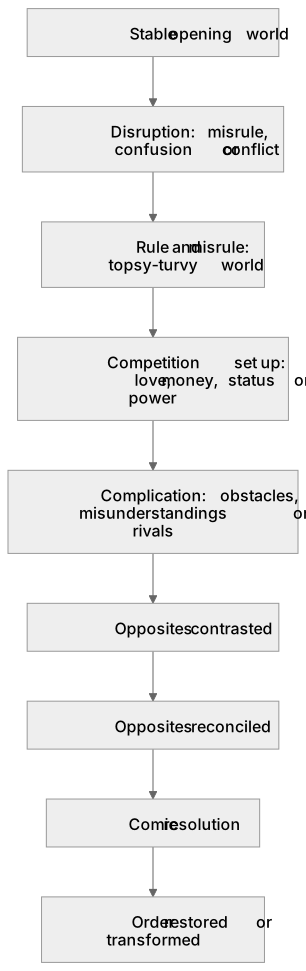
Comedy often follows a structural pattern from disorder to order. A stable opening world is disrupted by misrule, confusion or conflict, and the action eventually moves towards a comic resolution. Rule and misrule may appear as a topsy-turvy world where servants act like masters, authority is mocked or festive chaos temporarily takes over. Competition between characters, whether for love, money, status or power, is set up early and then complicated by obstacles, misunderstandings or rivals. Opposites, such as youth and age, town and country, or reason and desire, are contrasted and then reconciled. The ending may restore order, but often in a transformed form, through marriage, reunion, forgiveness or a new social arrangement. When analysing, trace the sequence of disruption, complication and resolution, and explain how the patterning shapes meaning.
What earns the marks
- Traces the movement from an initial order through disruption and misrule towards a comic resolution.
- Explains how rule and misrule are embodied in characters, settings or festive episodes.
- Analyses how competition is established, complicated and resolved across the plot.
- Examines how contrasted opposites are set against each other and then brought together or reconciled.
- Evaluates whether the ending restores the original order or creates a new, transformed order.
- Uses structural vocabulary, such as exposition, complication, climax, resolution and parallel plotting, to organise the argument.
Common mistakes and how to put them right
Describing the plot sequence without analysing how the patterning creates meaning.
Put it right by explaining the effect of each structural movement.
Assuming the ending is simply a happy return to the beginning.
Put it right by considering what has changed and what remains unresolved.
Treating competition and reconciliation as separate topics.
Put it right by showing how the resolution of competition depends on earlier contrasts and conflicts.
Exam tips
- Map the text's structure briefly before writing, noting where disorder, misrule and resolution occur.
- Use connectives such as initially, subsequently and ultimately to signal structural movement.
- Support claims about patterning with evidence from different points in the text, not just the ending.
Try the lesson
The start of the Aspects of comedy: the structural patterning of the text as it moves from disorder to order, incorporating rule and misrule, how competition between characters is set up and resolved, how opposites are contrasted and reconciled, leading to comic resolutions lesson, made from checked teaching notes for this specification point.
Have a go first
In a comedy studied for this section, the opening scenes present a household in confusion and the final scene presents a marriage feast. Which feature of comic structure does this change most directly illustrate?
Listen
Comedy often follows a structural pattern from disorder to order. A stable opening world is disrupted by misrule, confusion or conflict, and the action eventually moves towards a comic resolution. Rule and misrule may appear as a topsy-turvy world where servants act like masters, authority is mocked or festive chaos temporarily takes over. Competition between characters, whether for love, money, status or power, is set up early and then complicated by obstacles, misunderstandings or rivals. Opposites, such as youth and age, town and country, or reason and desire, are contrasted and then reconciled. The ending may restore order, but often in a transformed form, through marriage, reunion, forgiveness or a new social arrangement. When analysing, trace the sequence of disruption, complication and resolution, and explain how the patterning shapes meaning. A strong answer earns marks for these points. Traces the movement from an initial order through disruption and misrule towards a comic resolution. Explains how rule and misrule are embodied in characters, settings or festive episodes. Analyses how competition is established, complicated and resolved across the plot. Examines how contrasted opposites are set against each other and then brought together or reconciled. A common slip: Describing the plot sequence without analysing how the patterning creates meaning. Instead, explaining the effect of each structural movement. Exam tip: Map the text's structure briefly before writing, noting where disorder, misrule and resolution occur.
See it
Key words
Say what each word means before you turn the card.
Order and disorder
Try answering aloud or in your head before turning the card.
Rule and misrule
Try answering aloud or in your head before turning the card.
Contrast and resolution
Try answering aloud or in your head before turning the card.
See every definition
- Order and disorder
- The structural patterning of the text as it moves from disorder to order.
- Rule and misrule
- A topsy-turvy world where servants act like masters, authority is mocked or festive chaos temporarily takes over.
- Contrast and resolution
- Opposites are contrasted and then reconciled, leading to comic resolutions.
Label the diagram
Some boxes have lost their names. Pick the right name for each number.
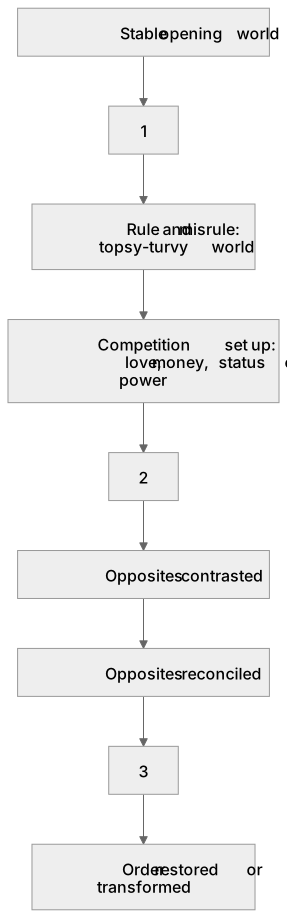
1Box 1
2Box 2
3Box 3
There is more to this lesson
The full lesson goes on to check your understanding and help you earn the marks. Create a free account to carry on, with your progress saved.
A week of Premium from your first lesson · Then the free plan continues · No card, no charge
Test your understanding of Aspects of comedy: the structural patterning of the text as it moves from disorder to order, incorporating rule and misrule, how competition between characters is set up and resolved, how opposites are contrasted and reconciled, leading to comic resolutions
Active recall beats re-reading. Take an instant quiz now to test what you’ve learned and lock it into long-term memory.
A week of Premium from your first lesson · Then the free plan continues · No card, no charge