AQA · A-Level · English Literature
Course version: 7717 · Version from Sept 2026
At the core of all the set texts is a tragic hero or heroine who is flawed…
Full specification wording
Aspects of tragedy: At the core of all the set texts is a tragic hero or heroine who is flawed in some way, who suffers and causes suffering to others and in all texts there is an interplay between what might be seen as villains and victims.
This statement asks you to treat the tragic hero or heroine as the organising centre of each set text, but not as a simple label to attach and leave.
Checked against the AQA 7717 specification (opens in a new tab) on .
- Point 1 of 14
- 3 key terms
Study notes
From the checked teaching notes for this specification point.
The idea
This statement asks you to treat the tragic hero or heroine as the organising centre of each set text, but not as a simple label to attach and leave. You need to show how a flaw operates: whether it is a hamartia such as pride, jealousy or indecision, how it leads the protagonist to suffer, and how that suffering radiates outwards to others. Equally important is the interplay between villain and victim. In Othello, Iago is a villain who also claims grievance, while Desdemona is a victim who speaks with moral authority; in Death of a Salesman, Willy is both a sufferer and a source of suffering for Biff and Linda. When you analyse a moment, ask who is harmed, who causes harm, and how the text complicates any neat division between the two.
What earns the marks
- Explains how the protagonist's flaw functions as a cause of suffering rather than merely a character trait, using textual evidence.
- Traces the consequences of the hero's or heroine's actions on at least one other character, showing how suffering is distributed.
- Analyses the interplay between villain and victim, including moments where those roles overlap or shift.
- Uses accurate tragic terminology such as hamartia, peripeteia, catharsis and catastrophe where it genuinely illuminates the text.
- Supports claims with close reference to language, structure and dramatic or narrative method.
- Connects the particular example to the wider tragic pattern of the whole text rather than treating it in isolation.
Common mistakes and how to put them right
Treating the flaw as a fixed personality label and listing it without showing how it causes action and suffering.
Put it right: Trace the flaw through a specific decision and its consequences.
Assuming villain and victim are mutually exclusive categories.
Put it right: Identify a moment where a character occupies both positions and explain the tension.
Retelling plot without analysing method.
Put it right: Quote or closely reference a short passage and comment on the writer's choices.
Exam tips
- Plan around the terms of the question, ensuring flaw, suffering and the villain-victim interplay are all addressed rather than only the most obvious one.
- Embed short quotations and analyse individual words or images rather than dropping in long block quotations.
- Keep the tragic genre visible throughout the essay, linking each point back to how tragedy works in the text as a whole.
Try the lesson
The start of the Aspects of tragedy: At the core of all the set texts is a tragic hero or heroine who is flawed in some way, who suffers and causes suffering to others and in all texts there is an interplay between what might be seen as villains and victims. lesson, made from checked teaching notes for this specification point.
Have a go first
In traditional tragic conventions, what is typically true of the central hero or heroine?
Listen
This statement asks you to treat the tragic hero or heroine as the organising centre of each set text, but not as a simple label to attach and leave. You need to show how a flaw operates: whether it is a hamartia such as pride, jealousy or indecision, how it leads the protagonist to suffer, and how that suffering radiates outwards to others. Equally important is the interplay between villain and victim. In Othello, Iago is a villain who also claims grievance, while Desdemona is a victim who speaks with moral authority; in Death of a Salesman, Willy is both a sufferer and a source of suffering for Biff and Linda. When you analyse a moment, ask who is harmed, who causes harm, and how the text complicates any neat division between the two. A strong answer earns marks for these points. Explains how the protagonist's flaw functions as a cause of suffering rather than merely a character trait, using textual evidence. Traces the consequences of the hero's or heroine's actions on at least one other character, showing how suffering is distributed. Analyses the interplay between villain and victim, including moments where those roles overlap or shift. Uses accurate tragic terminology such as hamartia, peripeteia, catharsis and catastrophe where it genuinely illuminates the text. A common slip: Treating the flaw as a fixed personality label and listing it without showing how it causes action and suffering. Instead, trace the flaw through a specific decision and its consequences. Exam tip: Plan around the terms of the question, ensuring flaw, suffering and the villain-victim interplay are all addressed rather than only the most obvious one.
See it
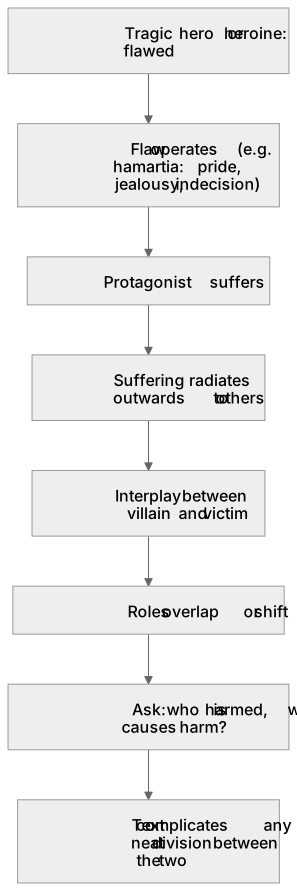
Put it in order
Put these steps in the order they happen.
- 1. Interplay between villain and victim
- 2. Text complicates any neat division between the two
- 3. Roles overlap or shift
- 4. Tragic hero or heroine: flawed
- 5. Flaw operates (e.g. hamartia: pride, jealousy, indecision)
- 6. Ask: who is harmed, who causes harm?
- 7. Protagonist suffers
- 8. Suffering radiates outwards to others
Key words
Say what each word means before you turn the card.
Hamartia
Try answering aloud or in your head before turning the card.
Suffering and its transmission to others
Try answering aloud or in your head before turning the card.
The instability of villain and victim roles
Try answering aloud or in your head before turning the card.
See every definition
- Hamartia
- A flaw such as pride, jealousy or indecision that operates as a cause of the protagonist's suffering rather than merely a character trait.
- Suffering and its transmission to others
- The protagonist's suffering radiates outwards to others, so that the hero or heroine both suffers and causes suffering.
- The instability of villain and victim roles
- An interplay in which villain and victim roles overlap or shift, complicating any neat division between the two.
Label the diagram
Some boxes have lost their names. Pick the right name for each number.
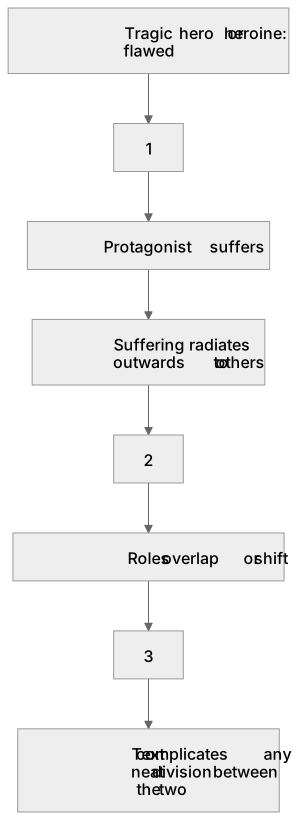
1Box 1
2Box 2
3Box 3
There is more to this lesson
The full lesson goes on to check your understanding and help you earn the marks. Create a free account to carry on, with your progress saved.
A week of Premium from your first lesson · Then the free plan continues · No card, no charge
Test your understanding of Aspects of tragedy: At the core of all the set texts is a tragic hero or heroine who is flawed in some way, who suffers and causes suffering to others and in all texts there is an interplay between what might be seen as villains and victims.
Active recall beats re-reading. Take an instant quiz now to test what you’ve learned and lock it into long-term memory.
A week of Premium from your first lesson · Then the free plan continues · No card, no charge