AQA · A-Level · English Literature
Course version: 7717 · Version from Sept 2026
Some tragic features will be more in evidence in some texts than in others…
Full specification wording
Aspects of tragedy: Some tragic features will be more in evidence in some texts than in others and students will need to understand how particular aspects of the tragic genre are used and how they work in the three chosen texts.
No two tragedies display the genre in identical proportions.
Checked against the AQA 7717 specification (opens in a new tab) on .
- Point 2 of 14
- 3 key terms
Study notes
From the checked teaching notes for this specification point.
The idea
No two tragedies display the genre in identical proportions. A classical text may foreground a high-status hero, a chorus and a catastrophe, while a modern domestic tragedy may place ordinary people, social pressure and memory at its centre. Your task is to judge which features are prominent in each of your three texts and to explain how those features function, rather than forcing every text into one template. For example, recognition and reversal may be sharply staged in one play but diffused across a novel's ending. Comparison should therefore be selective and purposeful: identify a feature, show how it operates in one text, then show how another text uses, modifies or underplays it.
What earns the marks
- Identifies which tragic features are prominent in each of the three chosen texts and which are muted or absent.
- Explains how a chosen feature works in a specific text through close reference to language, structure and dramatic method.
- Makes purposeful comparisons between texts, showing similarity and difference in the use of tragic conventions.
- Avoids treating the genre as a checklist and instead discusses how features combine to produce tragic effect.
- Uses accurate terminology such as catastrophe, recognition, reversal and catharsis only where it is justified by the text.
- Shows awareness that genre is shaped by context, form and the writer's choices.
Common mistakes and how to put them right
Assuming every set text must contain every tragic feature in equal measure.
Put it right: Rank the features by prominence in each text and justify the ranking with evidence.
Comparing texts only by listing parallel plot events.
Put it right: Compare how a shared feature is handled differently and to what effect.
Using genre terms as decoration without explaining their function.
Put it right: Define the term briefly and show what it does in the passage under discussion.
Exam tips
- Choose two or three tragic features to track across your texts rather than trying to cover the whole genre.
- Signal comparison explicitly with connectives such as whereas, similarly and in contrast, and follow each with analysis.
- Anchor every genre claim in a short quotation or precise structural reference so the argument stays textual.
Try the lesson
The start of the Aspects of tragedy: Some tragic features will be more in evidence in some texts than in others and students will need to understand how particular aspects of the tragic genre are used and how they work in the three chosen texts. lesson, made from checked teaching notes for this specification point.
Have a go first
When exploring the tragic genre across a variety of literary texts, what is generally true about the presence of specific tragic conventions?
Listen
No two tragedies display the genre in identical proportions. A classical text may foreground a high-status hero, a chorus and a catastrophe, while a modern domestic tragedy may place ordinary people, social pressure and memory at its centre. Your task is to judge which features are prominent in each of your three texts and to explain how those features function, rather than forcing every text into one template. For example, recognition and reversal may be sharply staged in one play but diffused across a novel's ending. Comparison should therefore be selective and purposeful: identify a feature, show how it operates in one text, then show how another text uses, modifies or underplays it. A strong answer earns marks for these points. Identifies which tragic features are prominent in each of the three chosen texts and which are muted or absent. Explains how a chosen feature works in a specific text through close reference to language, structure and dramatic method. Makes purposeful comparisons between texts, showing similarity and difference in the use of tragic conventions. Avoids treating the genre as a checklist and instead discusses how features combine to produce tragic effect. A common slip: Assuming every set text must contain every tragic feature in equal measure. Instead, rank the features by prominence in each text and justify the ranking with evidence. Exam tip: Choose two or three tragic features to track across your texts rather than trying to cover the whole genre.
See it
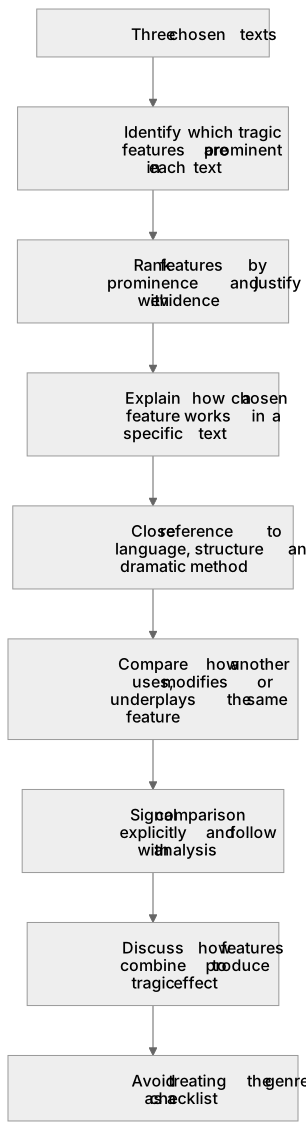
Key words
Say what each word means before you turn the card.
Variation within a genre
Try answering aloud or in your head before turning the card.
Selective and purposeful comparison
Try answering aloud or in your head before turning the card.
The function of tragic conventions
Try answering aloud or in your head before turning the card.
See every definition
- Variation within a genre
- No two tragedies display the genre in identical proportions, so some tragic features will be more in evidence in some texts than in others.
- Selective and purposeful comparison
- Comparison identifies a feature, shows how it operates in one text, then shows how another text uses, modifies or underplays it, rather than listing parallel plot events.
- The function of tragic conventions
- Students judge which features are prominent in each text and explain how those features work, rather than forcing every text into one template or using genre terms as decoration.
Label the diagram
Some boxes have lost their names. Pick the right name for each number.
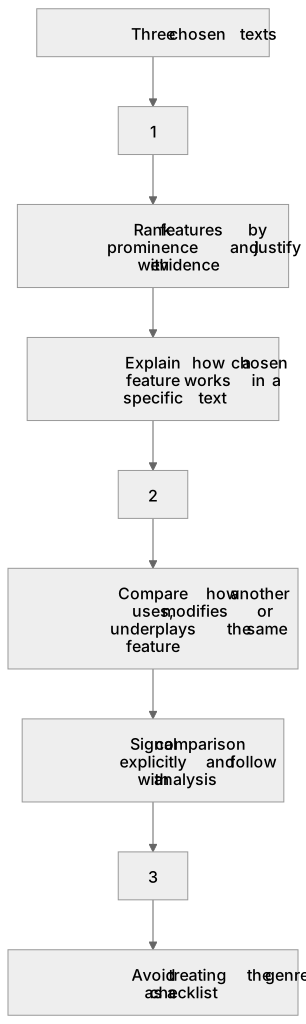
1Box 1
2Box 2
3Box 3
There is more to this lesson
The full lesson goes on to check your understanding and help you earn the marks. Create a free account to carry on, with your progress saved.
A week of Premium from your first lesson · Then the free plan continues · No card, no charge
Test your understanding of Aspects of tragedy: Some tragic features will be more in evidence in some texts than in others and students will need to understand how particular aspects of the tragic genre are used and how they work in the three chosen texts.
Active recall beats re-reading. Take an instant quiz now to test what you’ve learned and lock it into long-term memory.
A week of Premium from your first lesson · Then the free plan continues · No card, no charge