AQA · A-Level · English Literature
Course version: 7717 · Version from Sept 2026
Drama and further texts: F. Scott Fitzgerald: The Great Gatsby
Full specification wording
Aspects of tragedy - Set texts: Drama and further texts: F. Scott Fitzgerald: The Great Gatsby
The Great Gatsby is a modern tragedy that interrogates the American Dream through Jay Gatsby’s self-invention and his pursuit of Daisy Buchanan.
Checked against the AQA 7717 specification (opens in a new tab) on .
- Point 1 of 6
Study notes
From the checked teaching notes for this specification point.
The idea
The Great Gatsby is a modern tragedy that interrogates the American Dream through Jay Gatsby’s self-invention and his pursuit of Daisy Buchanan. Contextual understanding of 1920s America, prohibition, class, and old versus new money should inform interpretation without reducing the novel to social history. When writing, integrate short quotations into a line of argument, track motifs across chapters, and evaluate how language, form and structure create tragic effects. Assessment rewards a coherent, evidence-based case about tragedy, not a list of features.
What earns the marks
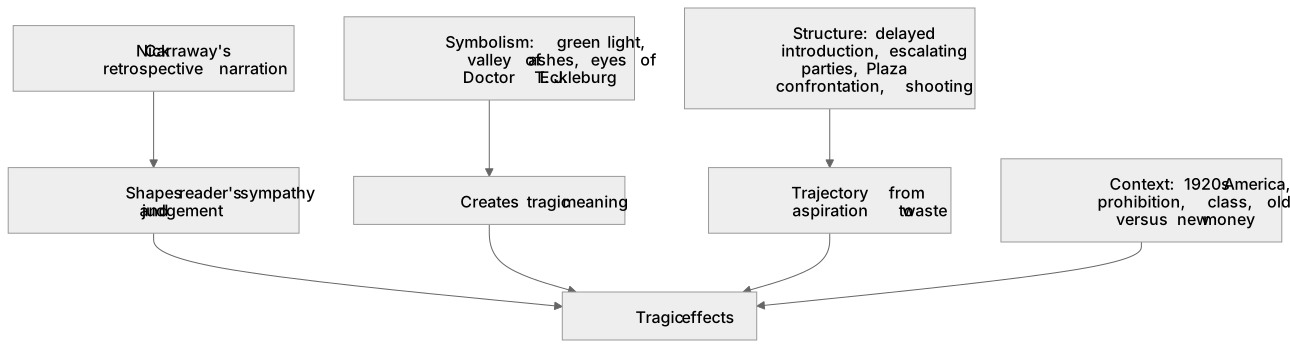
- Analyse how Nick Carraway’s first-person retrospective narration mediates the reader’s sympathy and judgement, for example through his claim to reserve all judgements while making moral evaluations of Tom and Daisy.
- Explore how Fitzgerald uses symbolism to develop tragic meaning, such as the green light representing Gatsby’s incorruptible dream and the valley of ashes exposing the human cost of wealth.
- Examine how structure shapes tragedy: the delayed introduction of Gatsby, the escalating parties, the confrontation at the Plaza, and the abrupt violence of the shooting create a trajectory from aspiration to waste.
- Consider how context informs tragedy, including post-war disillusionment, prohibition, social mobility, and the conflict between inherited wealth and self-made fortune.
- Evaluate how language and imagery construct Gatsby’s romantic self-narrative and its collapse, for example the ‘extraordinary gift for hope’ and the ‘dead dream’.
- Connect the novel’s treatment of love, class and identity to wider tragic conventions such as hubris, hamartia, nemesis and the waste of potential.
Common mistakes and how to put them right
Treating Gatsby only as a victim of Daisy’s cruelty rather than analysing his own complicity in idealising her.
Put it right: Examine how his dream depends on possession and repetition of the past.
Using context as a bolt-on paragraph about the 1920s without linking it to tragic effect.
Put it right: Integrate contextual points into the analysis of character, structure and symbol.
Retelling the plot instead of analysing Fitzgerald’s methods.
Put it right: Focus each paragraph on a technique, its effect, and its contribution to the tragic arc.
Exam tips
- Plan around the tragic focus of the question, selecting three or four episodes that let you track change across the novel.
- Embed short quotations and analyse individual words or images rather than quoting long passages.
- Use the text’s structure as an argument: show how Fitzgerald withholds, repeats or disrupts to create tragic expectation and loss.
Try the lesson
The start of the Aspects of tragedy - Set texts: Drama and further texts: F. Scott Fitzgerald: The Great Gatsby lesson, made from checked teaching notes for this specification point.
Have a go first
In The Great Gatsby, which character is the narrator through whose eyes the reader observes the events of the summer of 1922?
Listen
The Great Gatsby is a modern tragedy that interrogates the American Dream through Jay Gatsby’s self-invention and his pursuit of Daisy Buchanan. Contextual understanding of 1920s America, prohibition, class, and old versus new money should inform interpretation without reducing the novel to social history. When writing, integrate short quotations into a line of argument, track motifs across chapters, and evaluate how language, form and structure create tragic effects. Assessment rewards a coherent, evidence-based case about tragedy, not a list of features. A strong answer earns marks for these points. Analyse how Nick Carraway’s first-person retrospective narration mediates the reader’s sympathy and judgement, for example through his claim to reserve all judgements while making moral evaluations of Tom and Daisy. Explore how Fitzgerald uses symbolism to develop tragic meaning, such as the green light representing Gatsby’s incorruptible dream and the valley of ashes exposing the human cost of wealth. Examine how structure shapes tragedy: the delayed introduction of Gatsby, the escalating parties, the confrontation at the Plaza, and the abrupt violence of the shooting create a trajectory from aspiration to waste. Consider how context informs tragedy, including post-war disillusionment, prohibition, social mobility, and the conflict between inherited wealth and self-made fortune. A common slip: Treating Gatsby only as a victim of Daisy’s cruelty rather than analysing his own complicity in idealising her. Instead, examine how his dream depends on possession and repetition of the past. Exam tip: Plan around the tragic focus of the question, selecting three or four episodes that let you track change across the novel.
See it
Label the diagram
Some boxes have lost their names. Pick the right name for each number.
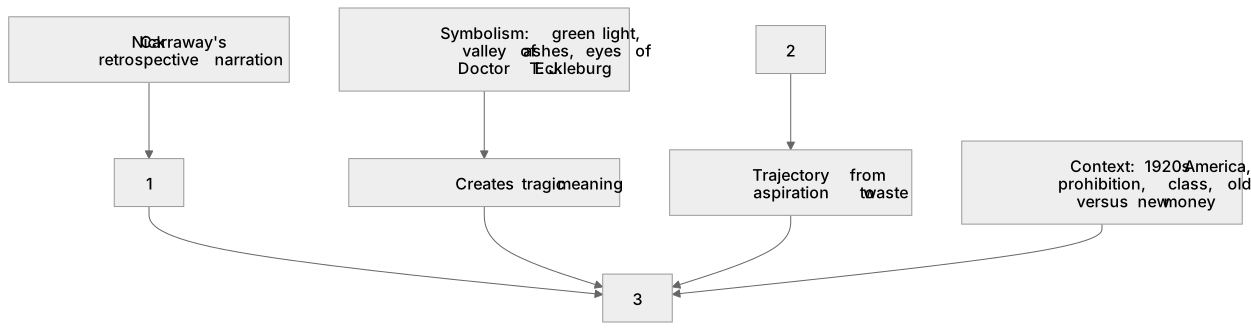
1Box 1
2Box 2
3Box 3
There is more to this lesson
The full lesson goes on to check your understanding and help you earn the marks. Create a free account to carry on, with your progress saved.
A week of Premium from your first lesson · Then the free plan continues · No card, no charge
Test your understanding of Aspects of tragedy - Set texts: Drama and further texts: F. Scott Fitzgerald: The Great Gatsby
Active recall beats re-reading. Take an instant quiz now to test what you’ve learned and lock it into long-term memory.
A week of Premium from your first lesson · Then the free plan continues · No card, no charge