AQA · A-Level · English Literature
Course version: 7717 · Version from Sept 2026
The absence of an ‘aspect’ can be as significant as its presence.
Full specification wording
Aspects of tragedy: The absence of an ‘aspect’ can be as significant as its presence.
Tragedy is often defined by what it withholds as much as by what it shows.
Checked against the AQA 7717 specification (opens in a new tab) on .
- Point 3 of 14
- 4 key terms
Study notes
From the checked teaching notes for this specification point.
The idea
Tragedy is often defined by what it withholds as much as by what it shows. A text may lack a conventional tragic hero, a clear hamartia, a moment of anagnorisis, or a resolving catastrophe, and that gap shapes meaning. For example, if a play denies the audience a final death or a restored order, the unresolved ending may intensify unease or expose the fragility of social values. Analysis should connect the missing aspect to the whole text, using close reference to language, form and structure, and considering how different audiences might respond.
What earns the marks
- Identifies a specific tragic aspect that is absent or withheld, such as a clear hamartia, anagnorisis, catharsis or a decisive catastrophe.
- Explains where the audience or reader would conventionally expect that aspect and how the text creates that expectation.
- Analyses the effect of the absence on meaning, tone or structure, for example unresolved tension, moral ambiguity or a sense of futility.
- Supports the argument with close reference to language, form and structure, such as a withheld final speech, an anticlimactic ending or a disrupted chronology.
- Connects the absence to the wider tragic pattern of the text and to relevant contextual or critical ideas.
Common mistakes and how to put them right
Treating absence as simply a gap in the text rather than a meaningful authorial choice.
Put it right by explaining what the omission does to the audience’s understanding.
Listing missing features without analysing their effect.
Put it right by linking each absence to a specific interpretative point about the tragedy.
Assuming all tragedies must contain the same aspects.
Put it right by recognising that the genre is flexible and that variation is itself significant.
Exam tips
- Anchor each point in a short quotation or precise structural detail so the argument remains text-based.
- Use comparative or evaluative language such as ‘withholds’, ‘denies’ or ‘delays’ to keep the focus on absence as an active technique.
- Plan at least one paragraph that explicitly contrasts what is present with what is missing to show awareness of the whole tragic design.
Try the lesson
The start of the Aspects of tragedy: The absence of an ‘aspect’ can be as significant as its presence. lesson, made from checked teaching notes for this specification point.
Have a go first
In some tragedies, a dramatist might deliberately withhold a conventional element, such as a clear moment of anagnorisis (recognition) for the protagonist. How might this absence function critically within the play?
Listen
Tragedy is often defined by what it withholds as much as by what it shows. A text may lack a conventional tragic hero, a clear hamartia, a moment of anagnorisis, or a resolving catastrophe, and that gap shapes meaning. For example, if a play denies the audience a final death or a restored order, the unresolved ending may intensify unease or expose the fragility of social values. Analysis should connect the missing aspect to the whole text, using close reference to language, form and structure, and considering how different audiences might respond. A strong answer earns marks for these points. Identifies a specific tragic aspect that is absent or withheld, such as a clear hamartia, anagnorisis, catharsis or a decisive catastrophe. Explains where the audience or reader would conventionally expect that aspect and how the text creates that expectation. Analyses the effect of the absence on meaning, tone or structure, for example unresolved tension, moral ambiguity or a sense of futility. Supports the argument with close reference to language, form and structure, such as a withheld final speech, an anticlimactic ending or a disrupted chronology. A common slip: Treating absence as simply a gap in the text rather than a meaningful authorial choice. Instead, explaining what the omission does to the audience’s understanding. Exam tip: Anchor each point in a short quotation or precise structural detail so the argument remains text-based.
See it
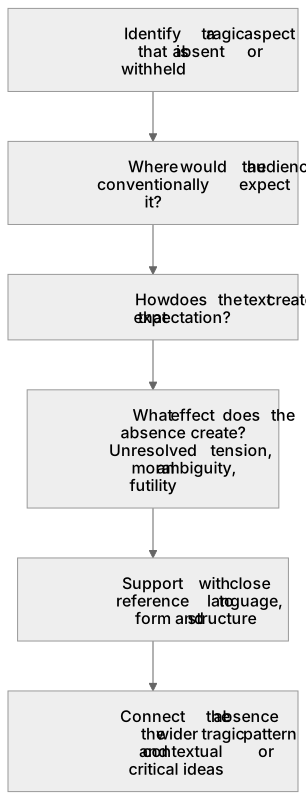
Put it in order
Put these steps in the order they happen.
- 1. How does the text create that expectation?
- 2. Where would the audience conventionally expect it?
- 3. Identify a tragic aspect that is absent or withheld
- 4. Connect the absence to the wider tragic pattern and contextual or critical ideas
- 5. Support with close reference to language, form and structure
- 6. What effect does the absence create? Unresolved tension, moral ambiguity, futility
Key words
Say what each word means before you turn the card.
Tragic structure and convention
Try answering aloud or in your head before turning the card.
Authorial choice and omission
Try answering aloud or in your head before turning the card.
Audience expectation and response
Try answering aloud or in your head before turning the card.
Ambiguity and unresolved endings
Try answering aloud or in your head before turning the card.
See every definition
- Tragic structure and convention
- The conventional aspects of tragedy, such as a clear hamartia, anagnorisis, catharsis or a decisive catastrophe, which a text may withhold.
- Authorial choice and omission
- Treating what is missing as a deliberate structural or thematic choice rather than simply a gap in the text.
- Audience expectation and response
- Where the audience or reader would conventionally expect an aspect, how the text creates that expectation, and how different audiences might respond.
- Ambiguity and unresolved endings
- An ending that denies the audience a final death or a restored order, which may intensify unease or expose the fragility of social values.
Label the diagram
Some boxes have lost their names. Pick the right name for each number.
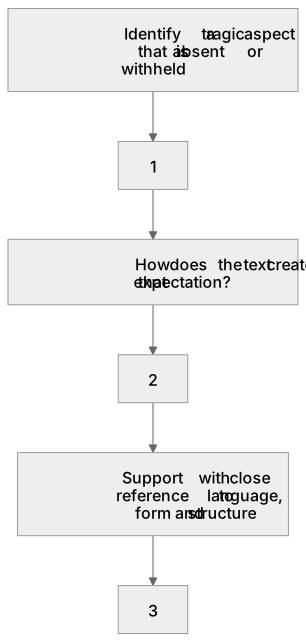
1Box 1
2Box 2
3Box 3
There is more to this lesson
The full lesson goes on to check your understanding and help you earn the marks. Create a free account to carry on, with your progress saved.
A week of Premium from your first lesson · Then the free plan continues · No card, no charge
Test your understanding of Aspects of tragedy: The absence of an ‘aspect’ can be as significant as its presence.
Active recall beats re-reading. Take an instant quiz now to test what you’ve learned and lock it into long-term memory.
A week of Premium from your first lesson · Then the free plan continues · No card, no charge