AQA · A-Level · English Literature
Course version: 7717 · Version from Sept 2026
The significance of violence and revenge, humour and moments of happiness
Full specification wording
Aspects of tragedy: the significance of violence and revenge, humour and moments of happiness
Tragedy is not unrelieved gloom.
Checked against the AQA 7717 specification (opens in a new tab) on .
- Point 10 of 14
- 4 key terms
Study notes
From the checked teaching notes for this specification point.
The idea
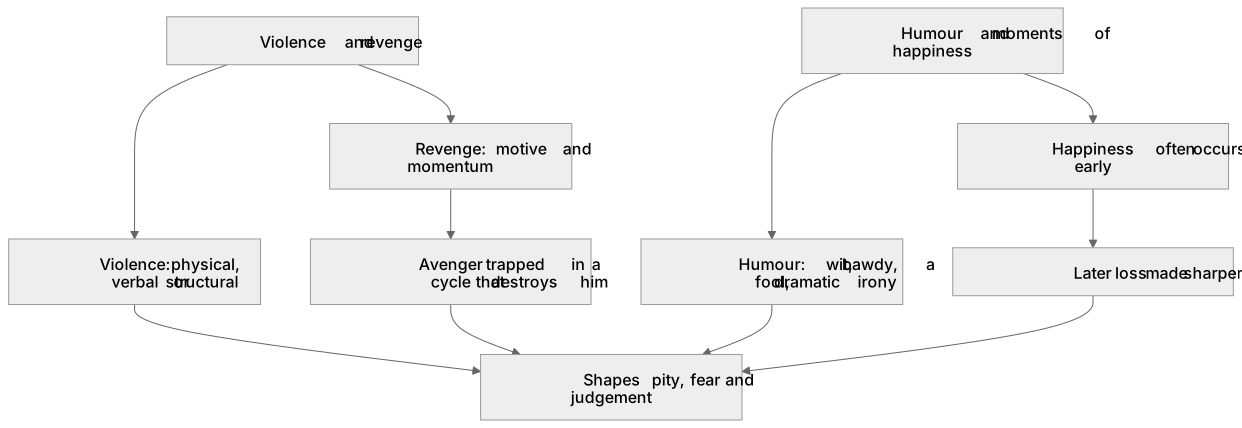
Tragedy is not unrelieved gloom. AQA asks you to weigh how violence and revenge drive the action, and how humour and happiness shape our response. Violence may be physical, verbal or structural; revenge supplies motive and momentum, often trapping the avenger in a cycle that destroys him. Humour can come from wit, bawdy exchange, a fool, or dramatic irony; moments of happiness often occur early, making later loss sharper. In Othello, Iago's jokes and the reunion in Cyprus give pleasure before the murder; in Hamlet, the gravediggers' comedy sits beside the fencing match. Track where these moments fall, who controls them, and how they alter pity, fear and judgement.
What earns the marks
- Explains how violence functions in the play: as physical act, threat, language or structural disruption, and what it reveals about power and disorder.
- Analyses revenge as motive and as moral problem, showing how the pursuit of vengeance consumes the avenger and spreads harm beyond the original wrong.
- Examines humour's dramatic sources, such as wit, puns, bawdy, the fool or gravedigger, and explains its effect on tension, character and audience sympathy.
- Discusses moments of happiness or harmony, often early or brief, and shows how they intensify later catastrophe by contrast.
- Uses precise textual evidence and integrates quotation into argument rather than listing examples.
- Connects these aspects to the tragic genre, considering how they shape pity, fear and the audience's final judgement.
Common mistakes and how to put them right
Treating humour as mere comic relief with no tragic function.
Put it right by analysing how comedy exposes character, foreshadows disaster or deepens irony.
Assuming revenge is simply justified because the initial wrong was real.
Put it right by weighing the avenger's methods, delays and collateral damage.
Describing violence only as bloodshed.
Put it right by including verbal cruelty, threats, psychological coercion and structural shocks.
Ignoring moments of happiness because they seem irrelevant.
Put it right by showing how early joy or reconciliation makes the ending more painful.
Exam tips
- Plan by aspect: one paragraph on violence, one on revenge, one on humour, one on happiness, each linked to the tragic whole.
- Embed short quotations and analyse individual words rather than paraphrasing long speeches.
- Use connectives such as 'however' and 'therefore' to show how comedy or joy qualifies the tragic tone rather than replacing it.
- Keep the tragic hero's arc in view so each aspect is tied to his downfall, not treated as an isolated theme.
Try the lesson
The start of the Aspects of tragedy: the significance of violence and revenge, humour and moments of happiness lesson, made from checked teaching notes for this specification point.
Have a go first
A tragic hero laughs and jokes with a close companion early in the play, then later kills the person who wronged him. How does the early humour most plausibly affect the audience's response to the revenge?
Listen
Tragedy is not unrelieved gloom. AQA asks you to weigh how violence and revenge drive the action, and how humour and happiness shape our response. Violence may be physical, verbal or structural; revenge supplies motive and momentum, often trapping the avenger in a cycle that destroys him. Humour can come from wit, bawdy exchange, a fool, or dramatic irony; moments of happiness often occur early, making later loss sharper. In Othello, Iago's jokes and the reunion in Cyprus give pleasure before the murder; in Hamlet, the gravediggers' comedy sits beside the fencing match. Track where these moments fall, who controls them, and how they alter pity, fear and judgement. A strong answer earns marks for these points. Explains how violence functions in the play: as physical act, threat, language or structural disruption, and what it reveals about power and disorder. Analyses revenge as motive and as moral problem, showing how the pursuit of vengeance consumes the avenger and spreads harm beyond the original wrong. Examines humour's dramatic sources, such as wit, puns, bawdy, the fool or gravedigger, and explains its effect on tension, character and audience sympathy. Discusses moments of happiness or harmony, often early or brief, and shows how they intensify later catastrophe by contrast. A common slip: Treating humour as mere comic relief with no tragic function. Instead, analysing how comedy exposes character, foreshadows disaster or deepens irony. Exam tip: Plan by aspect: one paragraph on violence, one on revenge, one on humour, one on happiness, each linked to the tragic whole.
See it
Key words
Say what each word means before you turn the card.
Violence
Try answering aloud or in your head before turning the card.
Revenge
Try answering aloud or in your head before turning the card.
Humour
Try answering aloud or in your head before turning the card.
Moments of happiness
Try answering aloud or in your head before turning the card.
See every definition
- Violence
- May be physical, verbal or structural, and reveals power and disorder.
- Revenge
- Supplies motive and momentum, often trapping the avenger in a cycle that destroys him.
- Humour
- Can come from wit, bawdy exchange, a fool, or dramatic irony, and shapes our response.
- Moments of happiness
- Often occur early, making later loss sharper by contrast.
Label the diagram
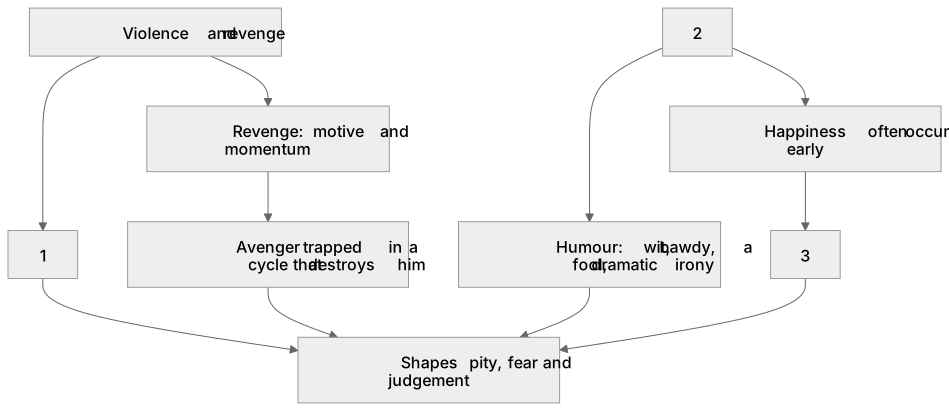
Some boxes have lost their names. Pick the right name for each number.
1Box 1
2Box 2
3Box 3
There is more to this lesson
The full lesson goes on to check your understanding and help you earn the marks. Create a free account to carry on, with your progress saved.
A week of Premium from your first lesson · Then the free plan continues · No card, no charge
Test your understanding of Aspects of tragedy: the significance of violence and revenge, humour and moments of happiness
Active recall beats re-reading. Take an instant quiz now to test what you’ve learned and lock it into long-term memory.
A week of Premium from your first lesson · Then the free plan continues · No card, no charge