AQA · A-Level · English Literature
Course version: 7717 · Version from Sept 2026
The structural pattern of the text as it moves through complication to…
Full specification wording
Aspects of tragedy: the structural pattern of the text as it moves through complication to catastrophe, from order to disorder, through climax to resolution, from the prosperity and happiness of the hero to the tragic end
Tragedy has a shape.
Checked against the AQA 7717 specification (opens in a new tab) on .
- Point 11 of 14
- 4 key terms
Study notes
From the checked teaching notes for this specification point.
The idea
Tragedy has a shape. AQA expects you to trace how a text moves from an initial condition, often order or prosperity, through complication, climax and catastrophe, to a resolution that may restore a fragile order. In Othello, Venice's order gives way to Cyprus's disorder, the temptation scene builds complication, the murder is catastrophe, and Lodovico's report provides resolution. In Death of a Salesman, Willy's remembered prosperity contrasts with present failure. Map turning points, note where the hero's fortune reverses, and explain how each stage causes the next. Structure is not background: it creates the audience's pity and fear.
What earns the marks
- Identifies the initial state of order, prosperity or happiness and explains what stability the hero enjoys or believes he enjoys.
- Traces complication: the arrival of the antagonist, temptation, error or internal flaw that disturbs equilibrium and begins the descent.
- Locates climax and catastrophe precisely, explaining how the crisis point produces the final disaster rather than merely preceding it.
- Analyses resolution: what is restored, what is lost, and how survivors or society reimpose order, often imperfectly.
- Uses structural vocabulary such as exposition, rising action, peripeteia, climax, catastrophe and denouement accurately and sparingly.
- Shows how the pattern embodies the play's ideas about fate, character, society and responsibility.
Common mistakes and how to put them right
Retelling the plot in chronological order without analysing why each stage causes the next.
Put it right by explaining causal links and turning points.
Treating the catastrophe as simply the final death or ending.
Put it right by distinguishing climax, catastrophe and resolution.
Assuming order is fully restored at the end.
Put it right by assessing how far the resolution is partial, uneasy or ambiguous.
Ignoring the hero's initial prosperity or happiness.
Put it right by establishing the starting point so the fall can be measured.
Exam tips
- Sketch a simple five-point structure line before writing and keep each paragraph anchored to a stage.
- Use precise terms such as peripeteia and catastrophe only where they genuinely fit, and define them briefly in context.
- Quote from opening and closing scenes to demonstrate the distance travelled from order to disorder.
- Link structure to meaning: ask what the pattern suggests about fate, character or society.
Try the lesson
The start of the Aspects of tragedy: the structural pattern of the text as it moves through complication to catastrophe, from order to disorder, through climax to resolution, from the prosperity and happiness of the hero to the tragic end lesson, made from checked teaching notes for this specification point.
Have a go first
In the structural pattern of tragedy, which term describes the destructive event that overturns the hero's prosperity and brings about the tragic end?
Listen
Tragedy has a shape. AQA expects you to trace how a text moves from an initial condition, often order or prosperity, through complication, climax and catastrophe, to a resolution that may restore a fragile order. In Othello, Venice's order gives way to Cyprus's disorder, the temptation scene builds complication, the murder is catastrophe, and Lodovico's report provides resolution. In Death of a Salesman, Willy's remembered prosperity contrasts with present failure. Map turning points, note where the hero's fortune reverses, and explain how each stage causes the next. Structure is not background: it creates the audience's pity and fear. A strong answer earns marks for these points. Identifies the initial state of order, prosperity or happiness and explains what stability the hero enjoys or believes he enjoys. Traces complication: the arrival of the antagonist, temptation, error or internal flaw that disturbs equilibrium and begins the descent. Locates climax and catastrophe precisely, explaining how the crisis point produces the final disaster rather than merely preceding it. Analyses resolution: what is restored, what is lost, and how survivors or society reimpose order, often imperfectly. A common slip: Retelling the plot in chronological order without analysing why each stage causes the next. Instead, explaining causal links and turning points. Exam tip: Sketch a simple five-point structure line before writing and keep each paragraph anchored to a stage.
See it
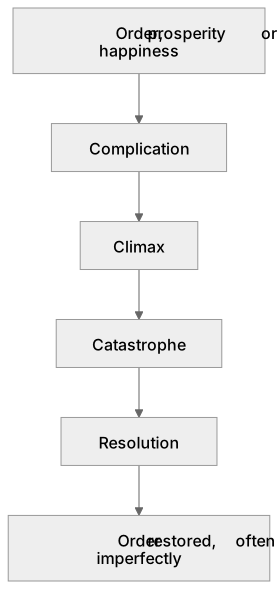
Put it in order
Put these steps in the order they happen.
- 1. Climax
- 2. Complication
- 3. Order, prosperity or happiness
- 4. Order restored, often imperfectly
- 5. Resolution
- 6. Catastrophe
Key words
Say what each word means before you turn the card.
Order and disorder
Try answering aloud or in your head before turning the card.
Complication, climax and catastrophe
Try answering aloud or in your head before turning the card.
Prosperity and the hero's fall
Try answering aloud or in your head before turning the card.
Resolution and restored order
Try answering aloud or in your head before turning the card.
See every definition
- Order and disorder
- The movement of the text from an initial condition of order towards disorder as it passes through complication to catastrophe.
- Complication, climax and catastrophe
- The stages through which the text moves, with complication building towards a crisis point that produces the final disaster.
- Prosperity and the hero's fall
- The movement from the prosperity and happiness of the hero to the tragic end.
- Resolution and restored order
- The closing stage in which order may be restored, often imperfectly, after the catastrophe.
Label the diagram
Some boxes have lost their names. Pick the right name for each number.
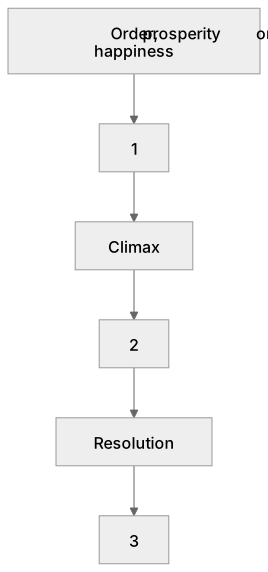
1Box 1
2Box 2
3Box 3
There is more to this lesson
The full lesson goes on to check your understanding and help you earn the marks. Create a free account to carry on, with your progress saved.
A week of Premium from your first lesson · Then the free plan continues · No card, no charge
Test your understanding of Aspects of tragedy: the structural pattern of the text as it moves through complication to catastrophe, from order to disorder, through climax to resolution, from the prosperity and happiness of the hero to the tragic end
Active recall beats re-reading. Take an instant quiz now to test what you’ve learned and lock it into long-term memory.
A week of Premium from your first lesson · Then the free plan continues · No card, no charge