AQA · A-Level · English Literature
Course version: 7717 · Version from Sept 2026
AO1: Articulate informed, personal and creative responses to literary…
Full specification wording
Assessment objectives: AO1: Articulate informed, personal and creative responses to literary texts, using associated concepts and terminology, and coherent, accurate written expression.
AO1 rewards a response that is genuinely yours and clearly argued.
Checked against the AQA 7717 specification (opens in a new tab) on .
- Point 1 of 5
- 4 key terms
Study notes
From the checked teaching notes for this specification point.
The idea
AO1 rewards a response that is genuinely yours and clearly argued. 'Informed' means rooted in close knowledge of the whole text, not plot summary. 'Personal and creative' means an interpretation you have shaped and can defend, perhaps reading a character against the grain. 'Associated concepts and terminology' covers terms such as motif, dramatic irony or free indirect discourse, used precisely. 'Coherent, accurate written expression' means paragraphs that build an argument, with quotations integrated and spelling, punctuation and grammar secure. In practice you might open with a claim about how a writer presents guilt, then select two or three short quotations and explain how each supports your line. Assessment is holistic: examiners judge the quality of your thinking and expression together, not a checklist of terms.
What earns the marks
- A clear, sustained argument that answers the exact question rather than drifting into general discussion of the text.
- Close knowledge of the whole text, shown through well-chosen references and quotations that are accurate and relevant.
- A personal and creative interpretation that goes beyond the obvious, while remaining defensible from the text.
- Precise use of literary concepts and terminology, integrated into the argument rather than listed for display.
- Coherent organisation, with paragraphs that develop a line of thought and connect to the question.
- Accurate written expression, including secure grammar, punctuation and spelling, and fluent integration of quotations.
Common mistakes and how to put them right
Retelling the plot instead of arguing a case.
Put it right by making every paragraph begin with a claim about meaning.
Dropping in terminology without explaining its effect.
Put it right by linking each term to a specific quotation and its impact.
Writing a personal response that ignores the text's evidence.
Put it right by anchoring every interpretation in quotation or close reference.
Exam tips
- Plan for a few minutes so your argument has a clear shape before you write.
- Use short, embedded quotations and analyse their wording rather than quoting long blocks.
- Leave time to reread your answer for coherence, spelling and punctuation, since expression is part of AO1.
Try the lesson
The start of the Assessment objectives: AO1: Articulate informed, personal and creative responses to literary texts, using associated concepts and terminology, and coherent, accurate written expression. lesson, made from checked teaching notes for this specification point.
Have a go first
Which of these best describes what AO1 rewards in an essay on a literary text?
Listen
AO1 rewards a response that is genuinely yours and clearly argued. Informed' means rooted in close knowledge of the whole text, not plot summary. Personal and creative' means an interpretation you have shaped and can defend, perhaps reading a character against the grain. Associated concepts and terminology' covers terms such as motif, dramatic irony or free indirect discourse, used precisely. Coherent, accurate written expression' means paragraphs that build an argument, with quotations integrated and spelling, punctuation and grammar secure. In practice you might open with a claim about how a writer presents guilt, then select two or three short quotations and explain how each supports your line. Assessment is holistic: examiners judge the quality of your thinking and expression together, not a checklist of terms. A strong answer earns marks for these points. A clear, sustained argument that answers the exact question rather than drifting into general discussion of the text. Close knowledge of the whole text, shown through well-chosen references and quotations that are accurate and relevant. A personal and creative interpretation that goes beyond the obvious, while remaining defensible from the text. Precise use of literary concepts and terminology, integrated into the argument rather than listed for display. A common slip: Retelling the plot instead of arguing a case. Instead, making every paragraph begin with a claim about meaning. Exam tip: Plan for a few minutes so your argument has a clear shape before you write.
See it
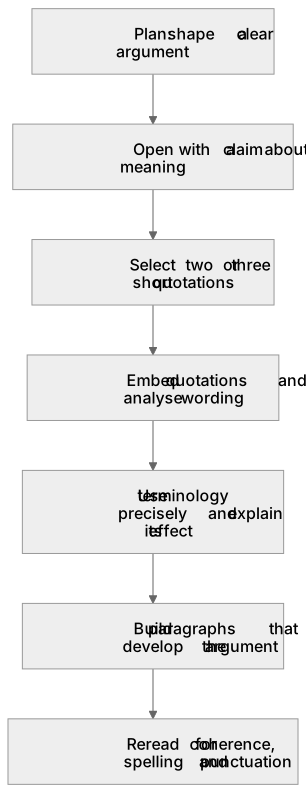
Put it in order
Put these steps in the order they happen.
- 1. Reread for coherence, spelling and punctuation
- 2. Build paragraphs that develop the argument
- 3. Select two or three short quotations
- 4. Use terminology precisely and explain its effect
- 5. Plan: shape a clear argument
- 6. Open with a claim about meaning
- 7. Embed quotations and analyse wording
Key words
Say what each word means before you turn the card.
Informed personal response
Try answering aloud or in your head before turning the card.
Literary concepts and terminology
Try answering aloud or in your head before turning the card.
Coherent argument
Try answering aloud or in your head before turning the card.
Accurate written expression
Try answering aloud or in your head before turning the card.
See every definition
- Informed personal response
- A response that is genuinely yours and clearly argued, rooted in close knowledge of the whole text rather than plot summary.
- Literary concepts and terminology
- Terms such as motif, dramatic irony or free indirect discourse, used precisely and integrated into the argument rather than listed for display.
- Coherent argument
- Paragraphs that build an argument and develop a line of thought, connecting to the question.
- Accurate written expression
- Secure grammar, punctuation and spelling, with quotations integrated fluently.
Label the diagram
Some boxes have lost their names. Pick the right name for each number.
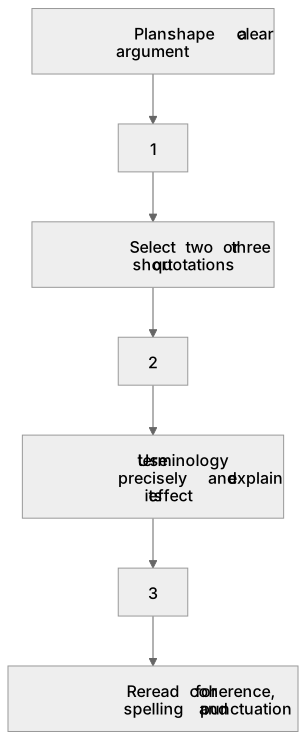
1Box 1
2Box 2
3Box 3
There is more to this lesson
The full lesson goes on to check your understanding and help you earn the marks. Create a free account to carry on, with your progress saved.
A week of Premium from your first lesson · Then the free plan continues · No card, no charge
Test your understanding of Assessment objectives: AO1: Articulate informed, personal and creative responses to literary texts, using associated concepts and terminology, and coherent, accurate written expression.
Active recall beats re-reading. Take an instant quiz now to test what you’ve learned and lock it into long-term memory.
A week of Premium from your first lesson · Then the free plan continues · No card, no charge