AQA · A-Level · English Literature
Course version: 7717 · Version from Sept 2026
AO5: Explore literary texts informed by different interpretations.
Full specification wording
Assessment objectives: AO5: Explore literary texts informed by different interpretations.
AO5 asks you to read a text through more than one critical lens and to show how those readings shape meaning.
Checked against the AQA 7717 specification (opens in a new tab) on .
- Point 5 of 5
- 4 key terms
Study notes
From the checked teaching notes for this specification point.
The idea
AO5 asks you to read a text through more than one critical lens and to show how those readings shape meaning. It is not about finding the single correct interpretation, nor about listing critics; it is about using interpretations as tools for exploration. For example, a Marxist reading of a novel may foreground class conflict and commodity culture, while a feminist reading of the same passage may foreground gendered power and the construction of the domestic sphere. You perform the skill by selecting relevant moments, applying a critical perspective, testing it against textual detail, and weighing its strengths and limits. Assessment rewards a coherent, evidence-based exploration of how different readings illuminate or complicate the text, not agreement with any one view.
What earns the marks
- Selects specific textual moments and reads them through at least two distinct critical perspectives, showing how each perspective produces different emphases or conclusions.
- Uses critical material or named interpretive positions accurately, integrating them into the argument rather than bolting them on as decoration.
- Tests each interpretation against close textual evidence, acknowledging where the reading is persuasive and where it is limited or partial.
- Explores how contextual factors such as class, gender, race, sexuality, historical moment or genre shape the interpretations being compared.
- Sustains a coherent line of argument about interpretation itself, rather than merely summarising critics or listing viewpoints.
- Shows awareness that interpretation is provisional and debateable, using phrases that weigh alternatives rather than assert a single truth.
Common mistakes and how to put them right
Treating AO5 as a requirement to name-drop critics without explaining how their readings change the meaning of specific passages.
Put it right by linking every critical viewpoint to quoted or closely referenced textual detail.
Assuming that one interpretation is simply right and others are wrong.
Put it right by presenting interpretations as competing lenses whose value lies in what they reveal and obscure.
Offering a single reading and calling it 'different interpretations' without genuinely contrasting perspectives.
Put it right: Explicitly juxtaposing two or more readings of the same moment or pattern.
Exam tips
- Plan by choosing two or three textual moments that can sustain contrasting readings, then decide which critical perspectives will generate the most productive tension.
- Use precise critical vocabulary such as 'patriarchal', 'hegemonic', 'bourgeois' or 'postcolonial' only when you can define it through the text itself.
- In each paragraph, state the interpretation, apply it to evidence, then evaluate what it illuminates and what it leaves out; this keeps AO5 exploratory rather than descriptive.
- Revise by writing short comparative readings of the same passage from two perspectives, so that the skill becomes habitual rather than last-minute.
Try the lesson
The start of the Assessment objectives: AO5: Explore literary texts informed by different interpretations. lesson, made from checked teaching notes for this specification point.
Have a go first
A student writes that a novel has only one valid reading. Which assessment objective does this approach fail to meet?
Listen
AO5 asks you to read a text through more than one critical lens and to show how those readings shape meaning. It is not about finding the single correct interpretation, nor about listing critics; it is about using interpretations as tools for exploration. For example, a Marxist reading of a novel may foreground class conflict and commodity culture, while a feminist reading of the same passage may foreground gendered power and the construction of the domestic sphere. You perform the skill by selecting relevant moments, applying a critical perspective, testing it against textual detail, and weighing its strengths and limits. Assessment rewards a coherent, evidence-based exploration of how different readings illuminate or complicate the text, not agreement with any one view. A strong answer earns marks for these points. Selects specific textual moments and reads them through at least two distinct critical perspectives, showing how each perspective produces different emphases or conclusions. Uses critical material or named interpretive positions accurately, integrating them into the argument rather than bolting them on as decoration. Tests each interpretation against close textual evidence, acknowledging where the reading is persuasive and where it is limited or partial. Explores how contextual factors such as class, gender, race, sexuality, historical moment or genre shape the interpretations being compared. A common slip: Treating AO5 as a requirement to name-drop critics without explaining how their readings change the meaning of specific passages. Instead, linking every critical viewpoint to quoted or closely referenced textual detail. Exam tip: Plan by choosing two or three textual moments that can sustain contrasting readings, then decide which critical perspectives will generate the most productive tension.
See it
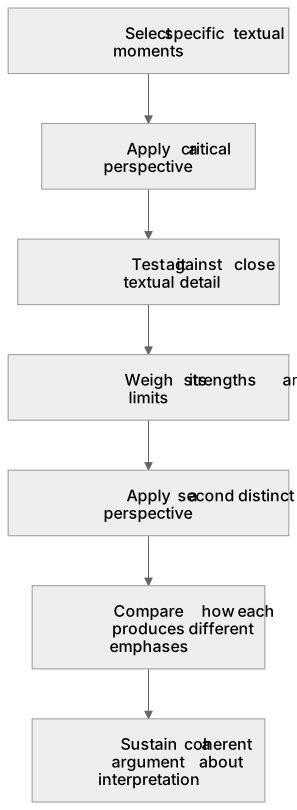
Put it in order
Put these steps in the order they happen.
- 1. Sustain a coherent argument about interpretation
- 2. Compare how each produces different emphases
- 3. Test it against close textual detail
- 4. Apply a second distinct perspective
- 5. Select specific textual moments
- 6. Apply a critical perspective
- 7. Weigh its strengths and limits
Key words
Say what each word means before you turn the card.
Critical perspectives and interpretive plurality
Try answering aloud or in your head before turning the card.
Close reading as the test of interpretation
Try answering aloud or in your head before turning the card.
Contextual shaping of meaning
Try answering aloud or in your head before turning the card.
Evaluation and weighing of readings
Try answering aloud or in your head before turning the card.
See every definition
- Critical perspectives and interpretive plurality
- Reading a text through more than one critical lens and showing how those readings shape meaning, rather than finding the single correct interpretation.
- Close reading as the test of interpretation
- Testing each interpretation against close textual evidence, acknowledging where the reading is persuasive and where it is limited or partial.
- Contextual shaping of meaning
- Exploring how contextual factors such as class, gender, race, sexuality, historical moment or genre shape the interpretations being compared.
- Evaluation and weighing of readings
- Weighing the strengths and limits of interpretations, using phrases that weigh alternatives rather than assert a single truth.
Label the diagram
Some boxes have lost their names. Pick the right name for each number.
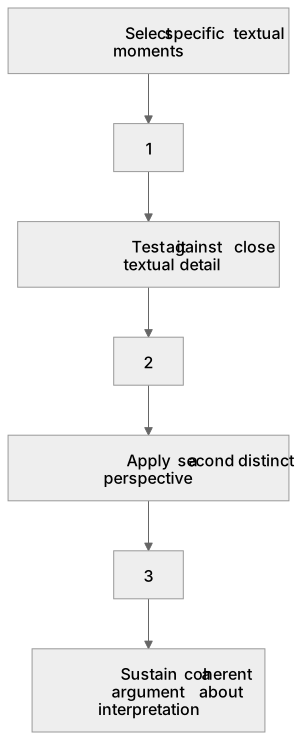
1Box 1
2Box 2
3Box 3
There is more to this lesson
The full lesson goes on to check your understanding and help you earn the marks. Create a free account to carry on, with your progress saved.
A week of Premium from your first lesson · Then the free plan continues · No card, no charge
Test your understanding of Assessment objectives: AO5: Explore literary texts informed by different interpretations.
Active recall beats re-reading. Take an instant quiz now to test what you’ve learned and lock it into long-term memory.
A week of Premium from your first lesson · Then the free plan continues · No card, no charge