AQA · A-Level · English Literature
Course version: 7717 · Version from Sept 2026
Assessment objectives: AO4: Explore connections across literary texts.
AO4 requires you to make purposeful comparisons between literary texts, usually the core text and your chosen partner text.
Checked against the AQA 7717 specification (opens in a new tab) on .
- Point 4 of 5
- 3 key terms
Study notes
From the checked teaching notes for this specification point.
The idea
AO4 requires you to make purposeful comparisons between literary texts, usually the core text and your chosen partner text. A connection can be a shared theme, a similar narrative method, a comparable use of form, or a revealing difference in how two writers treat related material. 'Explore' means the comparison must generate insight: you identify a point of contact, support it with evidence from both texts, then analyse what the similarity or difference reveals. For example, if both texts present a flawed authority figure, you might compare how one uses first-person confession to create sympathy while the other uses third-person satire to create distance, showing that the connection lies in technique as much as theme. Effective comparison is woven through the essay, not confined to a final paragraph.
What earns the marks
- Identifies a genuine point of connection between texts, such as theme, character type, form or narrative perspective.
- Supports the connection with precise evidence from both texts rather than asserting similarity.
- Analyses how the writers' methods create similarity or difference, not just what happens in each text.
- Uses the comparison to develop an argument about meaning, so the connection illuminates both texts.
- Sustains comparison across the response, balancing attention between texts rather than treating one as secondary.
Common mistakes and how to put them right
Listing separate points about each text and labelling them a comparison.
Put it right by pairing evidence and analysing the two examples in the same paragraph.
Choosing superficial links such as both texts feature death.
Put it right by narrowing to a specific shared concern and examining how each writer treats it differently.
Allowing one text to dominate while the other appears only in brief asides.
Put it right by planning roughly equal evidence and analysis for both texts.
Exam tips
- Use comparative signposting sparingly but clearly, for example 'whereas', 'similarly' and 'both writers', to keep the thread visible.
- Plan comparisons as paired evidence: select one quotation or moment from each text before you begin writing.
- Make the connection do analytical work by asking what the similarity or difference reveals about each writer's choices.
Try the lesson
The start of the Assessment objectives: AO4: Explore connections across literary texts. lesson, made from checked teaching notes for this specification point.
Have a go first
A student is planning an essay that addresses Assessment Objective 4 (AO4). Which of the following approaches best demonstrates the primary requirement of this objective?
Listen
AO4 requires you to make purposeful comparisons between literary texts, usually the core text and your chosen partner text. A connection can be a shared theme, a similar narrative method, a comparable use of form, or a revealing difference in how two writers treat related material. Explore' means the comparison must generate insight: you identify a point of contact, support it with evidence from both texts, then analyse what the similarity or difference reveals. For example, if both texts present a flawed authority figure, you might compare how one uses first-person confession to create sympathy while the other uses third-person satire to create distance, showing that the connection lies in technique as much as theme. Effective comparison is woven through the essay, not confined to a final paragraph. A strong answer earns marks for these points. Identifies a genuine point of connection between texts, such as theme, character type, form or narrative perspective. Supports the connection with precise evidence from both texts rather than asserting similarity. Analyses how the writers' methods create similarity or difference, not just what happens in each text. Uses the comparison to develop an argument about meaning, so the connection illuminates both texts. A common slip: Listing separate points about each text and labelling them a comparison. Instead, pairing evidence and analysing the two examples in the same paragraph. Exam tip: Use comparative signposting sparingly but clearly, for example 'whereas', 'similarly' and 'both writers', to keep the thread visible.
See it
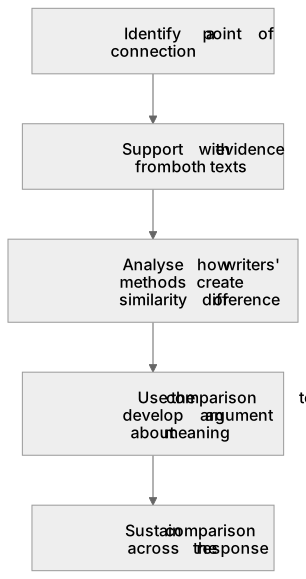
Put it in order
Put these steps in the order they happen.
- 1. Support with evidence from both texts
- 2. Analyse how writers' methods create similarity or difference
- 3. Identify a point of connection
- 4. Sustain comparison across the response
- 5. Use the comparison to develop an argument about meaning
Key words
Say what each word means before you turn the card.
Thematic parallels and contrasts
Try answering aloud or in your head before turning the card.
Comparative form and narrative method
Try answering aloud or in your head before turning the card.
Writers' differing treatments of shared concerns
Try answering aloud or in your head before turning the card.
See every definition
- Thematic parallels and contrasts
- Shared themes or revealing differences in how two writers treat related material, forming a point of connection between texts.
- Comparative form and narrative method
- A comparable use of form or a similar narrative method, such as first-person confession or third-person satire, that creates similarity or difference between texts.
- Writers' differing treatments of shared concerns
- How two writers treat related material differently, showing that the connection lies in technique as much as theme.
Label the diagram
Some boxes have lost their names. Pick the right name for each number.
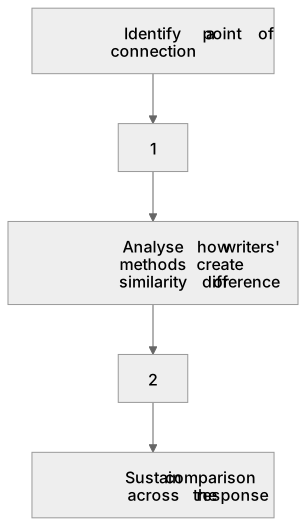
1Box 1
2Box 2
There is more to this lesson
The full lesson goes on to check your understanding and help you earn the marks. Create a free account to carry on, with your progress saved.
A week of Premium from your first lesson · Then the free plan continues · No card, no charge
Test your understanding of Assessment objectives: AO4: Explore connections across literary texts.
Active recall beats re-reading. Take an instant quiz now to test what you’ve learned and lock it into long-term memory.
A week of Premium from your first lesson · Then the free plan continues · No card, no charge