AQA · A-Level · English Literature
Course version: 7717 · Version from Sept 2026
How far there is a moral purpose and restoration of order
Full specification wording
Elements of crime writing: how far there is a moral purpose and restoration of order
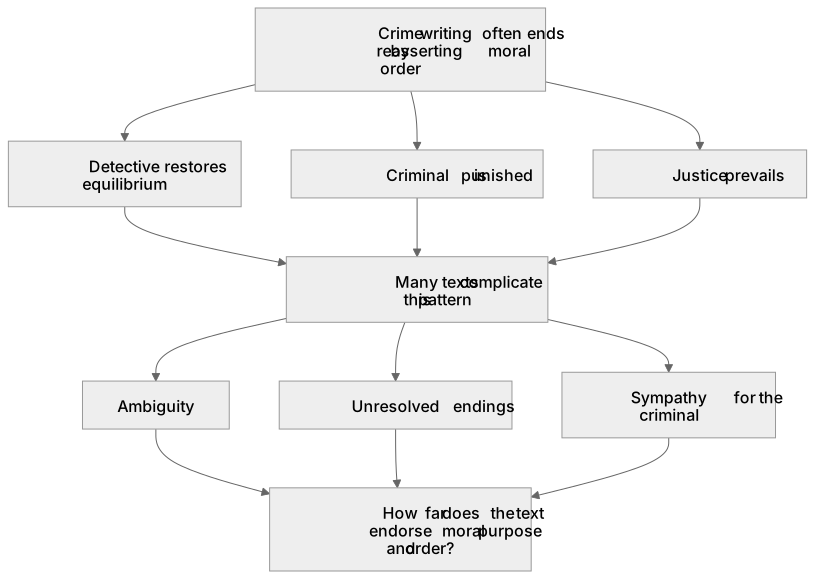
Crime writing often ends by reasserting moral order: the detective restores equilibrium, the criminal is punished, and justice prevails.
Checked against the AQA 7717 specification (opens in a new tab) on .
- Point 10 of 21
- 4 key terms
Study notes
From the checked teaching notes for this specification point.
The idea
Crime writing often ends by reasserting moral order: the detective restores equilibrium, the criminal is punished, and justice prevails. Yet many texts complicate this pattern. For example, in The Murder of Roger Ackroyd, Poirot restores order by exposing the murderer, but the solution implicates the narrator. In Brighton Rock, the law intervenes, but moral order remains elusive. Assessment focuses on close analysis of structure, characterisation, and language, and on debate about whether order is genuinely restored or merely imposed.
What earns the marks
- Analyse how the ending or resolution restores or fails to restore social and moral order, using textual evidence.
- Consider the role of the detective or investigator in re-establishing order and the values that order embodies.
- Examine whether the text presents crime as a disruption that must be corrected or as a symptom of deeper social problems.
- Evaluate how far the text invites readers to sympathise with criminals or victims, complicating simple moral judgements.
- Discuss how narrative structure, such as closure or open endings, shapes the reader's sense of moral purpose.
Common mistakes and how to put them right
Assuming that all crime writing ends with restored order.
Put it right: Analyse texts where order is ambiguous or absent, such as Brighton Rock.
Treating moral purpose as a fixed message rather than a subject of debate.
Put it right: Explore how different readers might interpret the text's morality.
Ignoring the role of the reader in constructing moral meaning.
Put it right: Consider how narrative gaps and unreliable narration invite active judgement.
Exam tips
- Plan your argument around 'how far' by establishing criteria for moral purpose and order, then testing them against the text.
- Use precise evidence from beginnings, middles, and endings to trace whether order is restored or disrupted.
Try the lesson
The start of the Elements of crime writing: how far there is a moral purpose and restoration of order lesson, made from checked teaching notes for this specification point.
Have a go first
In traditional 'Golden Age' crime fiction, how is the restoration of order typically achieved at the conclusion of the narrative?
Listen
Crime writing often ends by reasserting moral order: the detective restores equilibrium, the criminal is punished, and justice prevails. Yet many texts complicate this pattern. For example, in The Murder of Roger Ackroyd, Poirot restores order by exposing the murderer, but the solution implicates the narrator. In Brighton Rock, the law intervenes, but moral order remains elusive. Assessment focuses on close analysis of structure, characterisation, and language, and on debate about whether order is genuinely restored or merely imposed. A strong answer earns marks for these points. Analyse how the ending or resolution restores or fails to restore social and moral order, using textual evidence. Consider the role of the detective or investigator in re-establishing order and the values that order embodies. Examine whether the text presents crime as a disruption that must be corrected or as a symptom of deeper social problems. Evaluate how far the text invites readers to sympathise with criminals or victims, complicating simple moral judgements. A common slip: Assuming that all crime writing ends with restored order. Instead, analyse texts where order is ambiguous or absent, such as Brighton Rock. Exam tip: Plan your argument around 'how far' by establishing criteria for moral purpose and order, then testing them against the text.
See it
Key words
Say what each word means before you turn the card.
Justice and retribution
Try answering aloud or in your head before turning the card.
Social and moral order
Try answering aloud or in your head before turning the card.
Ambiguity and unresolved endings
Try answering aloud or in your head before turning the card.
Moral purpose
Try answering aloud or in your head before turning the card.
See every definition
- Justice and retribution
- The idea that the criminal is punished and justice prevails, which crime writing often uses to reassert moral order.
- Social and moral order
- The equilibrium the detective restores, which a text may endorse or undermine through ambiguity, unresolved endings, or sympathy for the criminal.
- Ambiguity and unresolved endings
- Ways in which a text complicates the pattern of restored order, so that moral order remains elusive or is merely imposed.
- Moral purpose
- Whether a text endorses a moral message through its resolution and narrative structure, or treats morality as a subject of debate.
Label the diagram
Some boxes have lost their names. Pick the right name for each number.
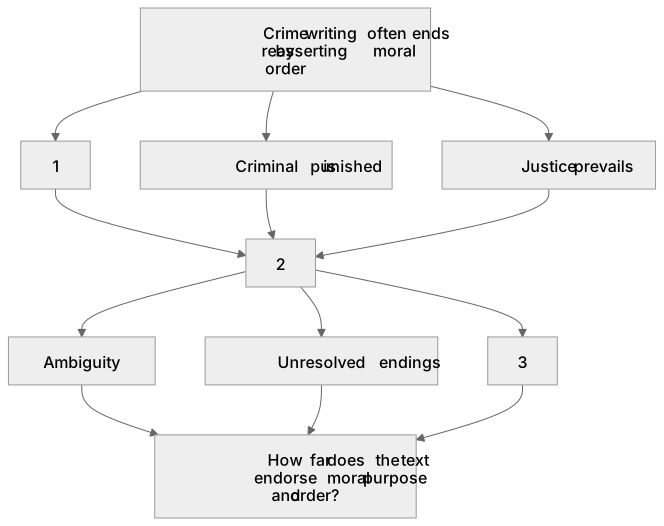
1Box 1
2Box 2
3Box 3
There is more to this lesson
The full lesson goes on to check your understanding and help you earn the marks. Create a free account to carry on, with your progress saved.
A week of Premium from your first lesson · Then the free plan continues · No card, no charge
Test your understanding of Elements of crime writing: how far there is a moral purpose and restoration of order
Active recall beats re-reading. Take an instant quiz now to test what you’ve learned and lock it into long-term memory.
A week of Premium from your first lesson · Then the free plan continues · No card, no charge