AQA · A-Level · English Literature
Course version: 7717 · Version from Sept 2026
Punishment, justice, retribution, injustice, accusation, the legal system,…
Full specification wording
Elements of crime writing: punishment, justice, retribution, injustice, accusation, the legal system, criminal trials and courtroom dramas, imprisonment, death
Crime writing turns on the gap between wrongdoing and its consequences.
Checked against the AQA 7717 specification (opens in a new tab) on .
- Point 16 of 21
- 4 key terms
Study notes
From the checked teaching notes for this specification point.
The idea
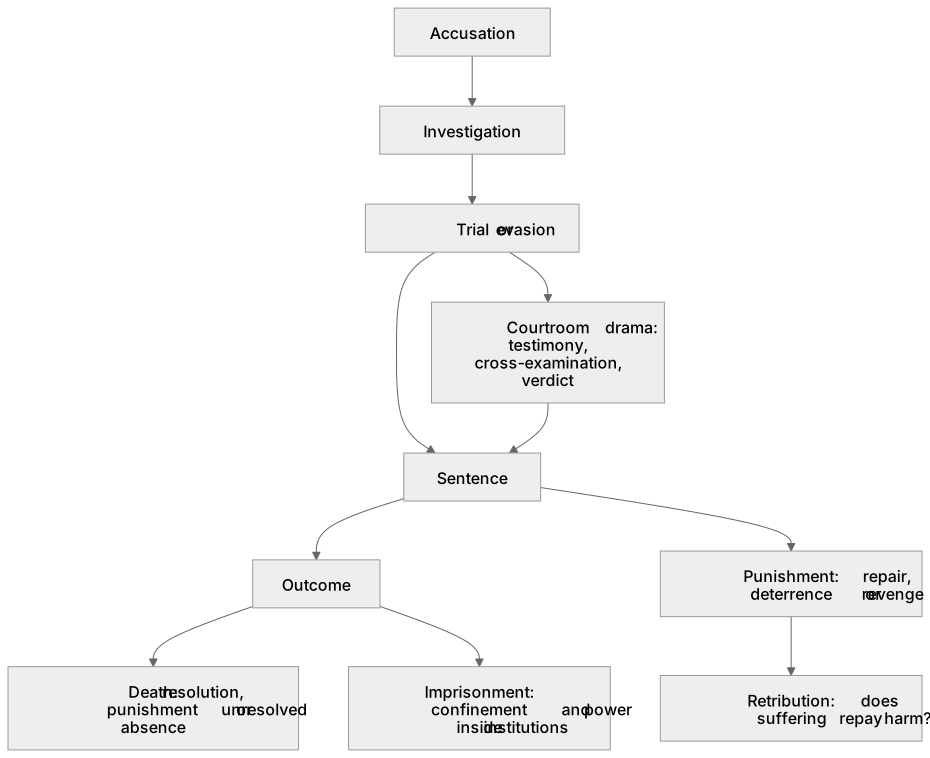
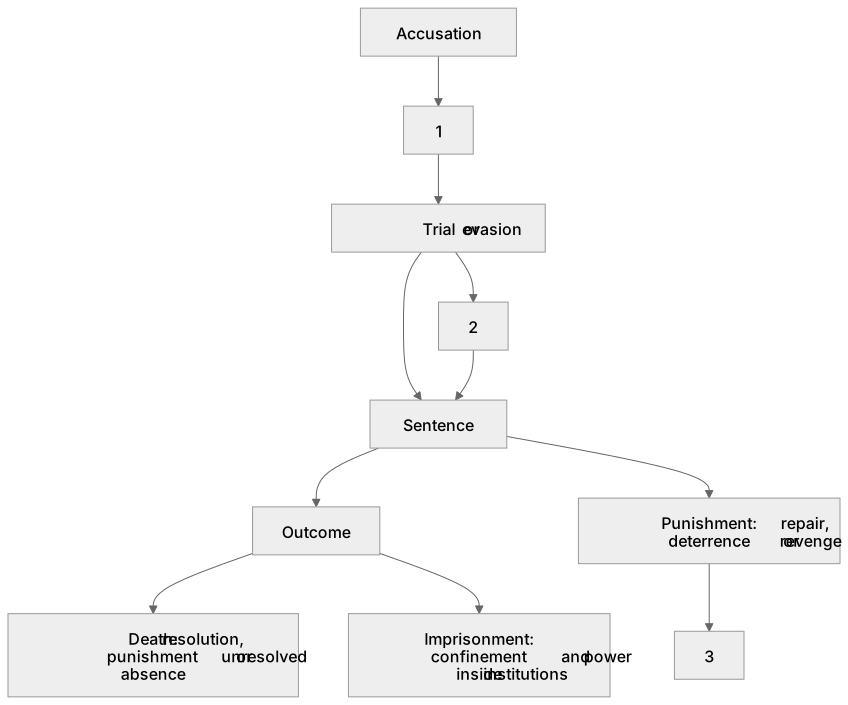
Crime writing turns on the gap between wrongdoing and its consequences. Accusation starts the process: a charge is made, a suspect named, a reputation risked. The legal system then mediates between private vengeance and public order, and courtroom dramas stage that mediation through testimony, cross-examination and verdict. Retribution asks whether suffering repays harm, while punishment asks what a society does with an offender. Imprisonment literalises confinement and often exposes power inside institutions. Death closes some narratives and denies closure in others. A useful method is to map each text's chain: accusation, investigation, trial or evasion, sentence, outcome.
What earns the marks
- Explains how accusation functions as a narrative trigger, identifying who accuses, on what evidence and with what authority.
- Analyses the legal system as a contested institution, showing how procedure, advocacy and evidence shape the reader's judgement of guilt.
- Distinguishes justice from retribution, using textual detail to show whether punishment is presented as repair, deterrence or revenge.
- Examines imprisonment as both setting and metaphor, commenting on confinement, surveillance and the psychology of the confined.
- Considers death as resolution, punishment or unresolved absence, and how it affects the reader's sense of order.
- Uses precise terminology for courtroom drama, such as testimony, cross-examination, verdict and sentence, without merely listing features.
Common mistakes and how to put them right
Treating justice and retribution as synonyms.
Put it right by defining each term separately and showing where the text puts them in conflict.
Assuming the legal system always represents moral authority.
Put it right by examining moments where procedure produces injustice or protects the powerful.
Describing a trial scene without analysing its function.
Put it right by linking each courtroom exchange to the text's wider argument about guilt or truth.
Exam tips
- Anchor every abstract term to a specific moment, speaker or structural choice rather than discussing the concept in isolation.
- When a question names one element, such as punishment, connect it to at least one adjacent element, such as accusation or the legal system, to show range.
- Track who speaks in courtroom scenes and who is silenced; voice and silence are productive analytical handles.
Try the lesson
The start of the Elements of crime writing: punishment, justice, retribution, injustice, accusation, the legal system, criminal trials and courtroom dramas, imprisonment, death lesson, made from checked teaching notes for this specification point.
Have a go first
In crime writing, which term describes the idea that a wrongdoer should suffer a penalty that matches the harm they have caused?
Listen
Crime writing turns on the gap between wrongdoing and its consequences. Accusation starts the process: a charge is made, a suspect named, a reputation risked. The legal system then mediates between private vengeance and public order, and courtroom dramas stage that mediation through testimony, cross-examination and verdict. Retribution asks whether suffering repays harm, while punishment asks what a society does with an offender. Imprisonment literalises confinement and often exposes power inside institutions. Death closes some narratives and denies closure in others. A useful method is to map each text's chain: accusation, investigation, trial or evasion, sentence, outcome. A strong answer earns marks for these points. Explains how accusation functions as a narrative trigger, identifying who accuses, on what evidence and with what authority. Analyses the legal system as a contested institution, showing how procedure, advocacy and evidence shape the reader's judgement of guilt. Distinguishes justice from retribution, using textual detail to show whether punishment is presented as repair, deterrence or revenge. Examines imprisonment as both setting and metaphor, commenting on confinement, surveillance and the psychology of the confined. A common slip: Treating justice and retribution as synonyms. Instead, defining each term separately and showing where the text puts them in conflict. Exam tip: Anchor every abstract term to a specific moment, speaker or structural choice rather than discussing the concept in isolation.
See it
Key words
Say what each word means before you turn the card.
Accusation
Try answering aloud or in your head before turning the card.
Legal system
Try answering aloud or in your head before turning the card.
Retribution
Try answering aloud or in your head before turning the card.
Imprisonment
Try answering aloud or in your head before turning the card.
See every definition
- Accusation
- A charge is made, a suspect named and a reputation risked, starting the process of crime writing.
- Legal system
- A contested institution that mediates between private vengeance and public order, with procedure, advocacy and evidence shaping judgement of guilt.
- Retribution
- Asks whether suffering repays harm, and must be distinguished from punishment, which asks what a society does with an offender.
- Imprisonment
- Literalises confinement and often exposes power inside institutions, acting as both setting and metaphor.
Label the diagram
Some boxes have lost their names. Pick the right name for each number.
1Box 1
2Box 2
3Box 3
There is more to this lesson
The full lesson goes on to check your understanding and help you earn the marks. Create a free account to carry on, with your progress saved.
A week of Premium from your first lesson · Then the free plan continues · No card, no charge
Test your understanding of Elements of crime writing: punishment, justice, retribution, injustice, accusation, the legal system, criminal trials and courtroom dramas, imprisonment, death
Active recall beats re-reading. Take an instant quiz now to test what you’ve learned and lock it into long-term memory.
A week of Premium from your first lesson · Then the free plan continues · No card, no charge