AQA · A-Level · English Literature
Course version: 7717 · Version from Sept 2026
The central motifs of love, money, danger and death
Full specification wording
Elements of crime writing: the central motifs of love, money, danger and death
Trace four recurring motifs across crime writing and explain how they interact.
Checked against the AQA 7717 specification (opens in a new tab) on .
- Point 15 of 21
- 4 key terms
Study notes
From the checked teaching notes for this specification point.
The idea
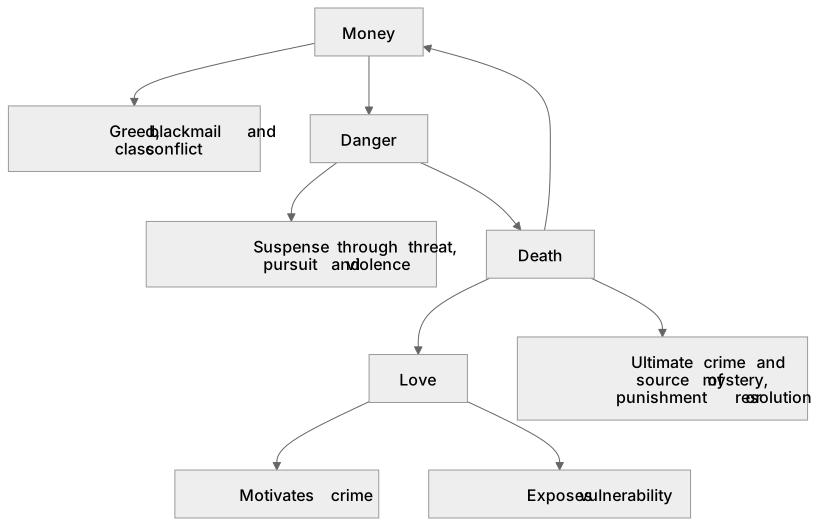
Trace four recurring motifs across crime writing and explain how they interact. Love can motivate crimes, as seen in Atonement, or expose vulnerability, like the loyalty trapping characters in Brighton Rock. Money drives greed, blackmail and class conflict, while danger creates suspense through threat, pursuit and violence. Death is both the ultimate crime and a source of mystery, punishment or resolution. These motifs rarely appear alone: a love of money can produce danger and death, and a death can reveal hidden love or debt. Identify where each motif appears, examine how the writer presents it through imagery, setting and structure, and evaluate how the motifs combine to shape theme, character and reader response.
What earns the marks
- Identifies and tracks the four motifs of love, money, danger and death across the text.
- Analyses how each motif is presented through imagery, symbolism, setting, dialogue and narrative structure.
- Explains how the motifs interact, for example how love of money generates danger and leads to death.
- Relates the motifs to character motivation, including greed, desire, fear and revenge.
- Connects the motifs to the conventions and concerns of crime writing, such as motive, pursuit, punishment and resolution.
- Evaluates how the interplay of motifs shapes theme, tension and the reader's understanding of crime.
Common mistakes and how to put them right
Listing motifs without analysing how they are presented.
Put it right by examining the language and structural choices that create each motif.
Treating the four motifs as separate and unconnected.
Put it right by explaining how they cause, intensify or resolve one another.
Retelling the plot whenever a motif appears.
Put it right by focusing on the writer's methods and the effects created.
Exam tips
- Organise revision around the four motifs and prepare flexible evidence for each one.
- When writing, show connections between motifs rather than discussing them in isolation.
Try the lesson
The start of the Elements of crime writing: the central motifs of love, money, danger and death lesson, made from checked teaching notes for this specification point.
Have a go first
In crime writing, which one of the following is identified as a central motif alongside love, money and danger?
Listen
Trace four recurring motifs across crime writing and explain how they interact. Love can motivate crimes, as seen in Atonement, or expose vulnerability, like the loyalty trapping characters in Brighton Rock. Money drives greed, blackmail and class conflict, while danger creates suspense through threat, pursuit and violence. Death is both the ultimate crime and a source of mystery, punishment or resolution. These motifs rarely appear alone: a love of money can produce danger and death, and a death can reveal hidden love or debt. Identify where each motif appears, examine how the writer presents it through imagery, setting and structure, and evaluate how the motifs combine to shape theme, character and reader response. A strong answer earns marks for these points. Identifies and tracks the four motifs of love, money, danger and death across the text. Analyses how each motif is presented through imagery, symbolism, setting, dialogue and narrative structure. Explains how the motifs interact, for example how love of money generates danger and leads to death. Relates the motifs to character motivation, including greed, desire, fear and revenge. A common slip: Listing motifs without analysing how they are presented. Instead, examining the language and structural choices that create each motif. Exam tip: Organise revision around the four motifs and prepare flexible evidence for each one.
See it
Key words
Say what each word means before you turn the card.
Love
Try answering aloud or in your head before turning the card.
Money
Try answering aloud or in your head before turning the card.
Danger
Try answering aloud or in your head before turning the card.
Death
Try answering aloud or in your head before turning the card.
See every definition
- Love
- A recurring motif that can motivate crimes or expose vulnerability, and that may be revealed by a death.
- Money
- A recurring motif that drives greed, blackmail and class conflict.
- Danger
- A recurring motif that creates suspense through threat, pursuit and violence.
- Death
- A recurring motif that is both the ultimate crime and a source of mystery, punishment or resolution.
Label the diagram
Some boxes have lost their names. Pick the right name for each number.
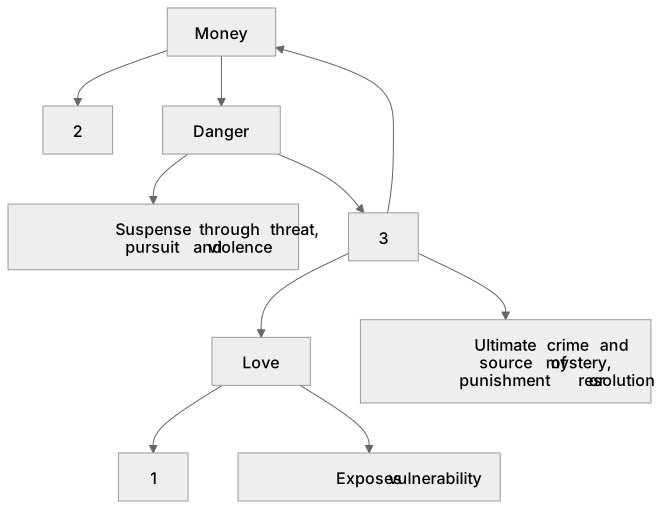
1Box 1
2Box 2
3Box 3
There is more to this lesson
The full lesson goes on to check your understanding and help you earn the marks. Create a free account to carry on, with your progress saved.
A week of Premium from your first lesson · Then the free plan continues · No card, no charge
Test your understanding of Elements of crime writing: the central motifs of love, money, danger and death
Active recall beats re-reading. Take an instant quiz now to test what you’ve learned and lock it into long-term memory.
A week of Premium from your first lesson · Then the free plan continues · No card, no charge