AQA · A-Level · English Literature
Course version: 7717 · Version from Sept 2026
The victims of crime and the inclusion of suffering
Full specification wording
Elements of crime writing: the victims of crime and the inclusion of suffering
This element asks you to examine who suffers when a crime is committed and how that suffering is represented.
Checked against the AQA 7717 specification (opens in a new tab) on .
- Point 14 of 21
- 3 key terms
Study notes
From the checked teaching notes for this specification point.
The idea
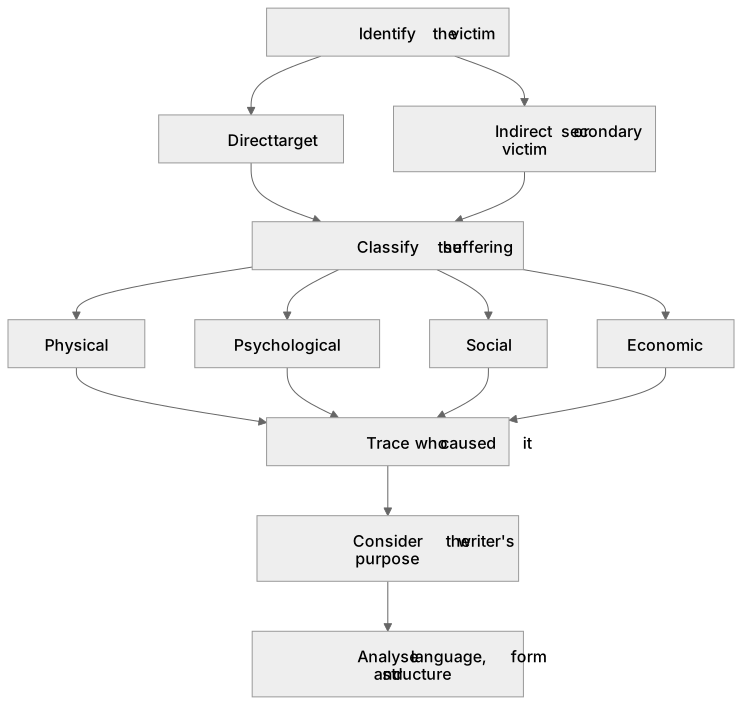
This element asks you to examine who suffers when a crime is committed and how that suffering is represented. Victims may be direct targets, such as the murdered Roger Ackroyd in Christie's novel, or indirect, such as Rose, the young waitress damaged by Pinkie's corruption in Brighton Rock. Suffering can be physical, psychological, social or economic, and writers include it to shape sympathy, raise moral questions and expose the cost of crime beyond the criminal act itself. When analysing, identify the victim, classify the suffering, trace who caused it, and consider the writer's purpose: is suffering used to condemn, to entertain, to critique society, or to complicate our judgement of the criminal? Close attention to language, form and structure shows how the text positions readers towards victims and offenders.
What earns the marks
- Identifies specific victims, distinguishing direct targets from indirect or secondary victims affected by the crime.
- Classifies the suffering shown, for example physical injury, grief, psychological trauma, poverty or social disgrace.
- Analyses how language, form and structure present suffering, such as imagery of blood, fragmented narration or dramatic irony.
- Explores the writer's purposes for including suffering, such as generating sympathy, moral condemnation or social critique.
- Connects the treatment of victims to the wider conventions of crime writing, including justice, detection and punishment.
- Evaluates how the inclusion of suffering shapes the reader's response to the criminal and to the crime itself.
Common mistakes and how to put them right
Treating the victim only as a plot device and ignoring their emotional or social suffering.
Put it right by analysing the victim's experience and the language used to convey it.
Assuming all suffering is physical.
Put it right by considering psychological, economic and social forms of suffering as well.
Describing what happens to victims without linking it to the writer's purpose.
Put it right by explaining how the suffering shapes meaning and reader response.
Exam tips
- Plan responses around a clear argument about who suffers and why the writer includes that suffering.
- Use precise quotations that reveal the nature of the suffering, then analyse individual words and images.
- Link every point about victims to the wider crime-writing genre and the text's moral concerns.
Try the lesson
The start of the Elements of crime writing: the victims of crime and the inclusion of suffering lesson, made from checked teaching notes for this specification point.
Have a go first
In a crime narrative, what is a common literary effect of foregrounding the visceral suffering of a victim rather than the mechanics of the investigation?
Listen
This element asks you to examine who suffers when a crime is committed and how that suffering is represented. Victims may be direct targets, such as the murdered Roger Ackroyd in Christie's novel, or indirect, such as Rose, the young waitress damaged by Pinkie's corruption in Brighton Rock. Suffering can be physical, psychological, social or economic, and writers include it to shape sympathy, raise moral questions and expose the cost of crime beyond the criminal act itself. When analysing, identify the victim, classify the suffering, trace who caused it, and consider the writer's purpose: is suffering used to condemn, to entertain, to critique society, or to complicate our judgement of the criminal? Close attention to language, form and structure shows how the text positions readers towards victims and offenders. A strong answer earns marks for these points. Identifies specific victims, distinguishing direct targets from indirect or secondary victims affected by the crime. Classifies the suffering shown, for example physical injury, grief, psychological trauma, poverty or social disgrace. Analyses how language, form and structure present suffering, such as imagery of blood, fragmented narration or dramatic irony. Explores the writer's purposes for including suffering, such as generating sympathy, moral condemnation or social critique. A common slip: Treating the victim only as a plot device and ignoring their emotional or social suffering. Instead, analysing the victim's experience and the language used to convey it. Exam tip: Plan responses around a clear argument about who suffers and why the writer includes that suffering.
See it
Key words
Say what each word means before you turn the card.
Sympathy and moral judgement
Try answering aloud or in your head before turning the card.
The human cost of crime
Try answering aloud or in your head before turning the card.
Suffering
Try answering aloud or in your head before turning the card.
See every definition
- Sympathy and moral judgement
- The shaping of sympathy and the raising of moral questions through the inclusion of suffering, which can complicate our judgement of the criminal.
- The human cost of crime
- The cost of crime beyond the criminal act itself, exposed through suffering that may be physical, psychological, social or economic.
- Suffering
- What victims experience when a crime is committed, which can be physical, psychological, social or economic and is included to shape sympathy and raise moral questions.
Label the diagram
Some boxes have lost their names. Pick the right name for each number.
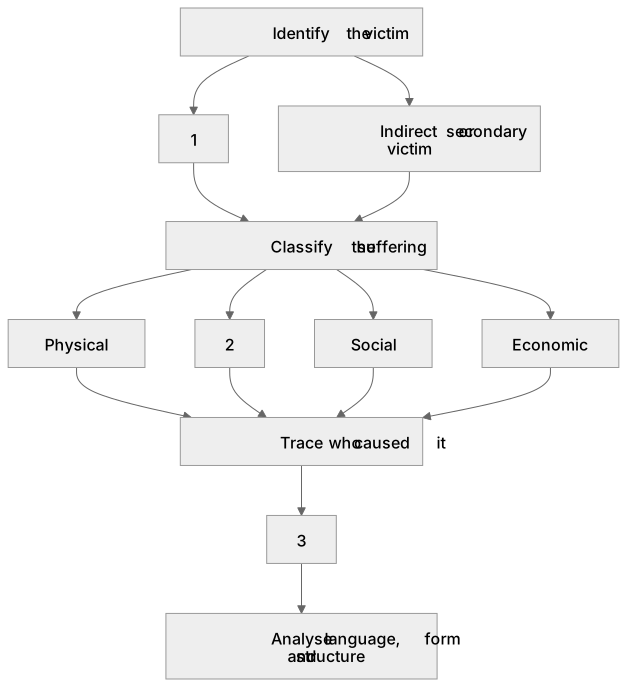
1Box 1
2Box 2
3Box 3
There is more to this lesson
The full lesson goes on to check your understanding and help you earn the marks. Create a free account to carry on, with your progress saved.
A week of Premium from your first lesson · Then the free plan continues · No card, no charge
Test your understanding of Elements of crime writing: the victims of crime and the inclusion of suffering
Active recall beats re-reading. Take an instant quiz now to test what you’ve learned and lock it into long-term memory.
A week of Premium from your first lesson · Then the free plan continues · No card, no charge