AQA · A-Level · English Literature
Course version: 7717 · Version from Sept 2026
A crucial word in the title of this option is ‘Elements’ and students need…
Full specification wording
Elements of political and social protest writing: A crucial word in the title of this option is ‘Elements’ and students need to consider the specific elements that exist in each of their texts.
The word ‘Elements’ signals that political and social protest writing is not a single formula but a set of recurring components that writers select, combine and adapt.
Checked against the AQA 7717 specification (opens in a new tab) on .
- Point 4 of 17
Study notes
From the checked teaching notes for this specification point.
The idea
The word ‘Elements’ signals that political and social protest writing is not a single formula but a set of recurring components that writers select, combine and adapt. To meet this requirement, you must identify which elements are actually present in each set text and explain how they function, rather than assuming every text contains every possible feature. For example, one novel may foreground direct protest through a character’s speech, while another may embed critique in setting, symbolism or narrative voice. A useful method is to annotate each text for evidence of, say, power, resistance, voice, setting or symbolism, then compare how those elements interact. Assessment rewards precise, text-specific analysis of how such elements create protest meaning, not a generic checklist.
What earns the marks
- Identifies specific elements of political and social protest writing that are demonstrably present in the named text, using textual evidence rather than assertion.
- Explains how at least one element operates in the text, for example how narrative voice or setting shapes the reader’s response to injustice.
- Compares or contrasts the presence and function of elements across texts, showing awareness that different texts use different combinations.
- Uses the term ‘Elements’ accurately to frame an argument about how protest writing is constructed, rather than treating it as a label to be listed.
- Supports analysis with close reference to language, form and structure, integrating short quotations or precise references into the discussion.
Common mistakes and how to put them right
Treating ‘Elements’ as a checklist that every text must tick.
Put it right: Identify only the elements actually evidenced in each text and analyse their specific effects.
Listing elements without explaining how they create meaning.
Put it right: Link each element to a concrete effect on the reader’s understanding of protest.
Assuming all protest writing is direct and angry.
Put it right: Recognise that elements such as irony, understatement or unreliable narration can also serve protest.
Exam tips
- Before writing, spend two or three minutes selecting two or three elements that are genuinely central to each text and plan how you will evidence them.
- Embed short quotations or precise references into your sentences so that analysis of elements is continuous rather than bolted on.
- Use comparative connectives such as ‘whereas’, ‘similarly’ and ‘in contrast’ to keep the focus on how elements differ between texts.
Try the lesson
The start of the Elements of political and social protest writing: A crucial word in the title of this option is ‘Elements’ and students need to consider the specific elements that exist in each of their texts. lesson, made from checked teaching notes for this specification point.
Have a go first
When analysing a text as a work of political and social protest, what does it mean to focus on the specific 'elements' of the genre?
Listen
The word ‘Elements’ signals that political and social protest writing is not a single formula but a set of recurring components that writers select, combine and adapt. To meet this requirement, you must identify which elements are actually present in each set text and explain how they function, rather than assuming every text contains every possible feature. For example, one novel may foreground direct protest through a character’s speech, while another may embed critique in setting, symbolism or narrative voice. A useful method is to annotate each text for evidence of, say, power, resistance, voice, setting or symbolism, then compare how those elements interact. Assessment rewards precise, text-specific analysis of how such elements create protest meaning, not a generic checklist. A strong answer earns marks for these points. Identifies specific elements of political and social protest writing that are demonstrably present in the named text, using textual evidence rather than assertion. Explains how at least one element operates in the text, for example how narrative voice or setting shapes the reader’s response to injustice. Compares or contrasts the presence and function of elements across texts, showing awareness that different texts use different combinations. Uses the term ‘Elements’ accurately to frame an argument about how protest writing is constructed, rather than treating it as a label to be listed. A common slip: Treating ‘Elements’ as a checklist that every text must tick. Instead, identify only the elements actually evidenced in each text and analyse their specific effects. Exam tip: Before writing, spend two or three minutes selecting two or three elements that are genuinely central to each text and plan how you will evidence them.
See it
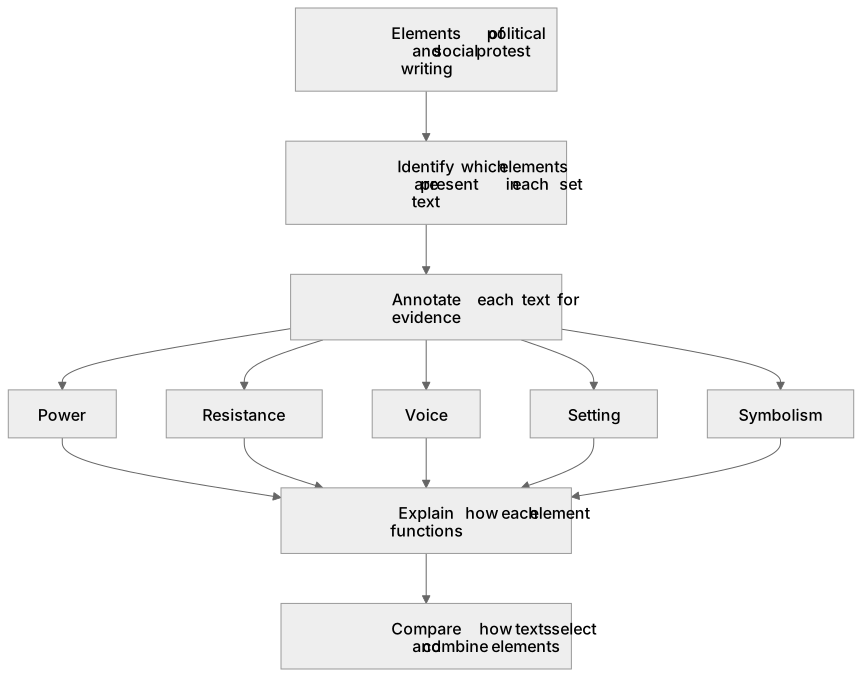
Label the diagram
Some boxes have lost their names. Pick the right name for each number.
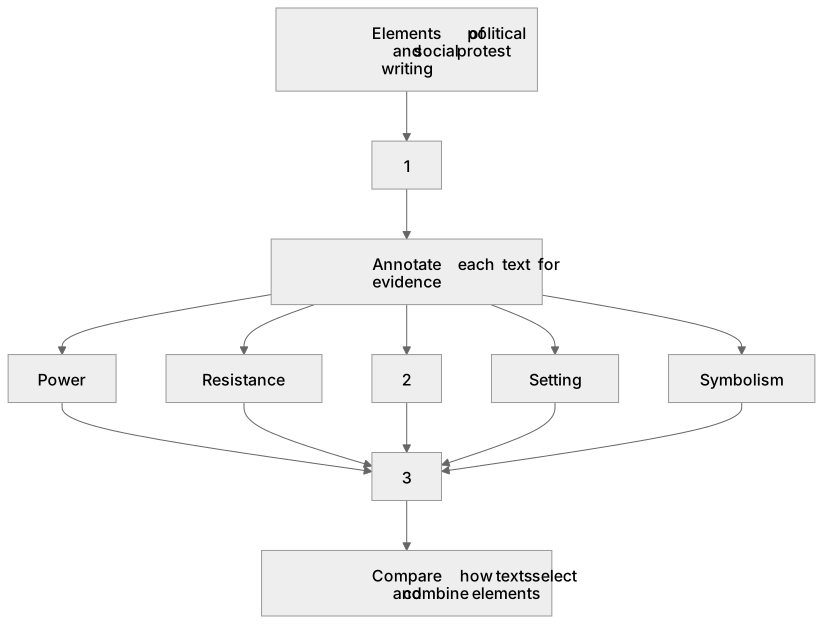
1Box 1
2Box 2
3Box 3
There is more to this lesson
The full lesson goes on to check your understanding and help you earn the marks. Create a free account to carry on, with your progress saved.
A week of Premium from your first lesson · Then the free plan continues · No card, no charge
Test your understanding of Elements of political and social protest writing: A crucial word in the title of this option is ‘Elements’ and students need to consider the specific elements that exist in each of their texts.
Active recall beats re-reading. Take an instant quiz now to test what you’ve learned and lock it into long-term memory.
A week of Premium from your first lesson · Then the free plan continues · No card, no charge