AQA · A-Level · English Literature
Course version: 7717 · Version from Sept 2026
William Blake: Songs of Innocence and of Experience (Pre-1900)
Full specification wording
Elements of political and social protest writing - Set texts: William Blake: Songs of Innocence and of Experience (Pre-1900)
Final correction: Innocence 'Chimney Sweeper' ends with 'need not fear harm'; Experience shows parents praising 'God & his Priest & King'.
Checked against the AQA 7717 specification (opens in a new tab) on .
- Point 2 of 9
- 4 key terms
Study notes
From the checked teaching notes for this specification point.
The idea
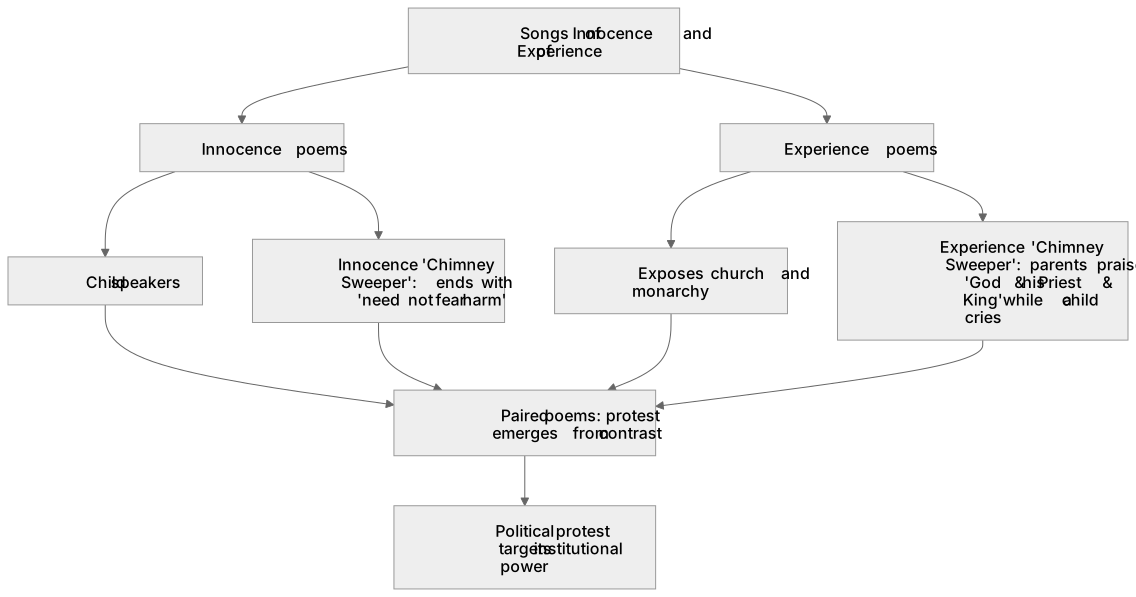
Final correction: Innocence 'Chimney Sweeper' ends with 'need not fear harm'; Experience shows parents praising 'God & his Priest & King'. Initial logic and parameters are validated. Blake's Songs pairs poems so protest emerges from contrast. Innocence uses child speakers; Experience exposes church and monarchy. 'The Chimney Sweeper' appears in both: the Innocence version ends with a conditional promise of safety, while the Experience version shows parents praising God and King while a child cries. Track recurring figures, settings and motifs. Consider how engraved plates shape meaning, and how ballad metre creates ironic distance. Political protest targets institutional power.
What earns the marks
- Explains how paired Innocence and Experience poems create protest through contrast.
- Analyses how Blake presents institutions as sources of suffering.
- Examines the effect of recurring figures and motifs across the collection.
- Discusses how form and language create protest.
Common mistakes and how to put them right
Treating the Songs as a simple celebration of childhood.
Put it right: Read Innocence as containing seeds of Experience.
Quoting a poem without naming whether it belongs to Innocence or Experience.
Put it right: Always identify the section.
Ignoring the illustrations and treating the text as a standalone printed poem.
Put it right: Comment on the plate design.
Exam tips
- Plan by argument, not by poem: choose a line of protest and move across several poems.
- Integrate short quotations into your own sentences and analyse individual words.
Try the lesson
The start of the Elements of political and social protest writing - Set texts: William Blake: Songs of Innocence and of Experience (Pre-1900) lesson, made from checked teaching notes for this specification point.
Have a go first
In Blake's 'London', which repeated word describing the streets and the river most directly conveys the speaker's sense of political and social constraint?
Listen
Final correction: Innocence 'Chimney Sweeper' ends with 'need not fear harm'; Experience shows parents praising 'God & his Priest & King'. Initial logic and parameters are validated. Blake's Songs pairs poems so protest emerges from contrast. Innocence uses child speakers; Experience exposes church and monarchy. The Chimney Sweeper' appears in both: the Innocence version ends with a conditional promise of safety, while the Experience version shows parents praising God and King while a child cries. Track recurring figures, settings and motifs. Consider how engraved plates shape meaning, and how ballad metre creates ironic distance. Political protest targets institutional power. A strong answer earns marks for these points. Explains how paired Innocence and Experience poems create protest through contrast. Analyses how Blake presents institutions as sources of suffering. Examines the effect of recurring figures and motifs across the collection. Discusses how form and language create protest. A common slip: Treating the Songs as a simple celebration of childhood. Instead, read Innocence as containing seeds of Experience. Exam tip: Plan by argument, not by poem: choose a line of protest and move across several poems.
See it
Key words
Say what each word means before you turn the card.
Innocence and experience as interdependent states
Try answering aloud or in your head before turning the card.
Institutional power and hypocrisy
Try answering aloud or in your head before turning the card.
Childhood, labour and exploitation
Try answering aloud or in your head before turning the card.
Engraved plates
Try answering aloud or in your head before turning the card.
See every definition
- Innocence and experience as interdependent states
- Paired states in which the Innocence poems contain seeds of Experience, so protest emerges from their contrast.
- Institutional power and hypocrisy
- The target of Blake's political protest, with the church and monarchy exposed as sources of suffering.
- Childhood, labour and exploitation
- A concern voiced through child speakers, as in 'The Chimney Sweeper', which appears in both sections.
- Engraved plates
- The designs whose shaping of meaning should be considered rather than treating the text as a standalone printed poem.
Label the diagram
Some boxes have lost their names. Pick the right name for each number.
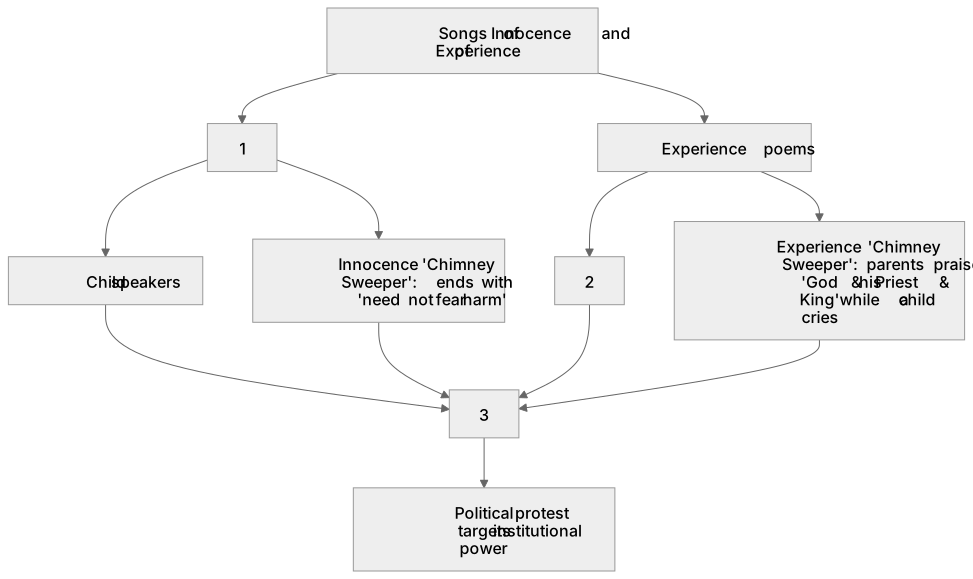
1Box 1
2Box 2
3Box 3
There is more to this lesson
The full lesson goes on to check your understanding and help you earn the marks. Create a free account to carry on, with your progress saved.
A week of Premium from your first lesson · Then the free plan continues · No card, no charge
Test your understanding of Elements of political and social protest writing - Set texts: William Blake: Songs of Innocence and of Experience (Pre-1900)
Active recall beats re-reading. Take an instant quiz now to test what you’ve learned and lock it into long-term memory.
A week of Premium from your first lesson · Then the free plan continues · No card, no charge