AQA · A-Level · English Literature
Course version: 7717 · Version from Sept 2026
The connection of the smaller world to the larger world
Full specification wording
Elements of political and social protest writing: the connection of the smaller world to the larger world
This element asks you to trace how intimate, local experience in a protest text opens onto wider political structures.
Checked against the AQA 7717 specification (opens in a new tab) on .
- Point 11 of 17
Study notes
From the checked teaching notes for this specification point.
The idea
This element asks you to trace how intimate, local experience in a protest text opens onto wider political structures. The 'smaller world' might be a household or a personal relationship; the 'larger world' is the nation or society. Your task is to show the connection. A productive method is to select a concrete detail and ask what national force it embodies. In Blake's 'London', 'mind-forg'd manacles' links individual perception to institutional repression; in Ibsen's A Doll's House, Nora's domestic sphere exposes the wider patriarchal laws of 19th-century society. Assessment rewards analysis of how the text forges the link through form, structure and imagery.
What earns the marks
- Identifies a specific local or domestic detail and names the wider political structure it connects to.
- Explains the mechanism of connection, for example through symbolism, setting or character interaction.
- Uses textual evidence precisely, quoting briefly and analysing the language to show the link.
- Relates the smaller-to-larger movement to the text's overarching political and social protest purpose.
Common mistakes and how to put them right
Treating the two worlds as separate topics.
Put it right: Make one analytical sentence do both jobs.
Assuming the larger world is always the cause.
Put it right: Explore reciprocal pressure between the individual and society.
Offering historical context as a substitute for textual analysis.
Put it right: Anchor context to specific quotations.
Exam tips
- Plan around two or three moments where the local-to-national link is sharpest and most evident.
- Use connectives to keep the relationship explicit, showing how the micro reflects the macro.
Try the lesson
The start of the Elements of political and social protest writing: the connection of the smaller world to the larger world lesson, made from checked teaching notes for this specification point.
Have a go first
In political and social protest writing, what does the phrase 'the connection of the smaller world to the larger world' most directly describe?
Listen
This element asks you to trace how intimate, local experience in a protest text opens onto wider political structures. The 'smaller world' might be a household or a personal relationship; the 'larger world' is the nation or society. Your task is to show the connection. A productive method is to select a concrete detail and ask what national force it embodies. In Blake's 'London', 'mind-forg'd manacles' links individual perception to institutional repression; in Ibsen's A Doll's House, Nora's domestic sphere exposes the wider patriarchal laws of 19th-century society. Assessment rewards analysis of how the text forges the link through form, structure and imagery. A strong answer earns marks for these points. Identifies a specific local or domestic detail and names the wider political structure it connects to. Explains the mechanism of connection, for example through symbolism, setting or character interaction. Uses textual evidence precisely, quoting briefly and analysing the language to show the link. Relates the smaller-to-larger movement to the text's overarching political and social protest purpose. A common slip: Treating the two worlds as separate topics. Instead, make one analytical sentence do both jobs. Exam tip: Plan around two or three moments where the local-to-national link is sharpest and most evident.
See it
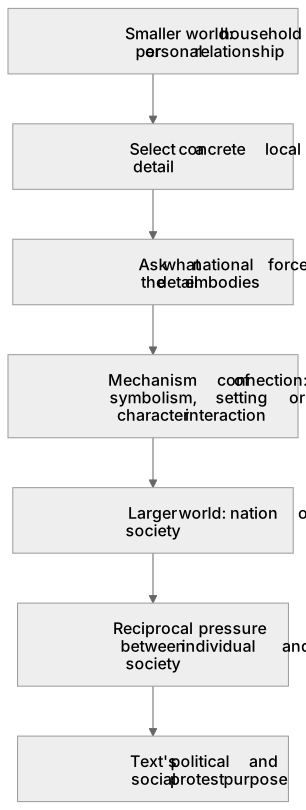
Put it in order
Put these steps in the order they happen.
- 1. Text's political and social protest purpose
- 2. Reciprocal pressure between individual and society
- 3. Ask what national force the detail embodies
- 4. Larger world: nation or society
- 5. Smaller world: household or personal relationship
- 6. Select a concrete local detail
- 7. Mechanism of connection: symbolism, setting or character interaction
Label the diagram
Some boxes have lost their names. Pick the right name for each number.
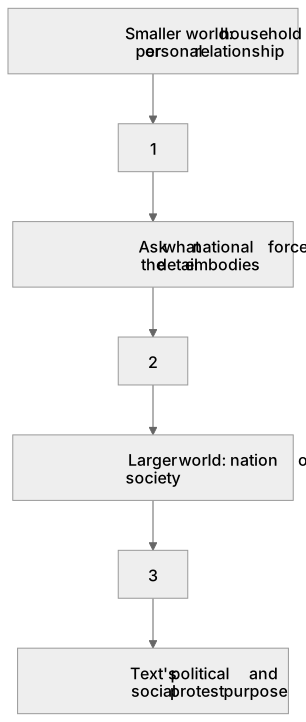
1Box 1
2Box 2
3Box 3
There is more to this lesson
The full lesson goes on to check your understanding and help you earn the marks. Create a free account to carry on, with your progress saved.
A week of Premium from your first lesson · Then the free plan continues · No card, no charge
Test your understanding of Elements of political and social protest writing: the connection of the smaller world to the larger world
Active recall beats re-reading. Take an instant quiz now to test what you’ve learned and lock it into long-term memory.
A week of Premium from your first lesson · Then the free plan continues · No card, no charge