AQA · A-Level · English Literature
Course version: 7717 · Version from Sept 2026
The focus on human organisation: domestically, in the work place, in local…
Full specification wording
Elements of political and social protest writing: the focus on human organisation: domestically, in the work place, in local and national governments
This element directs you to examine how protest writing represents the structures humans build to organise themselves.
Checked against the AQA 7717 specification (opens in a new tab) on .
- Point 12 of 17
- 4 key terms
Study notes
From the checked teaching notes for this specification point.
The idea
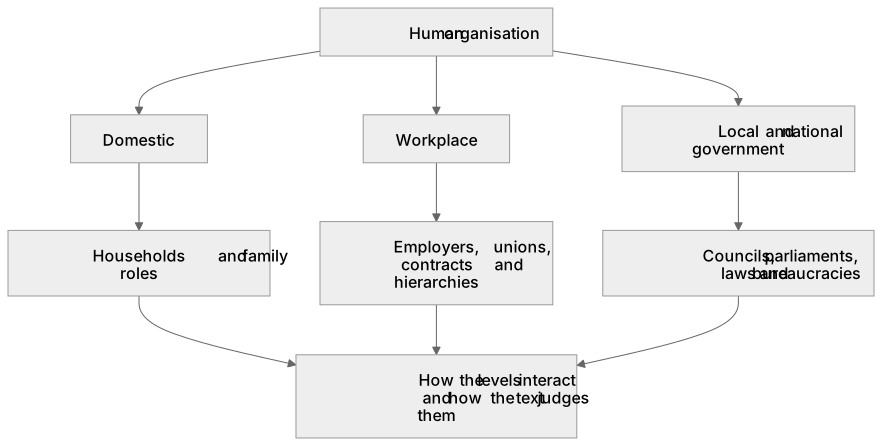
This element directs you to examine how protest writing represents the structures humans build to organise themselves. Organisation appears domestically, in households and family roles; in the workplace, through employers, unions, contracts and hierarchies; and in local and national government, through councils, parliaments, laws and bureaucracies. The analytical work is to show how these levels interact and how the text judges them. A useful method is to map one institution onto another: a factory discipline echoing a household patriarchy, or a council office mirroring state surveillance. In Dickens's Hard Times, Gradgrind's household and his school share one utilitarian logic; in Atwood's The Handmaid's Tale, domestic assignment is state policy. Assessment rewards close analysis of how form, structure and language expose the workings and costs of organised power.
What earns the marks
- Distinguishes the domestic, workplace and governmental levels of organisation and shows how the text connects them.
- Analyses how roles, rules, hierarchies and rituals within an institution are represented through language, structure and form.
- Explores the effects of organisation on individuals and groups, including compliance, resistance and complicity.
- Uses precise textual evidence, such as a quoted regulation, job title or household command, to ground claims about institutional power.
- Considers the writer's purpose in exposing organisation, including satire, irony, dystopian extrapolation or documentary realism.
Common mistakes and how to put them right
Listing institutions without analysing how they operate.
Put it right by examining the specific rules, roles or rituals that make an institution function in the text.
Confining discussion to national government and ignoring domestic and workplace levels.
Put it right: Deliberately tracking one idea across all three scales.
Describing characters' feelings about institutions without linking those feelings to the text's formal and structural choices.
Put it right by pairing each emotional claim with a technique.
Exam tips
- Organise an answer by scale — domestic, workplace, governmental — then show the connective tissue between them in a final movement.
- Quote small institutional details, such as a title, a rule or a piece of bureaucratic language, and analyse their connotations.
- Keep the writer's protest purpose visible: ask what each depiction of organisation is designed to expose or indict.
Try the lesson
The start of the Elements of political and social protest writing: the focus on human organisation: domestically, in the work place, in local and national governments lesson, made from checked teaching notes for this specification point.
Have a go first
In the context of political and social protest writing, how do authors typically use a focus on 'human organisation' across domestic, workplace, and government settings?
Listen
This element directs you to examine how protest writing represents the structures humans build to organise themselves. Organisation appears domestically, in households and family roles; in the workplace, through employers, unions, contracts and hierarchies; and in local and national government, through councils, parliaments, laws and bureaucracies. The analytical work is to show how these levels interact and how the text judges them. A useful method is to map one institution onto another: a factory discipline echoing a household patriarchy, or a council office mirroring state surveillance. In Dickens's Hard Times, Gradgrind's household and his school share one utilitarian logic; in Atwood's The Handmaid's Tale, domestic assignment is state policy. Assessment rewards close analysis of how form, structure and language expose the workings and costs of organised power. A strong answer earns marks for these points. Distinguishes the domestic, workplace and governmental levels of organisation and shows how the text connects them. Analyses how roles, rules, hierarchies and rituals within an institution are represented through language, structure and form. Explores the effects of organisation on individuals and groups, including compliance, resistance and complicity. Uses precise textual evidence, such as a quoted regulation, job title or household command, to ground claims about institutional power. A common slip: Listing institutions without analysing how they operate. Instead, examining the specific rules, roles or rituals that make an institution function in the text. Exam tip: Organise an answer by scale — domestic, workplace, governmental — then show the connective tissue between them in a final movement.
See it
Key words
Say what each word means before you turn the card.
Institutions, hierarchy and control
Try answering aloud or in your head before turning the card.
Domestic ideology and family roles
Try answering aloud or in your head before turning the card.
Labour, class and the workplace
Try answering aloud or in your head before turning the card.
Government, law and bureaucracy
Try answering aloud or in your head before turning the card.
See every definition
- Institutions, hierarchy and control
- The structures humans build to organise themselves, examined through the roles, rules, hierarchies and rituals that make them function and the organised power they exercise.
- Domestic ideology and family roles
- Organisation in households and family roles, one of the levels at which protest writing represents human organisation.
- Labour, class and the workplace
- Organisation in the work place, through employers, unions, contracts and hierarchies.
- Government, law and bureaucracy
- Organisation in local and national government, through councils, parliaments, laws and bureaucracies.
Label the diagram
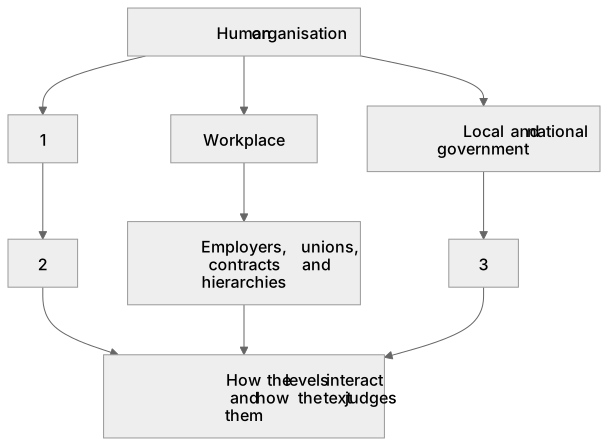
Some boxes have lost their names. Pick the right name for each number.
1Box 1
2Box 2
3Box 3
There is more to this lesson
The full lesson goes on to check your understanding and help you earn the marks. Create a free account to carry on, with your progress saved.
A week of Premium from your first lesson · Then the free plan continues · No card, no charge
Test your understanding of Elements of political and social protest writing: the focus on human organisation: domestically, in the work place, in local and national governments
Active recall beats re-reading. Take an instant quiz now to test what you’ve learned and lock it into long-term memory.
A week of Premium from your first lesson · Then the free plan continues · No card, no charge