AQA · A-Level · English Literature
Course version: 7717 · Version from Sept 2026
The settings that are created as backdrops for political and social action…
Full specification wording
Elements of political and social protest writing: the settings that are created as backdrops for political and social action and the power struggles that are played out on them. Both places (real and imagined) and time settings will also be significant here
Setting is never neutral in protest writing: it frames who holds power and who suffers.
Checked against the AQA 7717 specification (opens in a new tab) on .
- Point 6 of 17
- 4 key terms
Study notes
From the checked teaching notes for this specification point.
The idea
Setting is never neutral in protest writing: it frames who holds power and who suffers. Examine place, whether a real city, a plantation, a prison or an imagined dystopia, and ask how its physical and social features enable or constrain action. Then examine time, including historical moment, season, time of day and disrupted chronology, since timing can expose injustice or imply that change is possible. Consider how settings function as backdrops for political and social action and as stages for power struggles between rulers and ruled, employers and workers, colonisers and colonised. Track movement between settings, because journeys and contrasts often carry the argument. Finally, judge how setting shapes tone, symbol and the reader's sense of urgency.
What earns the marks
- Analyses specific settings as constructed spaces that enable or restrict political and social action.
- Explains how place and time settings together frame power struggles between groups or individuals.
- Uses precise evidence, such as description, imagery or stage directions, to support claims about setting.
- Distinguishes between real and imagined settings and considers what each mode of representation achieves.
- Examines shifts in time or place and interprets their significance for the text's political argument.
- Links setting to wider themes such as oppression, resistance, freedom or surveillance.
Common mistakes and how to put them right
Describing setting as mere background.
Put it right by arguing how the setting actively shapes action and power relations.
Ignoring time settings: correct this by analysing historical context, chronology, season or time of day alongside place.
Treating imagined settings as unrealistic and therefore irrelevant.
Put it right by showing how invented places comment on real political conditions.
Exam tips
- Anchor each point about setting in a short quotation or precise reference, then explain its political effect.
- Compare two contrasting settings in the text to sharpen your argument about power.
- Use time as well as place in your analysis, especially where chronology is disrupted or compressed.
Try the lesson
The start of the Elements of political and social protest writing: the settings that are created as backdrops for political and social action and the power struggles that are played out on them. Both places (real and imagined) and time settings will also be significant here lesson, made from checked teaching notes for this specification point.
Have a go first
In political and social protest writing, what is meant by describing a setting as a backdrop for power struggles?
Listen
Setting is never neutral in protest writing: it frames who holds power and who suffers. Examine place, whether a real city, a plantation, a prison or an imagined dystopia, and ask how its physical and social features enable or constrain action. Then examine time, including historical moment, season, time of day and disrupted chronology, since timing can expose injustice or imply that change is possible. Consider how settings function as backdrops for political and social action and as stages for power struggles between rulers and ruled, employers and workers, colonisers and colonised. Track movement between settings, because journeys and contrasts often carry the argument. Finally, judge how setting shapes tone, symbol and the reader's sense of urgency. A strong answer earns marks for these points. Analyses specific settings as constructed spaces that enable or restrict political and social action. Explains how place and time settings together frame power struggles between groups or individuals. Uses precise evidence, such as description, imagery or stage directions, to support claims about setting. Distinguishes between real and imagined settings and considers what each mode of representation achieves. A common slip: Describing setting as mere background. Instead, arguing how the setting actively shapes action and power relations. Exam tip: Anchor each point about setting in a short quotation or precise reference, then explain its political effect.
See it
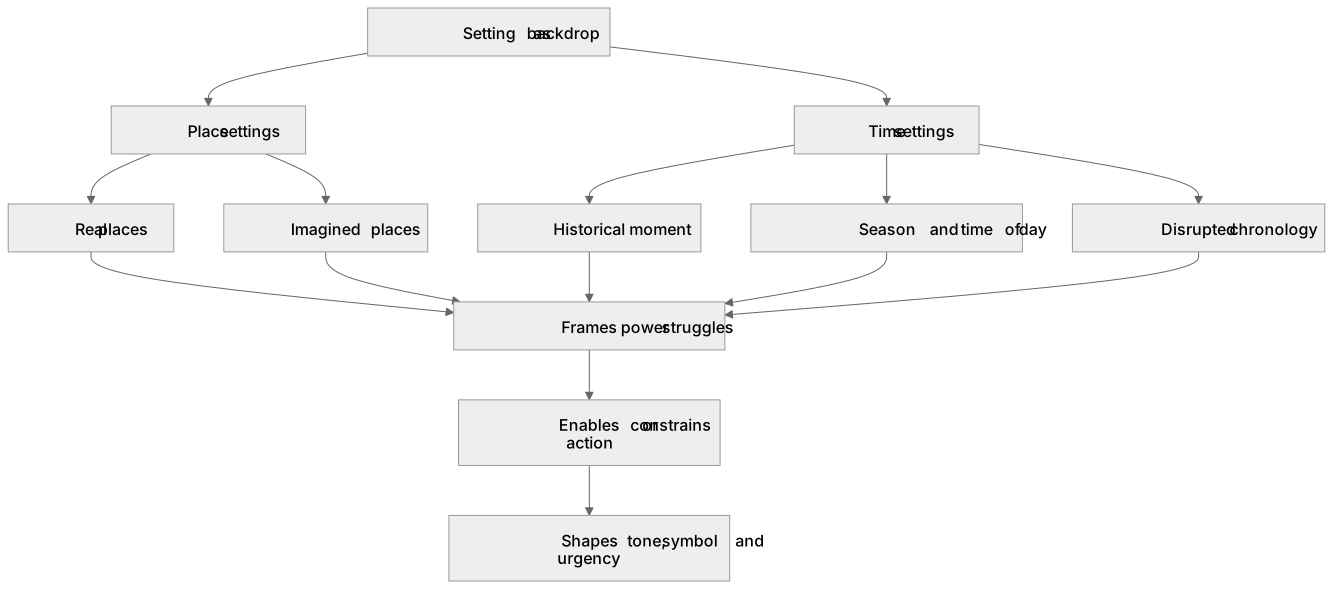
Key words
Say what each word means before you turn the card.
Space, power and control
Try answering aloud or in your head before turning the card.
Real and imagined geographies
Try answering aloud or in your head before turning the card.
Time, history and change
Try answering aloud or in your head before turning the card.
Movement, journey and displacement
Try answering aloud or in your head before turning the card.
See every definition
- Space, power and control
- Settings are constructed spaces that enable or restrict political and social action and stage power struggles between groups or individuals.
- Real and imagined geographies
- Places in a text may be real or imagined, and each mode of representation achieves something different for the protest message.
- Time, history and change
- Time settings, including historical moment, season, time of day and disrupted chronology, can expose injustice or imply that change is possible.
- Movement, journey and displacement
- Tracking movement between settings matters because journeys and contrasts often carry the text's political argument.
Label the diagram
Some boxes have lost their names. Pick the right name for each number.
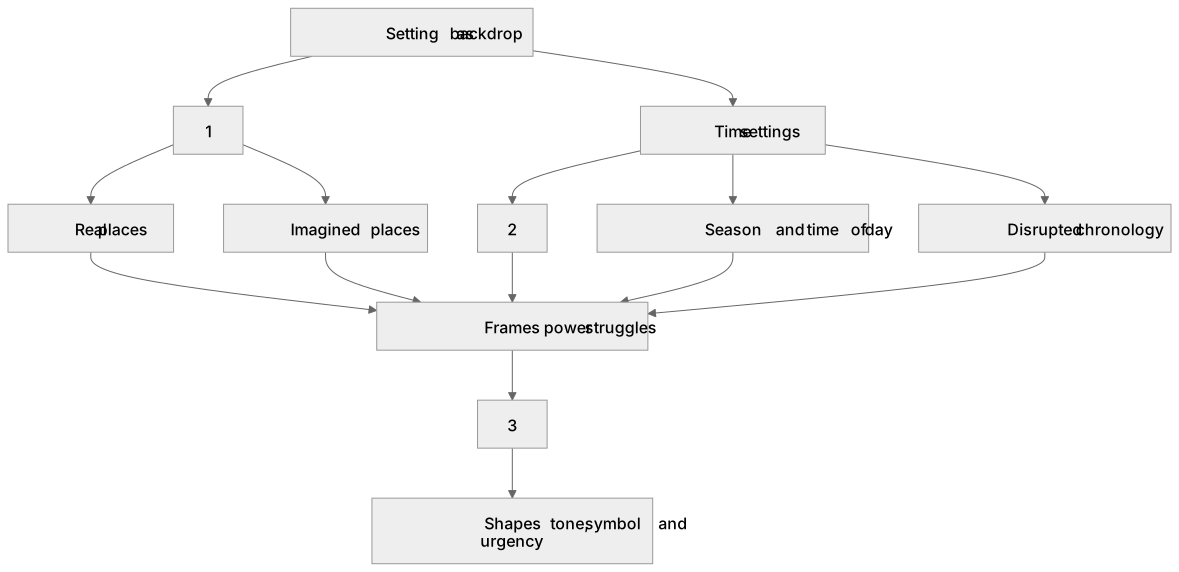
1Box 1
2Box 2
3Box 3
There is more to this lesson
The full lesson goes on to check your understanding and help you earn the marks. Create a free account to carry on, with your progress saved.
A week of Premium from your first lesson · Then the free plan continues · No card, no charge
Test your understanding of Elements of political and social protest writing: the settings that are created as backdrops for political and social action and the power struggles that are played out on them. Both places (real and imagined) and time settings will also be significant here
Active recall beats re-reading. Take an instant quiz now to test what you’ve learned and lock it into long-term memory.
A week of Premium from your first lesson · Then the free plan continues · No card, no charge