AQA · A-Level · English Literature
Course version: 7717 · Version from Sept 2026
The specific nature of the power struggle, the behaviours of those with…
Full specification wording
Elements of political and social protest writing: the specific nature of the power struggle, the behaviours of those with power and those without, those who have their hands on the levers of power
This element asks you to analyse how power actually operates in a protest text, not merely that it exists.
Checked against the AQA 7717 specification (opens in a new tab) on .
- Point 7 of 17
- 4 key terms
Study notes
From the checked teaching notes for this specification point.
The idea
This element asks you to analyse how power actually operates in a protest text, not merely that it exists. Begin by naming the specific nature of the struggle: is it constitutional, economic, gendered, colonial or coercive? Then examine behaviours on both sides. Those with power may censor, patronise, surveil, legislate or use violence; those without may comply, defer, subvert, organise or resist. Finally, identify who literally holds the levers of power: monarch, minister, magistrate, employer, landlord, priest, editor or patriarch. A useful method is to track one lever through the text, such as the law in The Handmaid's Tale, and show how Atwood dramatises its effects on behaviour and language.
What earns the marks
- Accurately identifies the specific nature of the power struggle in the text, for example legal, patriarchal, colonial, economic or religious, rather than describing power vaguely.
- Analyses the behaviours of those with power, such as censorship, surveillance, punishment, patronage or manipulation, using textual evidence.
- Analyses the behaviours of those without power, such as deference, silence, subversion, solidarity or open rebellion, using textual evidence.
- Identifies those who hold the levers of power and explains how institutional position translates into control over others.
- Explores how the writer's form, structure and language shape the reader's response to these power relations.
- Connects the representation of power to the political and social protest purpose of the text.
Common mistakes and how to put them right
Describing power as a general theme without specifying its nature.
Put it right by naming the precise mechanism, such as state surveillance or inheritance law.
Treating those without power as uniformly passive.
Put it right by distinguishing compliance, negotiation and resistance within the same text.
Listing powerful characters without analysing the levers they operate.
Put it right by linking each figure to an institution, law or discourse they control.
Exam tips
- Anchor every claim about power to a short quotation or precise moment, then analyse the wording rather than paraphrasing it.
- Use the phrase 'levers of power' as an analytical prompt: ask which institution, law or discourse each character can actually pull.
- Plan by power mechanism rather than by character so your argument develops across the whole text instead of becoming a list.
Try the lesson
The start of the Elements of political and social protest writing: the specific nature of the power struggle, the behaviours of those with power and those without, those who have their hands on the levers of power lesson, made from checked teaching notes for this specification point.
Have a go first
In a political and social protest text, which action by a character in authority most clearly demonstrates their control over the 'levers of power'?
Listen
This element asks you to analyse how power actually operates in a protest text, not merely that it exists. Begin by naming the specific nature of the struggle: is it constitutional, economic, gendered, colonial or coercive? Then examine behaviours on both sides. Those with power may censor, patronise, surveil, legislate or use violence; those without may comply, defer, subvert, organise or resist. Finally, identify who literally holds the levers of power: monarch, minister, magistrate, employer, landlord, priest, editor or patriarch. A useful method is to track one lever through the text, such as the law in The Handmaid's Tale, and show how Atwood dramatises its effects on behaviour and language. A strong answer earns marks for these points. Accurately identifies the specific nature of the power struggle in the text, for example legal, patriarchal, colonial, economic or religious, rather than describing power vaguely. Analyses the behaviours of those with power, such as censorship, surveillance, punishment, patronage or manipulation, using textual evidence. Analyses the behaviours of those without power, such as deference, silence, subversion, solidarity or open rebellion, using textual evidence. Identifies those who hold the levers of power and explains how institutional position translates into control over others. A common slip: Describing power as a general theme without specifying its nature. Instead, naming the precise mechanism, such as state surveillance or inheritance law. Exam tip: Anchor every claim about power to a short quotation or precise moment, then analyse the wording rather than paraphrasing it.
See it
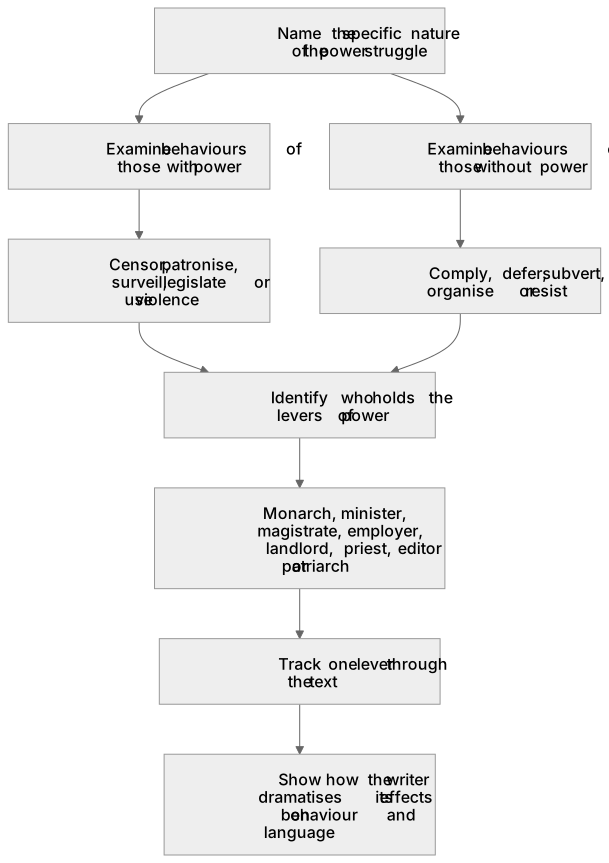
Key words
Say what each word means before you turn the card.
Power and control
Try answering aloud or in your head before turning the card.
Institutional authority
Try answering aloud or in your head before turning the card.
Resistance and compliance
Try answering aloud or in your head before turning the card.
Protest and social critique
Try answering aloud or in your head before turning the card.
See every definition
- Power and control
- The specific nature of the power struggle, the behaviours of those with power and those without, and those who have their hands on the levers of power.
- Institutional authority
- The position of those who literally hold the levers of power, such as monarch, minister, magistrate, employer, landlord, priest, editor or patriarch.
- Resistance and compliance
- The behaviours of those without power, who may comply, defer, subvert, organise or resist.
- Protest and social critique
- The political and social protest purpose of the text, to which the representation of power is connected.
Label the diagram
Some boxes have lost their names. Pick the right name for each number.
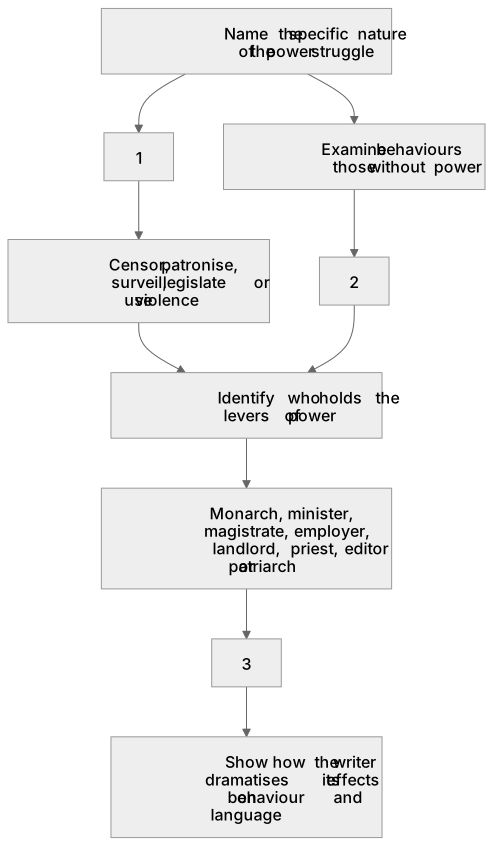
1Box 1
2Box 2
3Box 3
There is more to this lesson
The full lesson goes on to check your understanding and help you earn the marks. Create a free account to carry on, with your progress saved.
A week of Premium from your first lesson · Then the free plan continues · No card, no charge
Test your understanding of Elements of political and social protest writing: the specific nature of the power struggle, the behaviours of those with power and those without, those who have their hands on the levers of power
Active recall beats re-reading. Take an instant quiz now to test what you’ve learned and lock it into long-term memory.
A week of Premium from your first lesson · Then the free plan continues · No card, no charge